

Nigerian business leaders and economists have called on the Federal Government to ban foreign nationals, especially Chinese traders, from last-mile retail operations, saying their unfettered foray into local markets might damage the small firms that anchor the economy.
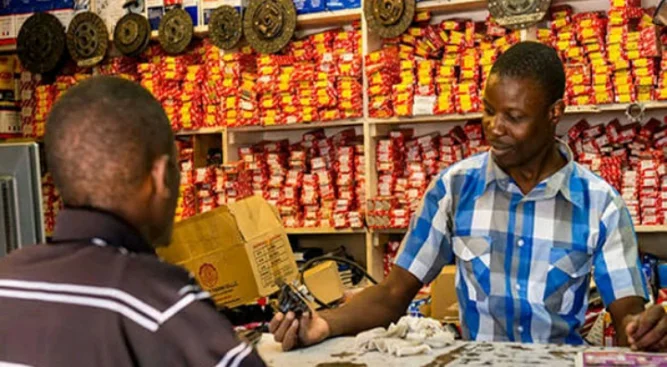
The call comes after traders at the Lagos Trade Fair Complex along the Lagos-Badagry Motorway protested last week, accusing Chinese nationals of moving beyond wholesale trading to direct retail sales to Nigerian consumers, a shift they said gives foreign vendors an unfair pricing advantage through direct links to manufacturers and suppliers in China.
Dr Femi Egbesola, President of the Association of Small Business Owners of Nigeria, said government must not sacrifice indigenous enterprise on the altar of trade liberalisation. “Are we going to be supporting foreigners at the expense of our own Small and Medium-sized Enterprises, our own business owners? “That should not be,” he continued, insisting that “retail to the last mile should not be part of what foreigners should be engaged in.” He also accused many Chinese traders of flouting regulatory standards such as state-issued company permits, and warned that failure to act might wipe out SMEs, which he said account for half of the country’s GDP and remain its biggest employment producers.
Dr Muda Yusuf, Chief Executive Officer of the Center for the Promotion of Private Enterprise said Nigeria had enough capacity in retail trading and should save the area for its residents and at best other Africans. He described commerce as the country’s second biggest employer after agriculture, and likened the situation to a manufacturer competing with its own distributors. “It’s not fair,” he said. “It will drive them out of their business.”
Some stakeholders opposed a ban. Dr Chidi Uleli, President of the Nigeria-China Investment Club, said the trend was a reflection of an increasingly globalised world and urged traders to consider the situation as an opportunity rather than a danger. More than 40 per cent of Nigeria’s imports were now from China, he said, citing South Korea, Hong Kong, Taiwan and Thailand as examples of countries that had done well by clustering into cooperative manufacturing instead of opposing competition. He advised traders to come together in cottage industries, saying insufficient power supply was an excuse given China’s investment in renewable energy.
The Lagos Chamber of Commerce and Industry urged dialogue, not street protests. LCCI President, Leye Kupoluyi stated that the Federal Competition and Consumer Protection Commission should act to stop the monopolisation of the market, saying the chamber had members among the affected traders and was willing to mediate.
Economists had a more structural diagnosis. The Director, African Retail Academy, Lagos Business School, Prof Uchenna Uzo, urged market associations to engage directly with manufacturers instead of allowing the disputes to spill into the streets, adding that the bigger problem that requires urgent attention is that Nigeria does not have a national retail policy framework.
Director, Lagos Business School Public Sector Initiative, Prof Franklin Ngwu, said the traders fears were valid, but explained that the real problem was the business environment in Nigeria. Ngwu said borrowing costs were high, power supply was unreliable and that regulatory bottlenecks made local manufacturers uncompetitive against their Chinese counterparts who had single-digit interest rates and better infrastructure. He cautioned that Nigeria’s estimated 14 million MSMEs might be “significantly impacted and possibly wiped out” if the trend continued, and asked for government-backed industrial clusters, cheaper loans and improved infrastructure to bolster local competitiveness.
About the Author