
The Senate’s decision on the changed Clause 60(3), which allows both electronic and manual transmission of results, has sparked new questions.
The Senate changed its mind yesterday and decided to allow electronic transmission of election results from polling places to the Independent National Electoral Commission Results Viewing Portal (IReV).
According to Daily Trust, the upper house approved sending election results to IReV electronically, but with a condition.
After EC8A forms were signed and stamped, Clause 60(3) was changed to say that results from polling places must be sent electronically to IReV.
The change said that the presiding officer and any party agents present at voting places had to sign before the electronic transmission.
But it said that if electronic transmission failed because of problems with communication, the signed or countersigned EC8A form would still be the principal one.
The change further said that in certain situations, the signed EC8A would be used to compile and announce the election results.
The option for “real-time upload of results” has been taken out with this change.
Some civil society groups and opposition parties who spoke yesterday said that the Senate’s decision was unfair and would make things more confusing.
The new version of clause 60(3) says, “that results shall be sent electronically from each polling unit to IReV.”
“And this communication will only happen when the presiding officer and party agents who are at the polling unit have signed and stamped the required EC8A.
“If the electronic transmission of the result fails because of a communication failure, the result on form EC8A signed by the presiding officer and/or countersigned by the polling agents shall, in that case, be the main source of collation and declaration of results.”
The House of Representatives version says that “The Presiding Officer shall electronically transmit the results from each polling unit to the IREV portal in real time and such transmission shall be done after the prescribed Form EC8A have been signed and stamped by the Presiding Officer and/or counter-signed by the candidates or polling unit agents where available at the polling unit.”
The House version of Section 60(3) says, “The Presiding Officer must send the results from each polling unit to the IREV portal in real time using electronic means. This must happen after the required Form EC8A has been signed and stamped by the Presiding Officer and/or counter-signed by the candidates or polling unit agents who are available at the polling unit.”
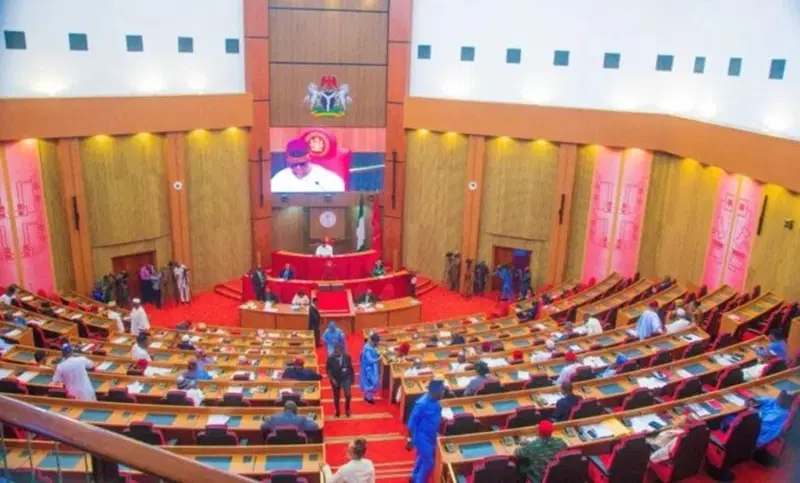
The Senate passed the resolutions after discussing and approving a motion made by Senator Mohammed Monguno (APC, Borno North), the Chief Whip of the Senate, during an emergency plenary session in Abuja. Abba Moro, the Minority Leader, seconded the measure.
Monguno asked the Senate to approve his request to take back his earlier motion, which had been passed during the February 4 sitting.
Monguno brought up the motion and remembered that the Senate passed the Electoral Act Repeal and Enactment Bill last Wednesday.
“Please note that after carefully looking over the bill, new problems have come up with clause 60(3) that need to be looked at by the legislature again to ensure fair and open elections.
“Based on the rules in Orders 1(b) and 52(6) of the Senate Standing Orders, 2023, as changed, I move as follows.”
“I have decided to withdraw my prior motion on Clause 60(3) of the Electoral Act Bill, which the Senate had already passed to change “transfer” to “transmit.”
“I also move that clause 60(3) be sent back to the whole committee for more discussion and approval.
“The reason for this change is that I was the one who made the motion to keep the current act.”
Monguno said, “The controversy it has caused has made me change my mind.”
Atiku: Mixed outcomes transmission is broken
Atiku Abubakar, who used to be the Vice President, stated that sending poll results electronically and by hand could hurt the fairness of the elections and make it harder to put the results together.
He talked to reporters after visiting retired General Ibrahim Babangida, the former Military President, in Minna yesterday.
He said, “Nigeria expected real-time electronic transfer for different levels of the election, but what we got is a mix of electronic and manual transmission, which is going to make things more confusing or chaotic.”
Atiku claimed that the best way to hold fair elections in the country was still to send results electronically in real time.
He asked opposition political groups to work together to push for changes to the electoral system, especially when it comes to how results are sent electronically.
“We shouldn’t let it stay where some people want it to stay.” “I don’t agree with that,” he remarked.
Rotimi Amaechi, a former Minister of Transportation, and his son were in the National Assembly yesterday to protest the Senate’s earlier decision not to let election results be sent in real time.
He said that the All Progressives Congress (APC) didn’t want electronic transmission of poll results because it was afraid it would lose elections.
He stated, “Some people say we, the politicians, want to protest, but our kids are in other countries.” But this is my first son. He is a doctor, and I brought him here to help individuals who are hurt.
“I think that all the opposition parties, like the PDP and ADC, should come out and protest against the attempt of one party.”
“If we come out and they say the demonstration has been taken over by the opposition, what is the APC doing? Are they not taking over? What are they scared of?”
ADC and PDP demand that results be sent electronically in real time
The African Democratic Congress (ADC) asked the Senate Wednesday to take out any problematic item that would allow for discretionary measures that could make the promise of real-time electronic transmission of election results weaker.
It insisted on sending results in real time and said that any alternative clauses would allow for “the intentional manipulation of election results.”
Bolaji Abdullahi, the ADC’s National Publicity Secretary, stated in a statement that they needed to clarify and follow up on their earlier comments about the Electoral Amendment Bill that the 10th Senate passed after fully understanding what the Senate voted yesterday.
The coalition party said that their first reaction was based on early reports that said the Senate had passed a version of the Electoral Amendment Bill that “guarantees the real-time transmission of election results, a long-standing safeguard necessary to protect the votes of Nigerians and preserve electoral integrity.”
However, the party said that later and more detailed reports have shown that the bill, as passed, has a “controversial provision” that adds optional clauses that could make the guarantee of real-time electronic transmission weaker and allow people to change the results of elections on purpose.
He said that the ADC wants to make it clear that “Any provision in our electoral laws that creates ambiguity, discretion, or technical loopholes around the transmission and collation of election results fundamentally undermines the integrity of the electoral process and cannot be accepted in good conscience.”
“Assurances don’t make elections credible; clear, unambiguous legal guarantees that preserve the will of the people do.
The ADC says that only an Electoral Amendment Act that clearly requires real-time electronic transmission of results, with no exclusions that could be abused, will gain the public’s trust and make Nigeria’s democracy stronger.
“We ask the National Assembly to quickly deal with and remove any part that weakens this protection and to make sure that the final version of the bill follows the Conference Committee’s suggestions for e-transmission of results.”
In the same way, the Peoples Democratic Party (PDP) told Nigerians through its spokesman, Ini Ememobong, to demand obligatory transmission and not the addendum that the Senate enacted.
The PDP said, “This addendum is nothing more than a backdoor attempt to achieve the same objective as the earlier outright rejection, while pretending to align with the wishes of the Nigerian people… Furthermore, it is inconceivable that the same BVAS technology which successfully undertakes accreditation throughout an election would suddenly become unreliable for the transmission of results and accreditation data arising from that same exercise.”
“This warning is a clear sign of the huge fear that senators who don’t want electronic transmission have,” he said.
The party told Nigerians to stay “resolute” in their demand for the real-time electronic broadcast of election results. There is no time for excuses now. “Politicians shouldn’t be the only ones who have this hard-won democracy.”
CSOs split
Taiwo Otitolaye, the Executive Director of Community Outreach for Development and Welfare Advocacy (CODWA), called the Senate’s decision a “double standard” and said that the problems with Nigeria’s network reliability are still not fixed.
“Nigerians didn’t like the original resolution and let the Senate know before they changed their minds. Nigeria is not alone; the world has moved on, so this is a good thing.
“There is no perfect place anywhere. CSOs must keep teaching people how to secure their votes and stop anyone from changing them.
Politicians may try to change the process, but citizens can come together to stop them. He said, “They can only cheat where they are well-known.”
Olasupo Abideen, the Global Director of the Brain Builders Youth Development Initiative, noted that the electronic sending of results is just one part of the bigger reform agenda that civil society groups are calling for.
He indicated that protests and campaigning might go on until the National Assembly completely addresses the issues that have been highlighted.
“E-transmission is simply one of the things we want. He replied, “We will keep talking until the Senate hears everything.”
He remarked that what the Senate did “showed that sovereignty ultimately belongs to the people.”
Musa Aliyu, the director of the Media Advocacy and Technologies Center (MATEK), said that the Senate’s most recent decision was a good one for Nigeria’s democracy.
He said it showed how important it is for elected leaders to be accountable and responsive, even when popular opinion is against what they say.
“The Nigerian Senate’s change of heart on sending out election results is a good thing. It illustrates that political officials need to be held accountable and listen to what people say, even when they don’t agree with them.
“This illustrates that people need to know how to expect the best from the people they elect. “These kinds of complaints need to be dealt with right away before they get out of hand,” he said.
Prof. Ojo says that relying too much on technology is dangerous.
Prof. Gbade Ojo, a political scientist at the University of Ilorin, said that the Senate’s decision to change the Electoral Act to allow electronic transmission of results was a good one. However, he warned that people should not expect too much from Nigeria’s technology.
He warned against blindly trusting technology, pointing to claims of foreign influence in US elections and recent problems with Nigeria’s banking and exam systems.
“This electronic transmission that Nigerians love so much was done in America, and there were claims of foreign interference.” Even JAMB had problems, and we all saw what happened in the financial sector when transfers took days to go through. He told them, “You can’t afford that kind of uncertainty in national elections.”
He noted that Nigeria’s frequent power outages, inadequate internet access, and repeated national grid failures make it very risky to rely only on electronic transmission.
“You are making INEC send results electronically when there isn’t any power in a lot of local government areas. He remarked, “That can cause instability if election results can’t be announced quickly.”
Dr. Edun Abdulkareem, head of the political science department at the University of Ilorin, said that the Senate’s decision “is a good step, but we haven’t done anything yet.”
He said, “We’re putting the cart before the horse.” E-transmission won’t work without stable electricity and networks. “Nigeria hasn’t gotten there yet.”
Abdulkareem said that the change still gives INEC full control over how to send things, exactly like it did previously.
Earlier, they indicated that INEC should decide how the information should be sent. It’s still the same thing. Nothing has changed.
He remarked, “If there is no electricity and no stable network, INEC will just say that electronic transmission was not possible, and if you take them to court, they will win.”
Abdulkareem warned Nigerians not to be fooled into thinking that the change ensures openness.
The Senate agrees to all parts
Meanwhile, the Senate changed the proposal in clause 60(3) of the Electoral Act (Amendment) Bill 2026 before passing it.
Akpabio said after reading the changed section, “The presiding officer shall electronically send the results from each polling unit to the IReV portal.” And this transmission should happen after the presiding officer and/or the candidates or polling agents have signed and stamped the required Form EC8A. This is because there are occasions when you don’t see any polling agents at the polling stations.
He added the law also says what to do when electronic communication isn’t possible.
“Provided that if the findings can’t be sent electronically because of a communication breakdown. He said, “In other words, if the network or something else fails and it is impossible to send the results electronically in Form EC8A signed and stamped by the presiding officer and/or countersigned by the candidates or polling agents where available at the polling units, the Form EC8A shall in such a case be the primary source of collation and declaration of results.”
During the emergency session to pass the Votes and Proceedings of the February 4 sitting, there was a short, loud fight in the Senate.
After Senator Monguno requested that the red chamber change its mind about its earlier judgment, Akpabio read out the specifics of the proposed change to Section 60(3). This made the session loud.
Some lawmakers didn’t like some of the terms in the new proposal.
After that, Senator Eyinnaya Abaribe asked for a point of order so that each senator might vote separately, referring to Order 70. He later took back the point of order, which could put the change to Clause 60(3) at risk.
Team from the Senate
Senator Simon Bako Lalong is in charge of the Senate team. Other members include senators Mohammed Tahir Monguno (Borno), Adamu Aliero (Kebbi), Orji Uzor Kalu (Abia), Abba Moro (Benue), Asuquo Ekpenyong (Cross River), Aminu Iya Abbas (Adamawa), Tokunbo Abiru (Lagos), Niyi Adegbonmire (Ondo), Jibrin Isah (Kogi), Ipalibo Banigo (Rivers), and Onyekachi Nwebonyi (Ebonyi). Their combined knowledge and representation from different parts of the country should help with the reconciliation process and make sure that the legislative outcome is clear.
Team from the House of Representatives
Rep. Adebayo Balogun (Lagos) is the chair of the committee in the House of Representatives. Other members include Rt. Hon. Ahmed Idris Wase (Plateau), Fred Agbedi (Bayelsa), Sada Soli (Katsina), Ahmadu Jaha (Borno), Igariwey Iduma Enwo (Ebonyi), Saidu Musa Abdullahi (Niger), Dr. Zainab Gimba (Borno), Awaji-Inombek D. Abiante (Rivers), James Faleke (Lagos), Paschal Agbodike (Anambra), and Obi Aguocha (Abia). The team is made up of people from different political backgrounds and districts, and its goal is to settle any disagreements between the two houses.
The Senate and House committees are working together to make sure that the Electoral Act Amendment Bill is consistent with the goals of the government and makes Nigeria’s election process more open, accountable, and efficient.
About the Author