
As part of a strategy to improve security on the continent, President Emmanuel Macron stated yesterday that France will increase its nuclear stockpile and may send nuclear-armed planes to friendly countries for the first time.
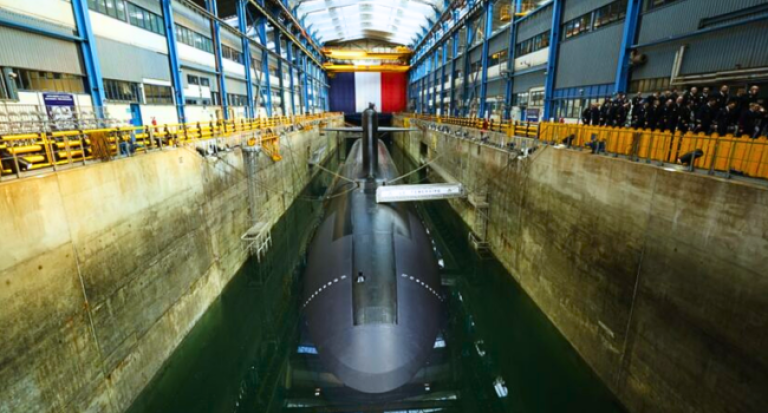
As the clock ticks down on his presidency, Macron spoke from the Ile Longue nuclear submarine base and said that eight European countries, including Germany, Poland, Sweden, and Britain, had agreed to take part in what he called a “forward” nuclear deterrence program, according to AFP.
After Macron’s address, France and Germany issued a joint statement claiming they had formed a “nuclear steering group.” They stated this would “add to, not replace, NATO’s nuclear deterrence.”
After the US and Israel launched attacks on Iran, Macron stated, “We are currently living in a time of geopolitical upheaval that is full of risks.” This campaign could make the Middle East less stable.
“We need to make our nuclear deterrent stronger because there are many threats, and we need to think about our deterrence strategy deep inside Europe while still respecting our sovereignty.”
Macron announced that eight European countries had decided to join his plan to deploy France’s nuclear weapons to make the continent safer.
He stated that the Netherlands, Belgium, Greece, and Denmark will be able to temporarily host French “strategic air forces,” which will be able to “spread out across the European continent” to “complicate the calculations of our adversaries.”
Macron went on to say that the plan may also include “the normal participation of allied forces in our nuclear activities,” as the recent military exercises that British forces took part in.
He made it plain that France would keep a close eye on nuclear decisions.
France and Germany said in a joint statement that they had decided to take “first concrete steps beginning this year.” These steps would include Germany’s regular participation in French nuclear exercises.
“Getting Ready with Our Friends”
As Russia’s war against Ukraine enters its fifth year and NATO allies worry about Washington’s waning commitment to Europe, Macron changed France’s nuclear policy.
European anxieties of US President Donald Trump’s unpredictability have not been eased by US officials’ assurances that the American deterrent will continue to cover Europe under the NATO alliance.
Macron said that the new endeavor would be “in addition to NATO’s nuclear mission.”
He stated, “The forward deterrence we are suggesting is a separate effort that has its own value and is fully complementary to NATO’s, both strategically and technically.”
He claimed announced he had ordered more nuclear warheads, but he also said that France would no longer provide any information about its inventory.
Macron talked about the steps France is taking because its allies are worried that the eurosceptic far-right National Rally party of Marine Le Pen will win next year’s presidential election and harm European collaboration.
Donald Tusk, the Prime Minister of Poland, indicated that Poland was talking to France and other European partners about what to do next.
“We are getting weapons with our friends so that our enemies will never attack us,” he remarked on X.
The Prime Minister of Sweden, Ulf Kristersson, also remarked that his country thought Macron’s plan was a good one.
“We would most like to see a world with no nuclear weapons at all,” he stated.
“But as long as Russia has these weapons and threatens its neighbors, democracies must be able to stop attacks and protect our own freedom and safety.”
Politics in Elections
With over 290 warheads, France has the fourth-largest nuclear arsenal in the world. Britain is the only other European country that has nuclear weapons. It is no longer a member of the EU.
The US and Russia, on the other hand, are the two biggest nuclear powers in the world and each has thousands of nuclear warheads.
Rafael Loss, a policy fellow at the European Council on Foreign Relations, said that if a far-right party wins the election next year, “many or even most of these steps could be undone.”
“Macron made it clear that France would not share decision-making power and would not plan nuclear operations with European partners. This is something that some people in France think undermines French sovereignty,” he informed our correspondent.
“Still, electoral politics can have a big effect on how allies and enemies see nuclear deterrence, as recent events since Trump’s re-election show.”
About the Author