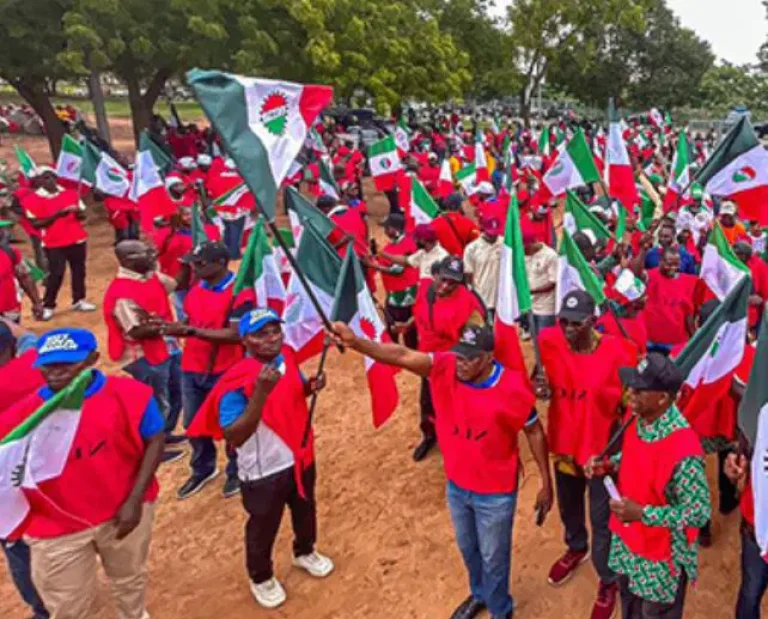

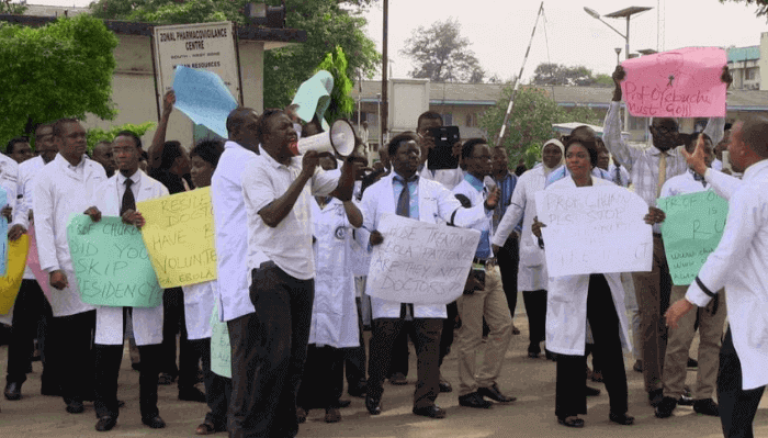
The Joint Health Sector Unions’ strike has been going on for three months now, and it has brought all activity in government-owned hospitals in Nigeria to a standstill. Patients are stuck and many are having to venture outside of public health institutions to get the care they need.
The PUNCH says that the industrial action, which is now in its third month, has grounded many services, especially in hospital pharmacy, labs, and other support departments, making it much harder to get healthcare.
The industrial action has caused a lot of problems for federal health institutions, but health workers in state-owned hospitals in Ekiti and Benue states have mostly stayed on duty, which has helped patients.
At the same time, resident physicians, nurses, and midwives at other state hospitals, like the Benue State University Teaching Hospital in Makurdi, have gone on separate strikes because they haven’t been paid, their pensions are in trouble, and the infrastructure is falling apart.
There were physicians and nurses at the Federal Teaching Hospital in Ido Ekiti, but other health personnel stayed away.
Ayodeji Ogunrinu, the Chairman of the Nigeria Union of Allied Health Professionals, Ekiti State Council, and the immediate past FETHI JOHESU Chairman, said that the health workers’ strike, which lasted for more than two and a half months, was terrible.
“It has taken away medical services that would have saved many lives, not just those in the communities but also staff members,” Ogunrinu said. That’s why I said it’s too bad.
The leader of JOHESU said that all staff in a health institution were crucial, saying, “Even the cleaner, even a health assistant, they are all very important.” I know what they do since I’m in physiotherapy.
He said that FETHI now looked like a ghost town because it didn’t have water, electricity, drugs, labs, or other important services. He also said that it would be hard for anyone or a medical officer to admit a patient.
Ogunrinu told the federal government to follow the instructions in the 2018 circular from the Federal Ministry of Labour. This circular is about changing the Consolidated Health Salary Scale for JOHESU members, which is the reason for the strike that started in late 2025.
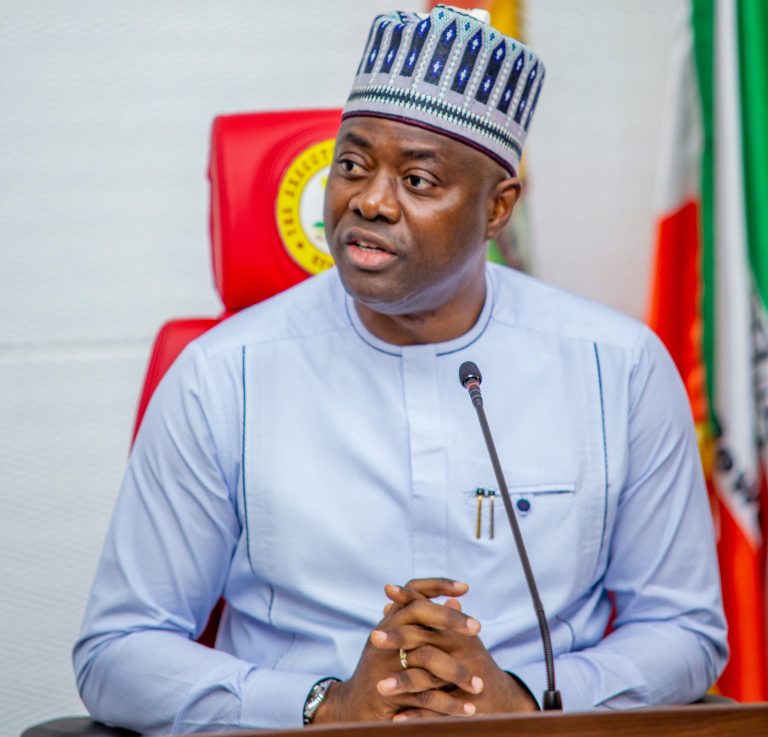
Adewale Adeosun, the Acting Chairman of JOHESU at Ekiti State University Teaching Hospital in Ado Ekiti, claimed that members at the hospital were not on strike as a sign of respect for the Governor of Ekiti State, Biodun Oyebanji.
Adeosun talked about how the JOHESU strike at federal health institutions affected the state-owned tertiary health institution. He added, “If you come to EKSUTH now, it is just like a market.” There are more patients showing up. Now, all the other patients who were supposed to travel to the government hospitals are going to EKSUTH.
The head of EKSUTH JOHESU claimed that the Oyebanji administration had done a lot for EKSUTH and that it would be unfair to join the strike.
Oluwafemi Ajoloko, the JOHESU State Chairman, said he hoped that the federal government will agree to members’ request to raise CONHESS in the next week or two.
Ajoloko added that while health workers in federal institutions were on strike, those at state-owned hospitals and primary health centers had remained at work. He also said that the strike had made the work of people at the state-owned facilities more difficult.
At the Obafemi Awolowo University Teaching Hospital in Ile-Ife, it was clear that things were slowing down. Some physicians, who didn’t want to be named because they weren’t allowed to talk about it, indicated that no serious treatment had been provided since the strike began.
The doctors also said that the strike was bad for training medical staff because patients who were supposed to have surgery since early November 2025 had not been seen.
Abdullateef Adeyeni, the JOHESU chairman of the OAUTHC chapter, said that the hospital had lost up to N1.5bn in money it had made on its own because of the strikes.
Adeyeni also told one of our reporters that the Coordinating Minister of Health and Social Welfare, Prof. Ai Pate, didn’t care about what the union wanted.
The labor leader added that activity at the factory had come to a standstill, in addition to the loss of income.
“Our Chief Medical Director said that the hospital has lost a lot. He added that the hospital has been losing at least N500 million every month. Because of this strike, OAUTH has lost as much as N1.5 billion in three months.
“The worst part is that patients are in pain.” He remarked, “The Federal Government has turned a deaf ear.”
It was noted that public hospitals in Ondo State were not getting many patients because of the ongoing strike.
A trip to the University of Medical Sciences Teaching Hospital in Akure, the state capital, showed that the hospital, which used to be full of patients and their families, now had a lot less patients since the strike.
There were only doctors and consultants working. The offices of JOHESU workers, the lab, the pharmacy, and the registration were all locked.
A lot of people also went to private hospitals for treatment since they weren’t happy with the care they got at the government hospital.
Mrs. Remilekun Ayebo, a patient, claimed she had been going to a private hospital for treatment and just went to the government hospital to see her doctor.
Dr. Olufunmilayo Dada of the National Association of Resident Doctors at the Federal Medical Centre in Owo said that the strike had not had a big impact on the services that the doctors at the facility were providing.
“The strike is still going on, but it isn’t affecting our services.” Dada said, “We are doing what we should be doing.”
Dr. Olumuyiwa Alonge, the head of the Nigerian Medical Association’s state chapter, said that the health workers’ strike made it harder for doctors to conduct their jobs.
“Every health worker has a job to do at every step of the medical process.” For example, the lab personnel aren’t working right now, so blood samples have to be taken to another place for testing. The same goes for pharmacists. Everyone at the hospital has a vital job.
Alonge said, “Even though we are working, it’s not as smooth as it used to be when everyone was at work.”
A trip to the University of Benin Teaching Hospital on Saturday indicated that services were almost completely stopped.
There were reports that the hospital was running at its lowest capacity, with pharmacy and labs closed.
A staff worker who asked to remain anonymous added, “Nothing is working.”
Abdulazeez, an officer of the Medical and Health Workers Union of Nigeria, UBTH chapel, said he was unhappy with how slowly the government was responding.
He claimed that the strike was meant to bring attention to the problems that JOHESU members are having, not to hurt patients.
“As of now, we haven’t seen any signs that the strike will end.” The President put together a team led by Imo State Governor Hope Uzodimma to look into the issue. They were expected to meet with the Nigeria Labour Congress and then tell the President what happened.
The President was in Turkey last week, and the NLC and the administration have not met since then. In December, the NLC and the TUC got involved. Both groups are also involved in the talks.
“There were other different committees formed up at different levels, but the one set up by the Federal Government is the most important. Sadly, there hasn’t been a meeting in a while.
“The strike has had an impact on hospitals and patients, but we don’t want to make them suffer.” He said, “We have been working on this problem for 12 years.”
A visit to the Lagos State University Teaching Hospital in Ikeja on Friday showed that the fee-paying pharmacy was closed and the laboratory department was mostly not working. Because of this, several patients were observed buying drugs from private pharmacies.
A staff member at the hospital, who asked to remain anonymous, said that services had been cut back a lot since the strike started.
“Before the strike, the pharmacy was open 24 hours a day, seven days a week. “The staff member responded, “But now they just open in the morning and close by 4 pm. They don’t come at all on weekends.”
A patient’s relative said that the hit stopped him from giving blood to his cousin.
“I wanted to give blood for my cousin who was brought here, but when I got to the lab, there were no staff members there to take my blood or check it.” He said, “I had to go outside to get blood.”
Alimosho General Hospital had similar problems, with the pharmacy only providing basic services.
Dr. Gbolahan Adenuga, who is in charge of the Lagos University Teaching Hospital Association of Resident Doctors, claimed that a lot of the work is currently being done by local staff and interns because JOHESU members are not there.
“Because of the strike, local staff and interns are now doing the work.
“Of course, the strike is causing problems and delays. Adenuga said, “Two people are now doing what ten people were supposed to do.”
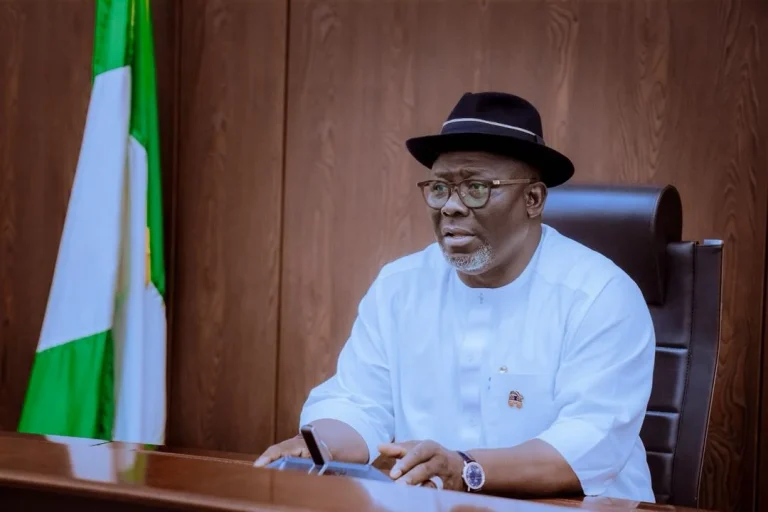
Benjamin Ioryem, the head of the JOHESU Benue State branch, stated, nonetheless, that the union was not on strike in the state.
Ioryem told our reporter over the weekend that there were nine problems in the state, eight of which were internal. The last one, which had to do with the state administration, was already getting attention.
“We are not on strike in Benue State because some of our problems are with hospital administration. Management has decided to deal with eight of the nine issues, which are all internal, like pay gaps, claims, and promotions.
The only big problem with the government is that medical physicians and nurses haven’t been paid in 18 months, which is what the governor is dealing with. We have come to an understanding with management and the government, so we are not on strike in Benue.
But health service in the state has been partially stopped since nurses, midwives, and resident doctors at the State University Teaching Hospital in Makurdi are still on strike.
Mr. Tahav Kershio, the state chairman of the National Association of Nurses and Midwives, said that members had been on strike for almost 10 weeks because they were taken off the contributory pension scheme, there weren’t enough workers, promotions were delayed, buildings were falling apart, leave grants were denied, and salaries were late.
The Association of Resident Doctors at the State University Teaching Hospital in Makurdi had also been on strike since November 1, 2025, because they hadn’t been paid their back wages, their pensions had been taken out without being paid, and the infrastructure was bad, according to Dr. Pededoo Kawen, the chairman.
Dr. Paul Ogwuche, the Commissioner for Health, said that the government was already working on some of the problems that the unions had brought up.
“As I speak, I can say with confidence that the unions that are on strike will stop at any moment.”
“We have been talking to them, and we have dealt with the main problem, which is the 18 months of raises the government owes them.
He said, “We are about to sign an agreement so that they can go back to work and give the best health care possible.”
About the Author