
With political parties bringing down the curtain on a brutal primary and changing alliances, Nigeria’s journey to the January 16, 2027, presidential election is already shaping up to be a familiar confrontation of heavyweights, ambition and high-stakes political calculations.
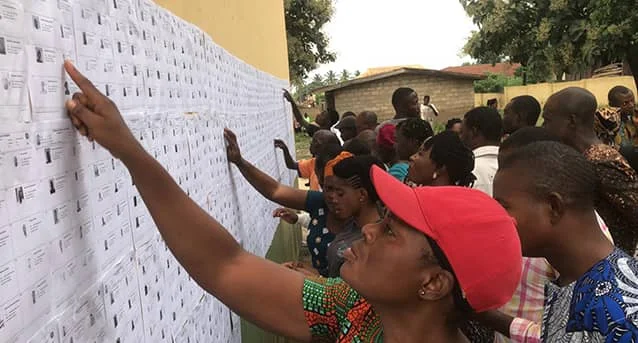
President Bola Tinubu is at the centre of the contest for the nation’s highest office after winning the presidential ticket of the All Progressives Congress (APC) in a landslide victory at the party’s nationwide direct primary held across the country’s 8,809 wards in all 774 local government areas, Channels TV reports.
Tinubu received 10,999,162 votes to beat his single opponent, businessman Stanley Osifo, who received 16,503 votes.
Announcing the outcome in Abuja, Chairman of the APC Presidential Primaries Election Committee, Pius Anyim, said Tinubu had met the standards of the party’s constitution and rules to emerge as candidate for the 2027 general election.
Tinubu accepted the nomination and thanked party members for the support.
“Thank you all. “You came back, looking at the figure, you changed the landscape,” the president stated.
Big Showdown.
The rise of Tinubu sets up another significant battle with former Vice President Atiku Abubakar, who bagged the presidential ticket of the African Democratic Congress (ADC).
The party said Atiku polled 1,846,370 votes to defeat former Rivers State governor Rotimi Amaechi and businessman Mohammed Hayatu-Deen who received 504,117 votes and 177,120 votes respectively.
He said the event was a demonstration that democracy is still alive in the ADC even with the obstacles confronting opposition parties in the country.
“We have shown that while democracy is being strangled and crushed by its ruling party and its agents, democracy is alive and well in the African Democratic Congress,” he stated.
Atiku called on party members to come together and help drag the country and its people out of the “destructive grip” of Tinubu’s ruling APC.
But the ADC primary was not without controversy. Amaechi rejected the outcome and reported widespread voter disenfranchisement, while Hayatu-Deen also voiced concerns about alleged vote tampering.
Obi’s NDC
Another key player in the developing rivalry is former governor of Anambra State, Peter Obi. Obi, who had joined the ADC among other opposition heavyweights, then switched to the Nigeria Democratic Congress (NDC) with former Kano State governor Musa Kwankwaso.
The NDC has declared its intention to use affirmation for its presidential primary; a decision widely viewed as clearing the way for Obi to emerge as the party’s candidate. There is also increasing talk that Kwankwaso could be his running companion.
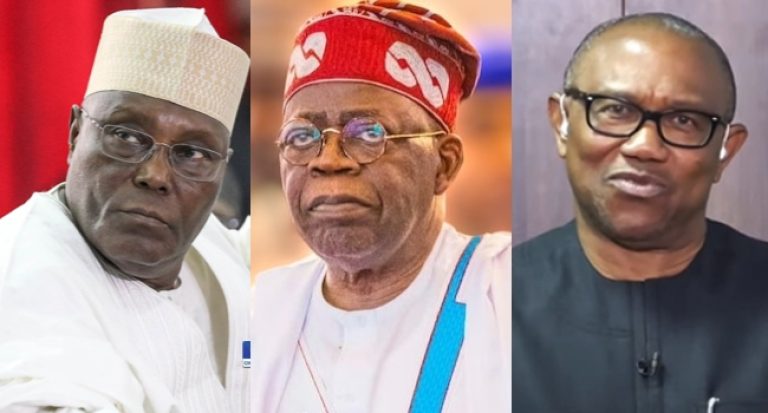
The development raises the likelihood of another three-way presidential race including Tinubu, Atiku and Obi, like the 2023 presidential election.
Battle of Strength
The Independent National Electoral Commission (INEC) declared Tinubu of the APC winner in the February 2023 presidential election with 8.79 million votes (36.61 per cent) beating Atiku (PDP) with 6.98 million (29.07 per cent), Obi (Labour Party) with 6.10 million (25.40 per cent) and Kwankwaso (NNPP) with 1.49 million (6.23 per cent).
The political tactician, Tinubu, will wield incumbency and partnership with at least 30 state governors in the ruling APC for the 2027 presidential election.
Atiku and Obi enter the 2027 race with distinct but considerable political advantages.
Atiku, a veteran of presidential contests, has political backing in the North, particularly from serving and past governors and MPs. His decades of experience in creating coalitions and already developed nationwide campaign apparatus created over decades in politics.
Obi’s primary assets include a solid base of youthful and urban support, the vibrant “Obidient” movement, a reputation for prudence and accountability and his status as a symbol of generational and political change.
Competitors And Others
Other parties have also declared their candidates, beyond the main contenders.
Abuja – Human rights activist Omoyele Sowore has been declared the presidential candidate of the African Action Congress (AAC) at the party’s primaries.
In his acceptance speech, Sowore said the AAC is
“We are here to change the course of history and to bring about revolutionary change,” he added.
But the Peoples Democratic Party (PDP) following consultations and voice voting across the states announced Senator Sandy Onor, a former Cross River governorship contender as its consensus presidential candidate.
The primaries are done and dust is settling as Nigeria’s political landscape once again becomes dominated by familiar names, shifting alliances and fresh goals. As contenders begin to appear from across the political spectrum, the focus is shifting, slowly, away from the internal fights to what promises to be yet another defining presidential battle in the country’s democratic journey.
About the Author