
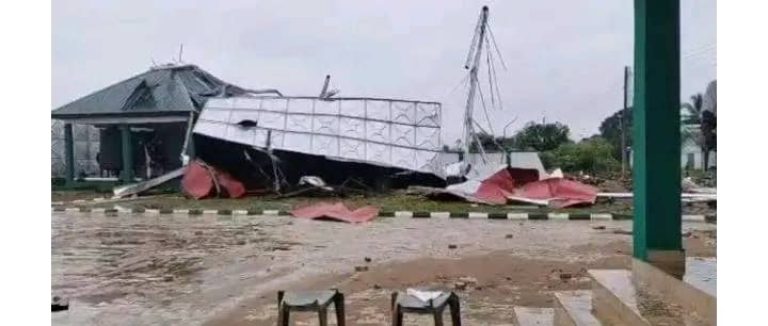
The Hydrocarbon Pollution Remediation Project (HYPREP) site in Ogoni land, Rivers State, has crumbled.
Residents and environmental campaigners were outraged when the project fell through after commissioning, according to Daily Trust.
One aspect of the federal government’s restoration efforts for the Ogoni towns ravaged by contamination from oil exploration is the provision of potable water.
As part of its mission to restore water quality to areas hit hard by decades of oil spills, the federal government built a water treatment plant in Gwara, Khana, Rivers, costing millions of naira.
Notable government officials, including those from the Federal Ministry of Environment, were present at last week’s inauguration to offer their praise.
According to locals who spoke with our reporter, a large portion of the reservoir platform collapsed shortly after the water treatment plant was commissioned due to structural flaws.
Hundreds of homes that had only recently started receiving the service had their water cut off, they said, because the incident had made the infrastructure non-functional.
“We were so happy when the project started running, thinking our suffering had finally ended,” remarked a local, Mrs. Fyneface Baridam.
However, the whole building collapsed a few days afterwards. The contractors clearly performed an inadequate job.
Since then, environmental rights organizations have denounced the episode, saying it exemplifies unethical practices and a lack of transparency in carrying out the cleanup initiatives suggested by the UN Environment Programme (UNEP).
The incident needs to be investigated immediately, according to Dr. Kaani Zorva, the executive director of COPER (the Centre for Oil Pollution and Environmental Response).
“This collapse is a moral failure; it is not just an engineering failure,” he remarked. Subpar projects destined to collapse are the result of the Ogoni people’s billions of dollars in funding.
Claims of mismanagement, delays, and low-quality work have dogged the Ogoni clean-up since its 2016 inception and subsequent revitalization by President Bola Tinubu’s administration.
The indigenous Ogoni people of the Niger Delta are worried that this new development may further derail the government’s environmental justice initiatives.
Professor Nenibarini Zabbey, who is in charge of the HYPREP project, has assembled a high-level committee to investigate the incident’s immediate and distant causes. They will be visiting the site right away.
In a statement posted on its official social media channel today, HYPREP management announced that the site had been visited by the Committee that was established by the Project Coordinator.
“The collapse of the overhead tank at the newly commissioned Gwara Water Station in Khana LGA is deeply disturbing the Hydrocarbon Pollution Remediation Project (HYPREP),” states the statement.
Meanwhile, a high-level team headed by Professor Nenibarini Zabbey, the project coordinator, has been formed to investigate the incident’s immediate and distant causes. This committee will visit the site as soon as possible.
As a result, the Committee has gone to the site and will investigate thoroughly to see whether there was third-party influence or probable structural failure.
We are taking steps to restore the damaged infrastructure and reticulate water to the impacted villages. In the meantime, we encourage the Gwara people to remain calm and understand.
HYPREP’s dedication to delivering projects of the highest quality that satisfy industry standards will not waver. To provide quality control and assurance, it has implemented both internal and external procedures. Consulting with an EcoProject expert, having the Monitoring and Evaluation Unit and Water Supervisors keep an eye on things, and more are all part of this.
Despite this one exception, sixteen water stations have been activated, providing water to forty different localities. More than two years have passed since several of them first launched.
To make sure the water projects last and help people, strong sustainability measures are in place. They include building solar farms as a backup power source, teaching laboratory workers new skills, and establishing the Water Consumers Association (WCA). The HYPREP Water Project’s laboratory is one of its distinguishing characteristics; it checks that the water that communities receive is up to WHO standards.
About the Author