
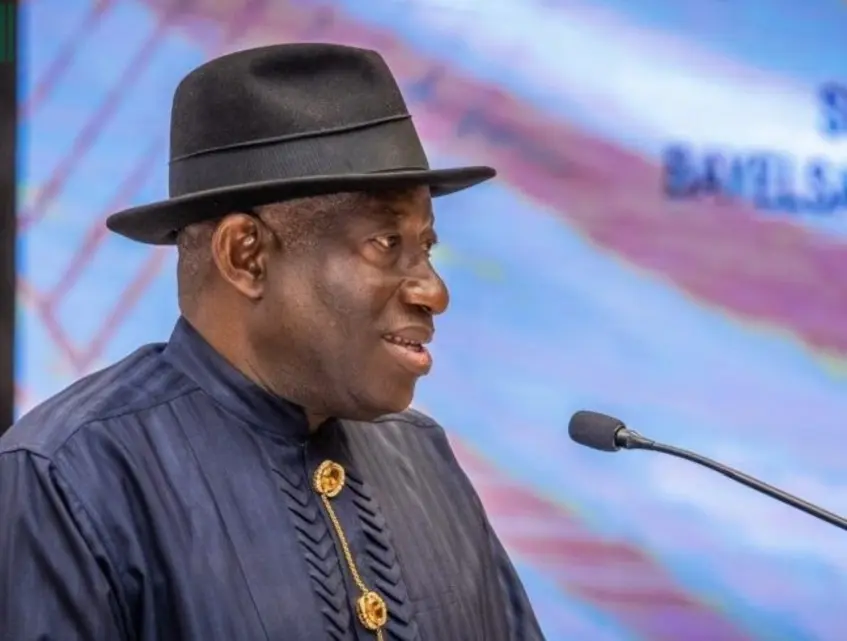
Former President Goodluck Jonathan has warned politicians that they must put national interest above party loyalty and sectional consideration in doing politics ahead of the 2027 presidential and general elections. Jonathan said Nigeria is greater than any political party and politician in the country.
According to Vanguard, Jonathan said “Politicians must know that you can only play politics in a peaceful Nigeria.”
He underlined that the country is bigger than the ruling All Progressives Congress (APC), the Nigerian Democratic Congress (NDC), the Action Democratic Congress (ADC) and other political groups.
Former president, who spoke at the 5th National Conference of the Forum of Former Deputy Governors of Nigeria in Abuja, called for national unity, stronger democratic institutions and greater commitment to good governance, saying that former deputy governors have a responsibility to deploy their experience in an effort to promote national development.
The conference, slated for October 20-21, is entitled, “Rethinking Nation-Building: Bridging the Leadership-Citizen Disconnect Through Orientation, Attitude, Character, Culture and Tradition Toward Sustainable Development.”
Jonathan, speaking through a former deputy governor of Adamawa State, Bala Ngilari, warned that ethnic, religious and regional divisions remained major obstacles to Nigeria’s political development. He reminded all that political office is temporary, but its consequences can shape generations, making it imperative for former public office holders to guide emerging leaders on integrity, accountability and responsible leadership.
He said he was optimistic about the future of Nigeria, given the resilience and ingenuity of its people, especially the young Nigerians, who he said deserved opportunity to work, develop and succeed.
He said: “The greatest impediment to Nigeria’s political development is disunity on ethnic, religious and regional basis. We must overcome our divisions and encourage politics of competence, integrity, inclusion and national interest.
“Nigeria must always be greater than any political party, individual or sectional interest.
As the deputy governor and governor of Bayelsa State before he became vice-president and president of the country, the former president said his experience taught him the importance of consultation, team work and strong institutions. He called on former deputy governors to promote cordial relationships between serving governors and their deputies, mentor younger politicians and discourage divisive politics.
I know the opportunities and challenges of the post of deputy governor, having served as a previous deputy governor and Governor of Bayelsa State before I became Vise President and later President of Nigeria.
“The experience teaches patience, loyalty, consultation and teamwork. It’s an eye-opener.” “More importantly, it teaches us that governance is not about one person but about strong institutions and serving the people.”
In his remarks earlier, the National Chairman of the Forum of Former Deputy Governors of Nigeria (FFDGN), Dr Chris Alozie Akomas challenged political leaders to jettison arrogance and embrace accountability. He said that power without character is destructive and governance without empathy is empty.
Akomas, who identified the widening gap between political leaders and the citizens as a major obstacle to Nigeria’s development, said sustainable development could not be achieved through policies, budgets and administrative reforms alone without a fundamental change in the attitudes, values and conduct of those entrusted with public responsibility.
The gap between leaders and the people they govern has permeated government institutions, communities and families, undermining the collective effort needed to develop a wealthy society, Akomas said.
You can’t construct a sustainable future on a base of indifference,” he said.
The former deputy governor, who argued that leadership should be judged by the commitment to serve the people, especially the vulnerable, and not by the privileges and influence that come with public office, said: “Leadership is not a badge of immunity; it is a higher standard of accountability,” urging public officeholders to replace arrogance with humility and responsibility.
“Power without character destroys, and governance without empathy is an empty shell.”
He warned that public trust would remain elusive if leaders continued to ignore the everyday struggles of ordinary Nigerians. Akomas who pointed out that Nigeria’s development challenges required more than new laws and government programs, said national renewal must begin with integrity, ethical conduct and a commitment to the common good.
The FFDGN chairman also cautioned against laying the whole duty of national regeneration on government officials, emphasising that individuals had an equal role to play in restoring the country’s ideals.
“A nation is not saved by a government alone, it is also sustained by the conscience of its people,” he remarked.
In his comments, the former governor of Kano State, Dr. Abdullahi Ganduje who called on Nigerians to embrace their diversity and cultivate a stronger sense of national identity, cautioned that ethnic politics continued to undermine nation-building, just as he linked Nigeria’s complex national integration problems to its colonial history but recognised the efforts of First Republic politicians in the fight for independence.
The immediate past national chairman of the ruling All Progressives Congress who also faulted the lack of continuity between successive administrations, said such practices undermined sustainable development. He said political friction between incumbent governors and their predecessors often led to the abandonment of projects and programs, stressing that continuity was necessary for consolidation and long-term progress.
He said Nigerian political parties lacked ideology, noting that leaders often change allegiance to serve personal advantage rather than the common good.
‘But we need to thank our First Republic politicians who built a spirit of nationalism and fought for the freedom of the country. They gained independence under political pressure.
‘Unfortunately, some of those leaders who had shown a nationalistic vision turned tribalistic in their attitudes following the Independence of Nigeria as political parties were generally structured along ethnic lines.
“As time goes by, it is our duty to come together, to believe in Nigeria and turn our diversity into an asset rather than a liability,” he stated.
Ganduje, who said deputy governors should be appreciated for their contributions to administration and not considered as mere substitutes for governors, asked, “What is the issue between a governor who has left office and the new governor who has taken over? Often we discover friction between them, sometimes even if they are in the same political party. It can be worse if they are from different parties.
This conflict robs us of continuity of government. Some projects may have been finished by the governor while others are still continuing. Incoming governors can walk away from or undo the projects and programs of the preceding administration. “So there is no continuity.”
Dr Ifeanyi Okowa, former governor of Delta State, who also decried the growing disconnect between government policies and citizens’ everyday experiences, said this had weakened public trust. According to him, nation-building depended on a social contract anchored on accountability, inclusion and shared responsibility, adding that citizens had increasingly felt alienated because their expectations and aspirations were not being adequately met.
Re-establishing confidence between the government and the governed was as crucial as economic growth, infrastructural development and administrative efficiency, he said.
Political leaders, members of the diplomatic corps, industry representatives, academics, youth and women’s organisations and professional bodies attended the meeting.
Ex-President Goodluck Jonathan was at the event and was the forum’s Grand Patron while ex-Governor of Delta State, Senator Ifeanyi Okowa, was co-chairman.
Earlier, the Director-General of the forum, Hon. Kenneth Ibe-Kalu, told the gathering that the organization was still devoted to fostering civic education, integrity and discipline to bridge the expanding gap between leadership and citizens.
Ibe-Kalu called on participants to translate their ideas into real measures that would enhance national unity, improve governance and promote sustainable development.
About the Author