
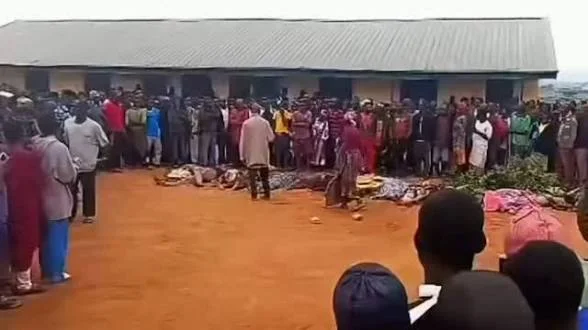
Over 30 persons are thought dead in a fresh attack on Chawai hamlet in Kauru Local Government Area of Kaduna State, in what residents described as one of the bloodiest assaults on the area in recent months.
Residents said dozens of highly armed intruders assaulted the village Sunday night, firing indiscriminately and attacking homes for many hours before retreating. Local reports reported that at least 28 bodies had been found and lodged in a mortuary, while two more victims had been buried soon after the incident. Seven injured survivors were said to be seeking treatment in separate hospitals.
Mahlon Vincent, a resident, told the BBC Hausa that the attackers went from home to house and targeted residents. He dismissed accusations that the violence was sparked by a fight between farmers and herders, stating that the victims were attacked inside their homes by around 50 armed men who operated for over three hours.
No independent verification of the casualty counts was available at the time of reporting this story, and the Kaduna State Police Command has not issued any official statement on the incident.
Many inhabitants of Chawai and nearby settlements have fled for safety following the recent incident amid worries of more violence.
The killings have been widely condemned. Former Vice President Atiku Abubakar characterised the attack as heart-rending and called on security services to double efforts in protecting lives and property, noting that insecurity remains one of the country’s greatest challenges.
Similarly, the Southern Kaduna People’s Union (SOKAPU) called on the Kaduna State Police Command to step up security operations in Kauru and other vulnerable local government areas.
The organization called for intelligence-led operations, deployment of more security personnel and destruction of criminal dens to stop more attacks and the evacuation of residents.
The attack is the latest in the ongoing cycle of violence that has continued to terrorise communities in Southern Kaduna, generating fresh fears over the safety of civilians as well as the efficiency of ongoing security operations.
About the Author