
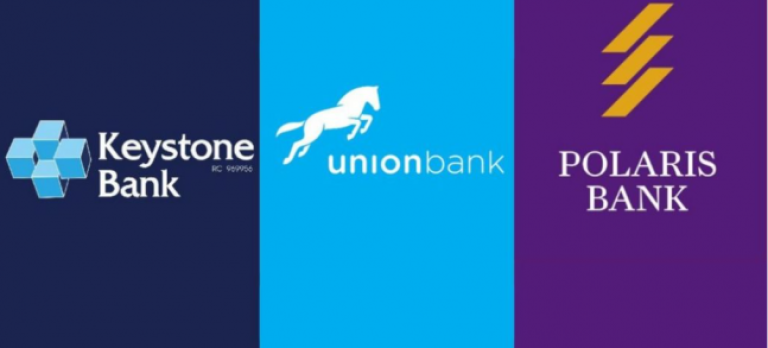
The Central Bank of Nigeria (CBN) may have given Union Bank of Nigeria (UBN), Polaris Bank and Keystone Bank more breathing space to complete their recapitalisation.
Sources claimed the apex bank has come to a consensus to allow the ‘managed’ banks to finish the process under a regulatory window of three weeks.
The Nation says that all banks have met the March 31 deadline assigned to them to recapitalise.
One source said the decision to provide special consideration to the three banks was based on the conditions they faced, including legal and regulatory ones.
The ‘managed’ banks will need at least N350 billion to keep their national banking licences under the new minimum capital base, which stipulates that banks with a national commercial banking licence must have a minimum share capital and share premium of N200 billion.
The three banks have the opportunity to restructure their activities into a regional licence which has a minimum capital of N50 billion.
Under the recapitalisation process, the apex bank raised the new minimum capital for commercial banks with international links, otherwise known as mega banks, to N500 billion; those with national permission, N200 billion and others with regional licence, N50 billion.
Merchant banks were given a minimum recapitalisation benchmark of N50 billion, non-interest banks with a national licence, N20 billion and non-interest banks with regional license, N10 billion
In January 2024, the CBN had dismissed the board and management of Union Bank, Keystone Bank and Polaris Bank for non-compliance with the provisions of Section 12(c), (f), (g), (h) of the Banks and Other Financial Institutions Act, 2020.
The apex bank said the breaches by the banks included regulatory compliance failures, corporate governance failures, failure to comply with the conditions for the issuance of their licenses, acts of omission and commission that could threaten financial stability, among others.
But the former owners of one bank had waged strenuous legal challenges, generating ambiguity over its ownership.
Recently, the prior proprietors of Union Bank, have won a Federal High Court order voiding its takeover by the CBN. But the apex bank challenged the decision.
The CBN was resolved to give the three banks a fair chance to explore all the alternatives under the banking recapitalisation, including fresh public and private capital raisings, adjustments of licence category and mergers and acquisitions, sources said.
The three banks are leaning towards “standalone options,” the sources said. They said there would be additional injections of funds and a likely revision of licenses.
In a formal statement on the conclusion of the recapitalisation on March 31, 2026, the CBN said the initiative was successful with 33 banks achieving the revised minimum capital requirements.
Nigerian banks generated N4.65 trillion fresh capital in 24 months which enhanced the resilience of the financial system and its ability to sustain the economy, the top bank said.
“The programme saw good participation from both local and foreign investors, with 72.55 per cent of capital from the local market and 27.45 per cent from the foreign market, reflecting sustained confidence in the Nigerian banking sector,” CBN said.
In what was seen as a veiled allusion to the three banks under its intervention management, the CBN said: “A small number of institutions remain under ongoing regulatory and judicial processes which are being dealt in line with existing supervisory and legal frameworks.
The CBN Governor, Olayemi Cardoso, had declared that the three banks were fully operating, assuaging fears of any detrimental impact beyond the initial deadline for recapitalisation.
He said CBN would continue to support the efforts of the impacted institutions to overcome their legal and regulatory challenges.
About the Author