
ERELU TÚNWÀṢẸ SERIES
BÍ ỌMỌDÉ BÁ ṢUBÚ, YÓÒ WO IWÁJÚ; BÍ ÀGBÀLAGBÀ BÁ ṢUBÚ, YÓÒ WO Ẹ̀HÌN WÒ.
When a child falls, they look ahead; when an elder falls, they look back to see what caused the fall.
The proverb reminds us to examine what went wrong and learn from it before moving forward.
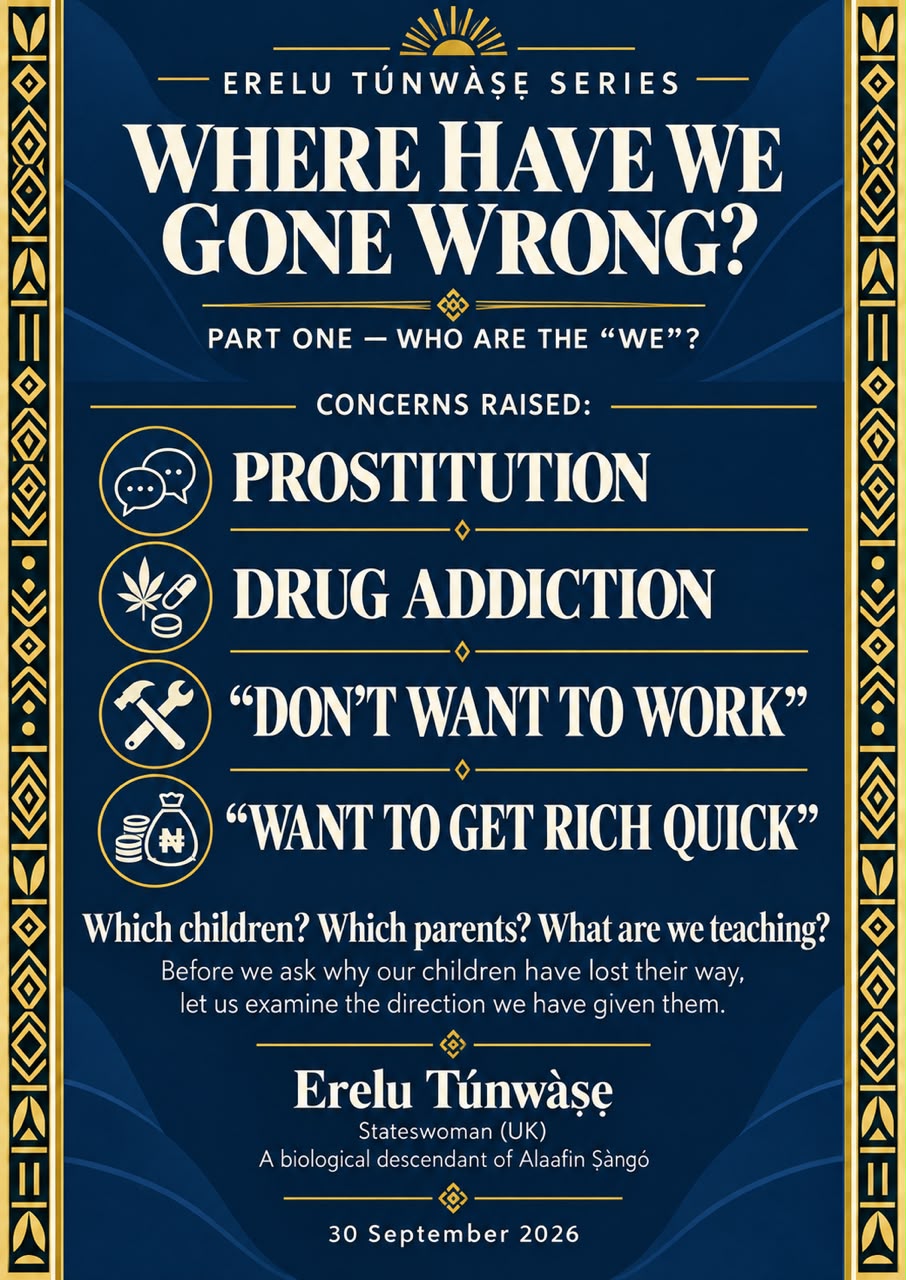
Princess Oluwabukola, popularly known as Lady of Africa, has expressed what is on the minds of many. In her video, she appeals to parents to consider what is happening to our children: addiction, prostitution, the pursuit of money by any means and a loss of connection to our culture.
Her question deserves our attention:
“Where have we gone wrong?”
But before we answer, I must ask:
WHO ARE THE “WE” WE ARE TALKING ABOUT?
Are we talking about parents? Teachers? Religious leaders? Those governing us? Or all of us, with our different responsibilities?
And which children are we discussing?
Children of struggling families? Children of the middle class? Children of the wealthy?
We cannot put them all together and assume that their upbringing, opportunities and daily experiences are the same.
I was conceived, born and brought up on Lagos Island. When I compare my childhood with what I see today, I sometimes find it difficult to believe how much has changed.
But my concern comes from more than memories. It comes from what I see and the conversations I have.
SOME CHILDREN ARE ALREADY WORKING TO SURVIVE.
On the streets of Ilé-Ifẹ̀, I see children selling pepper, oranges, bananas and puff-puff.
At the famous Àkàrà Junction, very close to Oduduwa University near Ipetumodu, I have seen young children selling bread and àkàrà as early as six in the morning, running towards vehicles to find customers.
I found this intriguing. My assumption was that their parents were the main àkàrà sellers, so I decided to speak to some of them.
They told me they earned commissions from selling for a woman who also kept their earnings for them. Several said the money helped pay their school expenses and support their mothers. Among those I met was a boy as young as six.
I was shocked.
When we say, “Our children do not want to work,” where do these children fit into that statement?
These are children already carrying financial responsibilities at an age when they themselves need care, protection and schooling.
I was also once approached by a young man who told me how he had started what he called an online “Yahoo business,” funded by a loan from a third party arranged through his mother.
His account raised another concern: what role are parents playing in the ways their children pursue money? What questions do they ask before helping to finance those activities?
Then there is another experience.
On a university campus, I met a sixteen-year-old who appeared unhappy about the course his father wanted him to study. I stopped to listen and tried to help.
That same day, he asked me to buy him a phone costing ₦150,000.
A few days later, he wanted to know what birthday gift I had in mind for him.
This was a young person I had only just met.
What had taught him to expect such things from someone who, until that day, had been a total stranger? What had he learnt about boundaries, gratitude and the value of money?
These few encounters cannot tell us everything about every family. But they show why we must be clear about whom we are discussing.
ARE WE MORE CONCERNED WITH KEEPING A MARRIAGE THAN CARING FOR THE CHILDREN?
In some families I encounter, parents seem to place more emphasis on preserving the marriage than on the care and upbringing of their children.
I have met women who have become the sole breadwinners, carrying the entire financial responsibility of the household. For some, supporting a husband appears to be the price they feel they must pay to prevent the marriage from breaking down.
I met one woman who provides everything in the home—including her husband’s airtime and data.
What responsibility does he take for the household and the upbringing of their children? How much time and energy does she have left after carrying this financial burden?
When keeping the marriage together becomes the overriding priority, who is making sure the children receive the care, attention and guidance they need?
DO OUR CHILDREN FEEL SAFE ENOUGH TO TELL US THE TRUTH?
In England, I have encountered young people from Hausa and Fulani backgrounds who struggled to reveal their beliefs and wishes to their parents.
One young woman became suicidal. She no longer wished to be a Muslim or to marry a Muslim, but felt unable to speak openly to her family.
According to what she told me, she used the opportunity of postgraduate study in the UK to get away from her family. Her mother understood that she was travelling for further education; the daughter also saw it as a means of escape.
This particular experience raises a serious question about parental expectations and a child’s freedom to speak honestly.
Are we listening to our children, or are we so determined to decide their lives that they feel they must hide the truth from us?
We can value our heritage and explain our beliefs while still listening to our children. When a young person reaches the point of wanting to die, their safety and access to compassionate support must come first.
Keeping up the appearance of an obedient child is no substitute for knowing whether that child is safe, heard and able to ask for help.
WHAT HAVE WE, THE ADULTS, TAUGHT OUR CHILDREN TO ADMIRE?
Honest work? Good character? Useful knowledge? Our language and heritage?
Or expensive phones, fashionable clothes, prestigious schools and the appearance of wealth?
When a parent teaches a child to look down on their own language, community and way of life, what connection to that heritage does the parent expect the child to preserve?
Lady of Africa also asks that we bring our children “back to God.”
That raises another question, which deserves its own discussion: which God, and what are we asking them to return to?
Many have already been brought up within Christianity or Islam by their parents. We must examine what they have been taught and how that teaching is reflected in everyday conduct.
I welcome Lady of Africa’s appeal. But we must look closely at ourselves before placing the whole burden of failure on the younger generation.
Before we ask why our children have lost their way, let us examine the direction we have given them.
Erelu Túnwàṣẹ
Stateswoman (UK)
A biological descendant of Alaafin Ṣàngo
30 September 2026
About the Author