
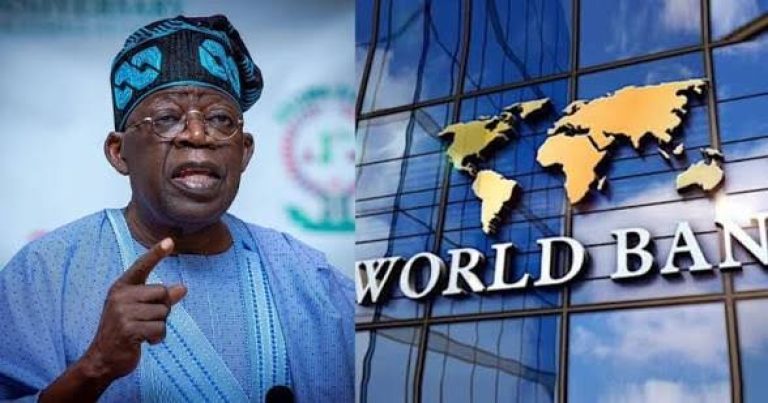
Nigeria’s federal government, led by President Bola Ahmed Tinubu, is requesting a new $500 million loan from the World Bank to create an infrastructure financing platform, with the proposed approval date of May 25, 2027, just four days before the inauguration of Nigeria’s next president.
The planned borrowing comes amid heightened political activities ahead of the 2027 general elections, raising doubts on the timing of increased financial obligations and their ramifications for the incoming administration, The PUNCH reported.
The World Bank’s Initial Project Information Document, which our correspondent got yesterday, said the facility, which forms part of a larger $3.85bn infrastructure finance program, is aimed to draw private investment into key areas of the Nigerian economy.
The document was drafted and revised on November 4, 2026. The program is titled Nigeria Infrastructure Financing and De-Risking Platform for Growth and Jobs (INFRAGROW).
The borrower is the Federal Ministry of Finance and the implementing agency is the Nigeria Sovereign Investment Authority.
The project’s technical design review is set for January 21, 2027 and its expected approval date is May 25, 2027, the bank said.
The presidential inauguration of Nigeria is constitutionally slated on May 29, 2027, after the expiration of the present four-year presidential tenure.
Because of the timeframe, the planned facility might get World Bank approval in the closing days of President Bola Tinubu’s current term, albeit approval would not necessarily translate into immediate release or implementation.
The planned finance is subject to approval and the indicated timetable of the World Bank is subject to change.
The research states that the country’s yearly infrastructure finance gap amounts to almost $100bn and that a lack of investment and poor project preparation are the key impediments to economic growth.
It noted that “Nigeria’s infrastructure financing gap estimated at approx. $100bn annually is a binding constraint on growth, fiscal sustainability, competitiveness and job creation.”
The bank said the problem was not just a shortage of funds but also the complexity of transforming existing resources into commercially viable infrastructure developments.
To close the financing gap consequently requires an integrated approach combining rigorous project preparation, suitably calibrated de-risking mechanisms tailored to each project’s residual risk profile and targeted sectoral reforms to boost the operating environment, it added.
The $500m of proposed World Bank financing would include $400m from the International Bank for Reconstruction and Development and $100m from the International Development Association.
The overall $3.85bn funding structure also comprises government and private investor contributions, guarantees and commercial lenders to stimulate more investment.
The deal will involve NSIA putting up $200 million in stock as a founding shareholder with private sector investors providing another $200 million.
We estimate commercial loan funding at $600m, plus other finance and guarantee agreements.
The World Bank document also includes $100m in IDA payment guarantees and $2.25bn in guarantees from other international financial institutions, taking guarantee-related financing arrangements to $2.35bn.
The finance facility is scheduled to function through four separately governed corporations, each one intended to overcome a certain barrier to infrastructure investment.
The first is the Project Preparation Facility, which will finance feasibility studies, transaction structuring, risk assessment and procurement support to help transform infrastructure plans into investment-ready projects.
The second, the Viability Gap Fund, will give financial help to economically vital initiatives which are not able to generate enough commercial returns while keeping tariffs low or government payments viable.
“Under the proposed endowment model, the VGF will keep its capital base and finance viability-gap support primarily from investment returns,” the document said.
The third subsidiary, the Risk funding Facility, will offer equity and other forms of patient funding to commercially viable infrastructure projects that struggle to attract investors prepared to take on higher risks.
The fourth, the Credit Guarantee Vehicle, will offer guarantees for certain credit defaults, non-payment by the public sector and political risks impacting eligible foreign investments. PoliticsFollow
The initiatives aim to stimulate involvement by commercial banks, pension funds, insurance firms and other institutional investors, the bank said.
The initiative will also assist changes to enhance the public institutions responsible for identifying, developing, procuring and managing public-private partnership projects.
This will be done through four components: institutional development; project planning; mobilisation of funds; and strengthening of the regulatory environment.
The first component will finance staffing, professional advisory services, statutory fees and operational infrastructure, with payments tied to demonstrable institutional achievements.
The second will enhance project planning and financial viability and the third will trigger the risk capital and credit guarantee facilities. The fourth will improve the government’s ability to manage infrastructure partnerships and associated fiscal risks.
“The Nigeria INFRAGROW project being proposed is an institution-building and private capital mobilisation operation to scale up sustainable infrastructure in Nigeria,” the World Bank said.
The project will also see the International Finance Corporation as a potential co-investor and the Multilateral Investment Guarantee Agency, which should offer political risk insurance.
The bank has assessed the environmental and social risks of the proposed project as high, especially as the funding platform might assist large infrastructure projects in the fields of energy, transport and water.
It cautioned that such expenditures could result in land acquisition, relocation of communities, environmental degradation, occupational dangers and other social impacts.
About the Author