

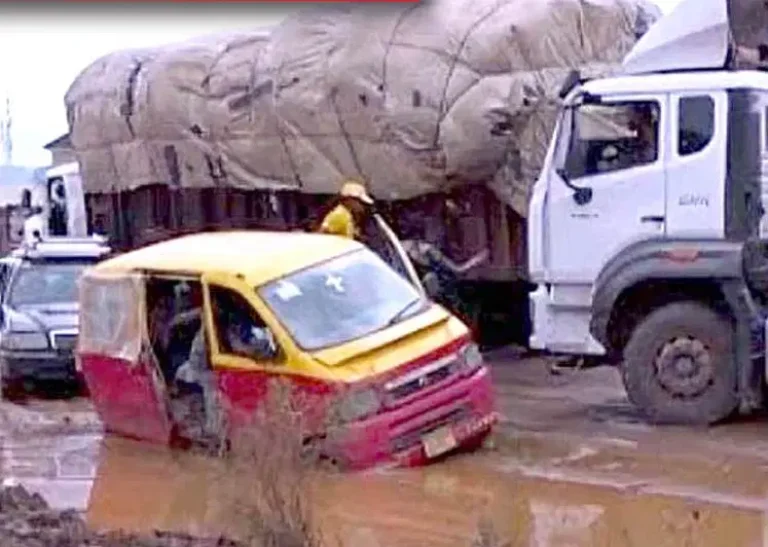
The Benin-Asaba Motorway Concession Company Limited (BAECC) has appealed to motorists and communities along the corridor to be patient as the company prepares to step up permanent construction activities on the 125-kilometre roadway.
In a statement today, Samuel Daramola, Chief Executive Officer, BAECC, appealed that the business was dedicated to delivering the project despite severe rainfall and the difficulty of repairing a widely trafficked route while keeping it accessible to traffic.
Daramola said motorists and communities were facing inconvenience, adding that the business was trying to reduce the burden through palliative measures while working on the permanent rebuilding, Vanguard reports.
“We are aware of the inconvenience that has been caused to motorists and communities and we do not take their concerns lightly,” he said.
“It’s not just about the permanent road. Our job is to do everything reasonably possible to keep people moving while work is going on.”
The project is being carried out under a 36-month construction program that includes major rebuilding and enlargement, earthworks, drainage, paving, culverts, traffic control and the installation of production facilities.
BAECC said it has already done a lot of work on different sections, including earthworks and subgrade preparation, drainage and culvert construction, asphalt and binder-course works and carriageway enlargement.
The company also mobilised asphalt plants, concrete batching plants, paving equipment, concrete mould plants, Wet Mix Macadam plants and other specialised construction equipment, it claimed.
“BAECC said billions of naira of private-sector resources have been committed to equipment, construction plants, materials, logistics and supporting infrastructure for the project.
Daramola said much of the preparation work might not be immediately visible to motorists, but it was vital for the permanent construction of the highway.
“A project of this magnitude is done in phases. “Before the travelling public sees kilometres of finished asphalt, there must be drainage, earthworks, pavement preparation, production plants and equipment mobilisation,” he stated.
The recent wet weather posed a huge difficulty at this stage with the ground being saturated and this had an impact on earthworks, pavement stabilisation and asphalt works, he said.
However, Daramola emphasised that the downpour influenced the sequencing and speed of specific activities, not stopping building completely.
“Our teams are still doing other engineering work and palliative work in places where permanent pavement work is limited by rainfall,” he said.
The business claimed the reconstruction had been made difficult by the requirement to keep the busy route available to thousands of automobiles, buses, commercial vehicles and articulated trucks.
BAECC said it had sometimes reopened treated portions earlier than it would normally desire to reduce congestion.
We’re creating and controlling traffic at the same time’, Daramola remarked.
“There are situations when engineering factors could recommend a lengthier closure of a segment, but the reality facing drivers mean we need to get the road reopened.
Permanent reconstruction will proceed while palliative measures will be implemented on tough parts to decrease hardship, the business stated.
BAECC said it was getting ready for a big acceleration of permanent activities from October as weather improves.
The program will include drainage completion, pavement reconstruction, asphalt binder and wearing course installation, culvert building and other permanent works on several sections.
It also said that additional staff, equipment and construction resources were being mobilised for the dry-season construction window.
“As the rains go back, Nigerians will see a lot of permanent works being fasttracked,” Daramola remarked. Africans & Diaspora
He urged the motorists and host towns to measure the project in terms of the entire building schedule and not just the challenges being faced at the moment.
We are not asking anyone to forget the problems of the present. We know them and we are addressing them with palliative interventions while we are creating the permanent answer’, he said.
“We need time and opportunity to deliver the project within the construction program. Ultimately judge us by the quality, longevity and safety of the roads we produce.”
BAECC also vowed to continue working with the Federal Government, appropriate authorities and host communities to build a safe and reliable highway.
“You are not seeing the road as it will be when it is completed,” Daramola remarked.
We ask for a bit more patience and the chance to finish what we have begun.
About the Author