

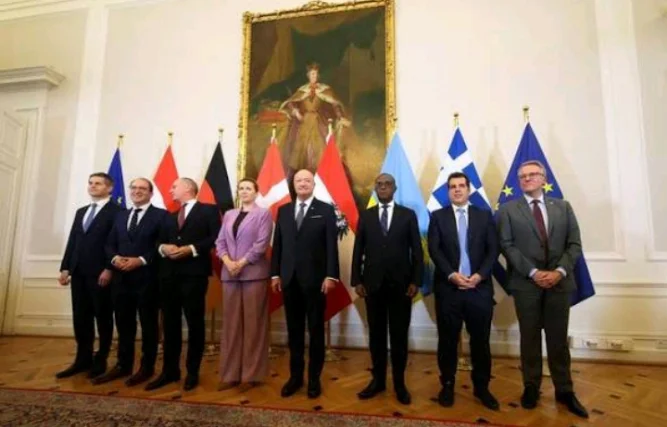
Five European Union member states said on Thursday they have agreed to set up a “return hub” in Rwanda to host rejected asylum seekers, the first such facility outside the EU and a major hardening of European migration policy.
Germany, Austria, Denmark, Greece and the Netherlands announced the deal on Monday at a press conference in Vienna, with Austrian Chancellor Christian Stocker saying that the group planned to “open the first return center in Rwanda in 2027”.
The experimental project should initially house roughly 100 people, with each of the five nations likely sending around 20 refugees.
The initiative is only for migrants who have exhausted all legal ways of staying in the EU yet cannot be sent back to their home countries for a variety of reasons.
“Today is a very important step on the way to a new migration system,” said Danish Prime Minister Mette Frederiksen, who was present for the announcement.
This is part of a larger change in thinking, Stocker said. “We have to be the masters of our own house,” he said, calling the centers a major paradigm shift in European migration policy.
The initiative comes after a recent EU legislation that created the legal basis for member states to establish return centers in third nations. The five countries have said they expect to get the Rwanda center up and running by 2027.
Rwanda’s selection has garnered strong condemnation from rights groups. The government has a “well-established record of repression of dissent, arbitrary detention, ill-treatment in detention,” said Clementine de Montjoye, senior Africa researcher at Human Rights Watch, who accused Kigali of aiding armed rebels in neighbouring Democratic Republic of Congo.
See also FAA Lifts Nationwide Ground Stop but Warns Flight Chaos Will Persist Through the Weekend “Paying Kigali to host a deportation program would not only cause suffering and harm to those deported, it would finance and provide political leverage to a government responsible for serious human rights abuses at home and abroad,” she said.
The scheme enjoys the support of the European Union, which has shown its readiness to cooperate with the union. “We did careful preparatory work, also regarding ensuring respect for human rights,” EU executive spokesperson Markus Lammert said of the project.
The UN’s International Organization for Migration may lend a hand, and an IOM representative said the organization was in talks with some EU nations “regarding plans for the establishment of return hubs or similar mechanisms.”
The proposal is separate from Britain’s abandoned Rwanda plan, which involved transporting asylum seekers to the African nation to process their claims, before being found unlawful by the UK Supreme Court and then abandoned. Unlike that model, the EU initiative is only aimed at people already ordered to leave the bloc.
About the Author