
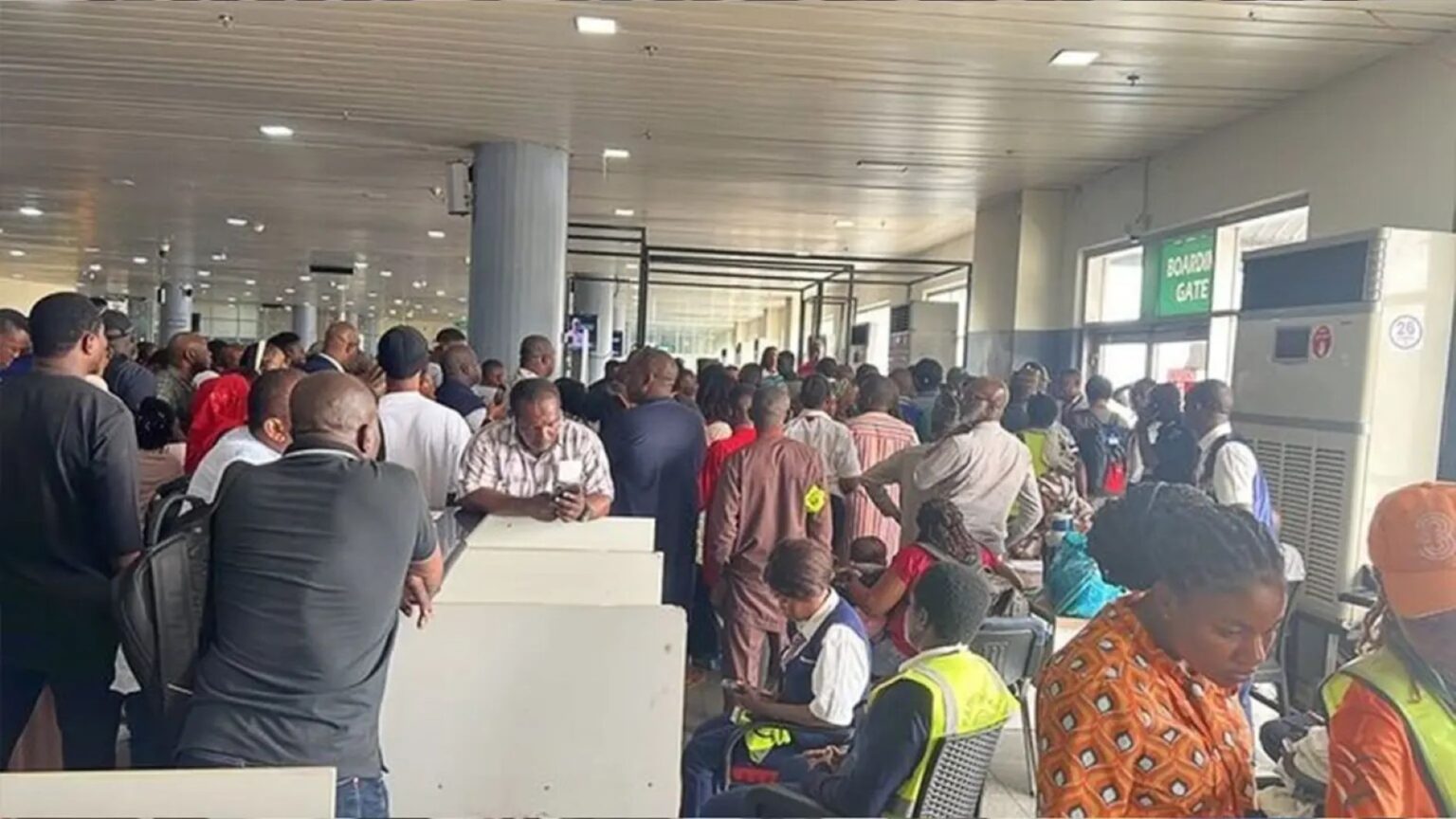
No less than 80 flights were cancelled during the picketing yesterday in Lagos and Abuja airports for about eight hours, while more were disrupted across local and regional networks, cumulatively compounding the plight of struggling Nigerian carriers.
Our correspondent’s rough estimation that the preliminary loss in revenue and various services was N2 billion, without factoring the airlines’ reimbursement responsibilities to stranded customers at airports throughout the country, was cited by The Guardian.
Recall that unhappy aviation workers’ unions yesterday shut down operations of Air Peace airline, protesting claimed non-remittance of about N20 billion, non-remittance of the five percent Ticket Sales Charge (TSC) to the regulators and the right of workers to unionise.
The picketing, however, deepened the acrimony between the unionists and the airline’s workers as Air Peace drivers reportedly used company buses to barricade the access to the runway at the Murtala Muhammed Airport, Lagos, shutting out all other domestic carriers and compounding the woes of the industry.
The collateral damage, enormous misery on air travellers and economic sabotage have prompted the operators and stakeholders to seek for a probe and prosecution of some union members and Air Peace drivers.
The picketing of the airline started in the early hours of yesterday by the National Union of Air Transport Employes, Air Transport Services Senior Staff Association of Nigeria and National Association of Aircraft Pilots and Engineers, supported by the Nigeria Labour Congress and Trade Union Congress.
The unions had earlier issued three levels of warning that they would picket airlines that refused to pay the Nigeria Civil Aviation Authority five per cent Ticket Sales Charge.
The unions said Air Peace alone owed aviation agencies approximately N15 billion in TSC, and was also accused of obstructing its workers’ efforts to join trade unions.
Air Peace alone accounts for an estimated 40 percent of daily airline revenue, so the suspension of its operations alone caused a huge economic loss to the business.
Air Peace operates an average of 80 flights daily over its domestic, regional and international network, carrying an estimated 8,000 passengers.
The unions later picketed the airline and other carriers’ operations obstructing access to their terminals in Lagos and Abuja consequently affecting passenger movement and departure of scheduled aircraft.
Air Peace spokesman Efe Osifo-Whiskey said the doors to its Alpha and Zulu terminals at the Murtala Muhammed Airport Terminal 1, its operations at Terminal 2, and the Nnamdi Azikiwe International Airport, Abuja, were shut.
“The blockade had a big impact on passengers travelling across the airline’s network and stopped scheduled flights from taking off,” he said.
“The blockade has limited access to these terminals, thereby stopping the scheduled flights from Lagos and Abuja from departing. Therefore, the disruption to flight operations has had a major impact on passengers due to travel across our network.
“Air Peace sincerely regrets the disruption and inconvenience caused to all affected and stranded passengers due to circumstances beyond the airline’s control,” Osifo-Whiskey added.
A source close to Air Peace told our correspondent that no fewer than 50 per cent of the airline’s flights, including services to Lagos-Abuja and Lagos-Port Harcourt, were cancelled before the unions called off the picketing.
General Secretary, ATSSSAN, Frances Akinjole, said the unions launched the action after the management of Air Peace refused to meet with them on negotiations on how to remit the purported debt and resolve unionism in the airline.
He said the latest move was sequel to the failure of the Minister of Aviation and Aerospace Development, Festus Keyamo to broker a meeting between the unions and airline operators last Friday.
He said the unions attended the meeting scheduled by the ministry but Air Peace later said it would not meet with the unions.
“The airline has been discouraging industrial democracy to other airlines,” he claimed. The airline (Air Peace) has just committed an act of terrorism. It placed its trucks on the runway, blocking the runway and preventing aeroplanes from taking off or landing on the runway.
“We are not picketing Air Peace for fun. The airline has to be our starting point. It is the national flag carrier.
“For now, we are picketing their Lagos operations only. We all know that most airlines leave from or arrive in Lagos. So it’s calculated. I don’t know how long it’ll take us to picket the airlines. We will continue with this strategy for the time being.”
Akinjole said unions have agreed to stop picketing while they investigate.
But the Chief Executive Officer (CEO) of Aero Contractors, Ado Sanusi, has urged the federal government to probe the activities of the labour unions.
Sanusi told our correspondent that the strike had adverse effect on Aero Contractors out of Abuja.
But he claimed the union’s action was confined at the General Aviation Terminal (GAT) of Lagos airport why the activities in other parts of the country were only mildly affected.
He said he didn’t know how much money the airline lost because of the disruption, which went on for roughly 10 hours, but verified it caused flight delays across its routes.
“We can’t comment on the financial side. That is the dollar side of the cost, after an assessment has been done. We have to undertake a study and assess what the strike costs influence.
This implies a larger problem in aviation than we realised. The unions are not happy with the airlines not paying five percent. If the unions are taking it upon themselves to picket the airlines, then it has an issue since the parastatals have ways of collecting the five percent.
“Nigeria is a country of law and we are law abiding citizens. “I think the Federal Government should investigate this because people are taking law into their own hands.
United Nigeria Airlines (UNA) also said it cancelled 32 of its flights yesterday as a consequence of the picketing.
The UNA’s Public Relations Officer (PRO), Chibuike Uloka revealed that the UNA has eight functional planes and that all were fully booked before the picketing.
The two Boeing 737s had a capacity for 175 passengers each and were planned to fly eight flights, he said. The CRJ 190, with a capacity of 100 passengers, also had eight flights scheduled across its network.
The airline’s two CRJs, with 80- and 90-seat capacity, were due to fly four flights each. The 50-seat ERJ was also to fly eight flights. “The disruption by the unions could have cost UNA about N500 million.
However, this is not the first time Nigerian airports have been shut down by trade unions. Unions have picketed Bi-Courtney Aviation Services Limited (BASL), operators of the terminal, at least twice in the last eight years since operations commenced at the Murtala Muhammed Airport Two (MMA2).
The first picketing took place on October 9, 2018, as aviation unions, including ATSSSAN, NUATE, and the National Association of Aircraft Pilots and Engineers (NAAPE), barred access to MMA2 over an industrial dispute between the terminal operator and its personnel.
Airlines operating from the terminal were impacted, leaving travellers stranded. Among the airlines operating out of the terminal are banks, restaurants, telecommunication stores and other retail establishments.
Also, on 1 November 2022 the terminal operator was picketing, purportedly refusing its workforce the ability to join any union of their choice.
Aviation unions, in addition to private operators, also often go on strike action and protests against aviation agencies such the Federal Airports Authority of Nigeria (FAAN), the Nigerian Airspace Management Agency (NAMA) and the NCAA.
The Director, Public Affairs and Consumer Protection, NCAA, Mr Michael Achimugu, said the regulatory body had directed the arrest of the suspect driver.
He stated that suitable punishment would be meted out to the suspect and underlined that such a conduct would not be tolerated by the regulatory agency.
Meanwhile, the President of Aviation Safety Round Table Initiative (ASRTI), Ademola Onitiju, also berated the unions for the “selective strike” launched on yesterday.
Onitiju said in a statement that the union’s conduct was in violation of the minister’s continuous intervention, but added the unions had a right to pursue the welfare of their members under generally acknowledged standards.
“But picketing airport terminals because of the non-remittance of Ticket Sales Charges and Cargo Sales Charges to the NCAA is totally out of order,” he said.
The NCAA however asked to the unions to cease the industrial action and return to the conversation.
Director-General of Civil Aviation, Chris Najomo, said the authority was concerned about the implications of the move on passengers and other stakeholders.
He called on the unions to “put away their swords and show restraint” as the concerns were being dealt with.
The NCAA said the meeting called by the Minister of Aviation and Aerospace Development last week may have been a way to resolve the conflict but the meeting did not hold since several airline operators did not accept the invitation.
Najomo also assured the flying public that the industrial conflict did not jeopardise flight safety and added that the NCAA was committed to its statutory safety monitoring responsibilities.
“The NCAA assures the travelling public that there is no compromise in flight safety and the Authority continues to exercise its statutory safety oversight responsibilities,” he said.
We urge all sides to engage in communication and collaboration. We are sure that the situation will be resolved soon and normal flight operations will resume as soon as reasonably practicable.”
About the Author