

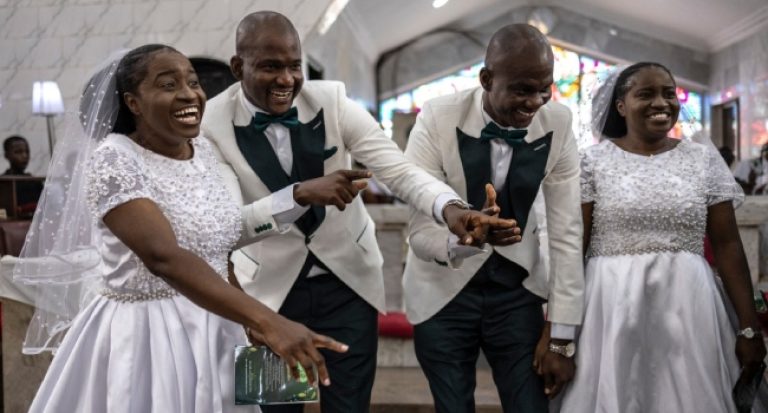
Two brides, both in the same white dress. Two grooms, both in matching suits and bowties. Two sets of twins working as page boys and flower girls. Posters huge of two couples with the same names. Even the wedding hashtag — #TwinningInLove2026 — didn’t do much to clear up the uncertainty.
Twin sisters Taiwo and Kehinde Adediran walked down the aisle of a church in Ibadan, southwestern Nigeria, arm-in-arm with their father, to marry twin brothers Taiwo and Kehinde Oguntoye. Guests stood up from their seats, pulling out smartphones to record what many called a once-in-a-lifetime wedding.
Twins marrying twins? Seriously? “I’ve never seen this before!” yelled a passerby outside the church as crowds crowded around the newlyweds for photos following the ceremony.
Channels TV adds that for many in attendance, the union of Taiwo and Kehinde with Taiwo and Kehinde seemed almost too flawlessly symmetrical to be genuine.
“We have always wanted to get married together and to get married to twins,” said Taiwo Oguntoye, beaming after the ceremony. And everything came to pass by the particular grace of God. I can’t wait to marry the love of my life! ”
The time When Taiwo and Kehinde met Taiwo and Kehinde
In both cases, the twins originated from Ibadan, where twin births occur with more frequency than typical.
The Oguntoye Twins, as they are often called in the area, have made promoting twin culture a career.
They are involved in tourism and cultural activities, founders of Twins World Creations and initiators of Twin Tourism, commemorating the region’s twins.
Their love tale began years ago when a professor at the University of Ibadan told the brothers she knew twin sisters that they should meet.
The four became friends, but when the brothers recommended taking the relationship to the next level, the sisters were not convinced.
“We said no, we don’t want to date twins!” bride Kehinde Adediran said, laughing.
The friendship died. Years later, the brothers made contact again.
The answer was different this time.
In the Yoruba tradition, twins have a special importance.
The customary names of the first-born twin are Taiwo and the second-born Kehinde, regardless of gender.
Twins are often seen wearing matching clothes from childhood, sometimes with matching shoes, jewellery and accessories.
That sense of twinning informed every moment of the wedding weekend.
The grooms’ families gave the brides mounds of gifts, from yams and drinks to textiles and suitcases, at Friday’s customary engagement ritual, where the couples dressed in matching red clothes and relatives danced around the gifts.
The wedding photographs were posed with care and the look-alike siblings, in their early forties, had visitors stopping time and time again to compare them.
Fraternal twins are the Oguntoye brothers, identical twins are the Adediran sisters.
The party continued Saturday with a large Yoruba “owambe” banquet after the church pews.
Smoke machines poured out of the entryway as the couples appeared via flashing lights to shouts and a sea of raised iPhones.
There were dozens of other twins among the attendees.
“I’ve always wanted to marry a twin too,” chuckled Kehinde Akanji, 26, a friend of the grooms who came with his twin brother. “This is the first time we’ve seen something like this.”
For Dupe Aduroja Giwa, the Alaga, the master of ceremonies at the traditional wedding, a lifetime of weddings had not prepared her for this one.
“Twins from the same family marrying twins from the same family?” she remarked. “I’ve never seen this in my life. “It’s a privilege to be a part of it.
It’s not everyday that one Taiwo marries another Taiwo and one Kehinde marries another Kehinde after all.
About the Author