
Retired military officers, human rights advocates, attorneys, and other worried Nigerians are upset that the federal government is letting terrorists who have changed their minds back into society after six months of de-radicalization and vocational training.
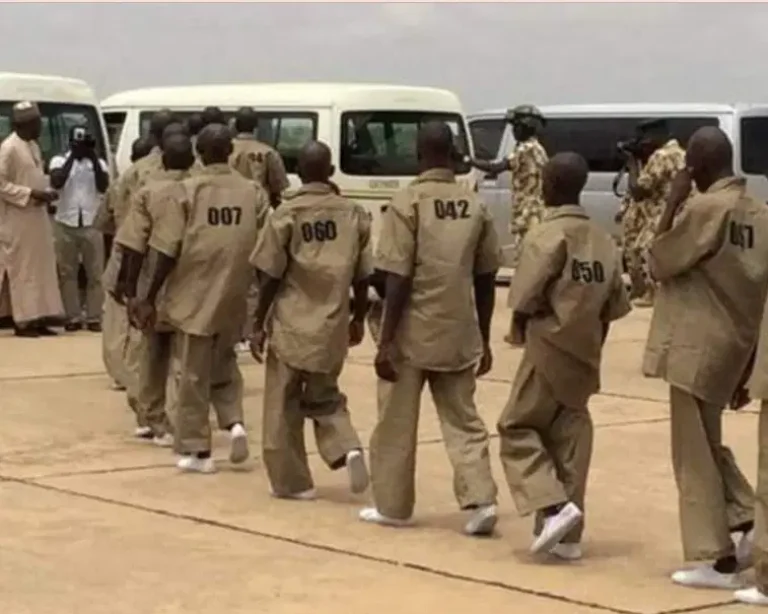
According to Saturday Vanguard, the government said last Thursday that 744 former terrorists would be reintegrated after they graduated from the De-radicalisation, Rehabilitation, and Reintegration Camp as part of Operation Safe Corridor.
The military called the exercise a strategic move to stop radicalism, but many Nigerians have cautioned that it could be a way for terrorists to gather information, get into security agencies, and avoid punishment.
The 744 people who benefited, mostly from the North-East, with 597 from Borno State alone, went through months of rehabilitation that included vocational training, civic education, religious reorientation, and psychosocial therapy.
There were also people from Niger, Chad, Cameroon, and Burkina Faso who were not Nigerian. This shows that the insurgency Nigeria has been fighting for more than ten years is not limited to Nigeria.
But there was a flood of criticism of the policy right after the study came out.
“Deradicalized or just not interested?””– Rear Admiral Olisemelogor
Rear Admiral Dickson Olisemelogor, a former navy commander, made some of the most organized complaints. He made a clear contrast between disengagement and actual de-radicalization and warned that the program may be a way to acquire intelligence and get into security agencies.
He said, “The idea of bringing back de-radicalized deviants into society is good.” But what I observe in our case is not deradicalization but disengagement. The lads are taken out of their groups and put in touch with different government agencies to help them feel better, but this doesn’t help them deal with the reasons for their anger. This is a tremendous error for me.
“Deradicalization” means changing someone’s beliefs, and it has to be seen over time that the person has really changed. Also, the person’s problems, such being unemployed, having a land dispute, or being religiously intolerant, need to be dealt with. In my opinion, most of the so-called repentant Boko Haram youngsters are not de-radicalized since they only come out when the military is putting pressure on them or when they are hungry. Some are sent on purpose to gather information and get into security agencies. This is why they go back to their previous gang or start a new one when they get the chance. People who have joined our security agency have been known to secretly turn against their unit during operations or even go away to start kidnapping organizations.
To change the story, he suggested the following actions: “The Federal and state governments should work with the National Orientation Agency to execute proper grassroots awareness campaigns in the North. Musicians and religious figures who are not radical could be used to speak out against extreme ideas.
“Make it mandatory for all media outlets in the afflicted states (radio and TV) to teach and win over the people by using Hausa and Arabic. They could use radio waves like the BBC does.
“Make sure that all religious leaders in mosques and churches understand the idea of national security and pass it on to their followers. Also, use public-private partnerships to bring back industry to the North so that the many unemployed young people can find work.”
We said bad things about it—Serving Major General
A Major General who was on duty and spoke anonymously said, “I was one of those who criticized the so-called ‘safe corridor.’ I didn’t really get it.” How would they fit in? The Air Force recently struck Jilli market, which was a supply hub for Boko Haram. Terrorists came out in the open to buy food and gas. They are part of a community. After all that, you want to bring them back into the society where they used to be?
“Some people don’t even get the ideology; they just like Boko Haram.” To be honest, some of our higher-ups even agree with them. “They have gotten into the system.”
He went even further and questioned the basic basis of the Nigerian state: “I have worked as a defense attaché in various nations, and I have come back to realize that Nigeria is not a nation. We are just a bunch of folks that have to get along. A Yoruba man never likes a Hausa man. Some Yoruba don’t try to hide how much they don’t like the Igbos. What do the Hausa and the Niger Delta have in common? Not a thing! At one point, the military was told directly not to block Chadian civilians from coming into Nigeria with cows. Can you believe that?”
Amb. says it’s wrong. Mary Abyomi-Fatile
Ambassador Mary Abyomi-Fatile, who is in charge of Prayer and Support for the Nigerian Armed Forces and other security agencies, had a strong opinion.
She said clearly, “I do not support the Operation Safe Corridor approach.” I think it’s absolutely wrong. We haven’t completed dealing with the people who are making our country unsafe, but we’re trying to bring back criminals who say they’re sincerely sorry or who may just be pretending to be sorry for their own gain.
“There has to be a cost for these kinds of crimes.” If the price isn’t high enough, people will regard it as a way to get around the rules instead of a warning. Justice ought to be clear and strong; else, what will stop the next person from joining?”
It is not fair to the people who died, according to a businesswoman from Kano.
A businesswoman from Kano named Aminat Saudi, who said terrorists killed six of her family members in Borno state, questioned the program’s moral balance.
She remarked, “No one is talking about the victims of their evil act, other than the fear that this repentant approach could be part of the terrorists’ plan to get into parts of the economy.”
“What happens to the relatives of the people who were slain by the terrorists who say they are sorry? What happens to the people who lost their homes, farms, and pieces of their bodies? Who pays back the ransom that victims of these so-called “repentant terrorists” paid? People will only regard the Safe Corridor idea as being sympathetic to terrorists unless these points are answered.
Be careful and honest when you approach Nwagunma.
Okechukwu Nwagunma, a human rights activist, put the matter in a larger moral context by asking, “Can a nation heal without accountability?”He noted that the federal government’s plan to reintegrate former Boko Haram members who have been de-radicalized is a difficult and delicate matter that needs to be handled with care, openness, and a strong sense of justice and accountability.
He said that “in principle, deradicalization and reintegration are accepted parts of modern counterinsurgency strategies.” Programs that encourage people to defect, stop being violent, and get better can help weaken insurgent groups, break cycles of violence, and promote long-term stability around the world. So the notion itself isn’t wrong in and of itself. But in Nigeria, there are many important issues that need to be addressed. The first is justice and accountability. Many people who have been hurt by Boko Haram, as well as the families of those who have been killed, kidnapped, or forced to leave their homes, feel left out when former combatants are brought back into society without clear ways to hold them accountable. Reintegration must not lead to a lack of accountability. There should be a clear system that tells the difference between people who committed serious crimes and others who were forced to do so or did not take part in fighting. When necessary, there should be legal penalties.
“Second, not being clear. People have said bad things about programs like Operation Safe Corridor because they don’t get enough public scrutiny. People who move into these communities typically don’t have enough information or input, which makes them scared, angry, and untrusting. Reintegration won’t work unless the community agrees to it.
“Third, risks to security and recidivism.” There have been allegations and suspicions, whether completely proven or not, that some “rehabilitated” people would go back to their old ways or operate as informants for rebel groups. This shows how important it is to do thorough risk assessments, keep an eye on things, and give help after reintegration.
“Fourth, ignoring victims. People think that there is an unfair situation where ex-combatants get rehabilitation packages, but victims, especially internally displaced people, are still living in terrible conditions with little help. This creates a moral and policy conflict that makes people less likely to trust the program.
“Fifth, challenges to reintegration in the community. For successful reintegration, there needs to be organized psychosocial assistance, job opportunities, and ongoing interaction with the communities that welcome them. Without these, efforts to reintegrate could make tensions in the area worse instead than helping people get along.
What needs to be done?
Nwagunma says that “the government needs to anchor reintegration efforts within a broader transitional justice framework, one that includes truth-telling, reparations for victims, community dialogue, and accountability mechanisms.” There should also be independent control, which may include civil society, to make sure everything is honest and open.
“Reintegration can help stop an insurgency, but in Nigeria, it only works if it combines the need for security with the need for justice for victims, openness, and trust in the community. He said, “Without these, the program could be seen as a reward for violence instead of a way to peace.”
Reintegration of terrorists is a major hoax, says a lawyer who is threatening to sue.
Dr. Maxwell Opara, a legal expert, has promised to go to federal court to stop the Federal Government’s program to de-radicalize, rehabilitate, and reintegrate terrorists. He calls the release of 744 former insurgents back into society the “epitome of fraud” and a mockery of the justice system and the victims of terrorism.
Opara said this yesterday on Arise TV’s morning show, which was watched in Abuja. He was responding to the graduation of 744 former terrorists and victims of violent extremism from the Federal Government’s Operation Safe Corridor camp in Gombe, where they had reportedly received 24 weeks of vocational training.
“I will be going to a federal high court next week to put an end to this craziness.” He said, “We can’t keep going like this.”
Opara said that the program, which is based on a United Nations framework, goes against the basic rules of Nigerian law. These rules say that people who fulfill the right criteria must be investigated, prosecuted, convicted, and then given the chance to be pardoned by the president.
“Our laws are there once a crime is committed.” He remarked, “Once you are investigated, you will be charged to court.” He also said that coercion is not a valid defense for an adult who commits a crime.
He remarked that the victims’ agony and the high cost of their lives are very different from the way criminals are treated.
“I have a client who accidentally killed someone during a fight. That young woman has been in Suleja Prison for more than 25 years, as I write this. Then, there was a person, a specific citizen, who fired everyone in a town in the name of terrorism. After six months, they told us they had changed their minds and would be rejoining society.
“Which community?” The community that no longer exists. So, who got them? The folks who are already living in the IDP camp. “The victims of this terrorist act are still in the IDP camp, and instead of thinking about how to help them, you are using our hard-earned money to help criminals,” he stated.
He didn’t believe the Defence Headquarters’ claim that most of those freed were forced into terrorism, and he warned that the program was establishing a bad legal example. “When they force you into crime, convince you to do it, or pay you to do it, that should not be a defense once you are an adult and commit a crime.” He remarked, “I am telling you this on national television: this thing is a perfect example of fraud.”
Opara also told the Defense Headquarters to present statistics that proves the initiative, which started during the late Muhammadu Buhari administration, had indeed cut down on terrorism.
“I challenge the Chief of Defence Staff’s representative: since you used this method in Nigeria, tell us what the rate of terrorism was when you started it and what it is now.” “This is a way for the government to get people to become terrorists,” Opara remarked.
He also told the Economic and Financial Crimes Commission (EFCC) to look into the money spent on the initiative, saying that the cycle will only start over again.
“After this one, they will get another budget in the next six months. I want the EFCC to look into how much money was spent on this silly process. How many people in the whole federation are suspected of being terrorists? How many are in Abuja? How many people are in DSS cells? Do you do this with all of them now?”Why?” he asked.
Opara noted that the fact that eight foreign people were among those released, including natives of Burkina Faso, Cameroon, Chad, and Niger Republic, just made him more worried about the program’s legality and direction.
Opara said that the UN resolution is only an advisory and not automatically binding on sovereign states. This is because the program’s supporters, including the UN framework it is based on, say that prosecution alone is not enough to stop re-radicalization and that criminal justice systems can be overwhelmed by the sheer number of terrorism suspects.
“The resolution from the United Nations is not binding. When you have the resolution, you think about your own situation and your own law. He said, “You don’t do the right thing at the wrong time.”
He said that the quick prosecution of Hamisu Wadume, who helped fund Boko Haram, should be used as a model. “Why don’t you follow it the same way you did Nnamdi Kanu? In just two months, they finished the trial, found him guilty, and gave him a sentence. What happened to these guys that made Nigeria the fourth most dangerous country in the world for terrorism?”he inquired.
Concerned Nigerians say it’s not fair to put the welfare of former terrorists first.
Other concerned parties also spoke out against bringing back repentant terrorists into society, saying that it is wrong to put their needs ahead of those of their victims. Some people said that the decision would hurt the morale of soldiers who are already risking their lives every day to fight terrorists.
It will set a bad example, according to Elder Sunday Oibe, Chairman of the Northern States Christian Elders Forum (NOSCEF).
“Giving rewards to people who have fought against the state sends the wrong message to people who follow the law and victims of violence. How can one explain a system in which terrorists are rewarded while seeming to be sorry? What do innocent Nigerians, including soldiers, get for their deaths? Such behaviors could set a harmful example, making it more likely that other people will commit crimes in the hopes of getting better and getting advantages later. If the government lets this happen, it could lead to more people becoming terrorists in the hopes of getting a job later. It is wrong to reward people who have killed, hurt, and damaged property when the victims, such as widows, orphans, and communities that have been harmed, are allowed to suffer. The federal government should think again about any such plan and put the needs of victims, holding offenders accountable, and measures that improve national security and public trust first.
Northern Youths kick, saying it might make things worse for safety.
The Northern Youth Council of Nigeria (NYCN) also strongly disagrees with the Federal Government’s plan to bring former terrorists back into society. Isah Abubakar, the National President, stated in a statement, “Putting the rehabilitation and reintegration of former fighters ahead of justice and compensation for victims hurts trust and could make things less safe.” It’s good that people are working to make peace, but they shouldn’t do it at the expense of justice for victims. Families who have lost loved ones and jobs deserve to be recognized, helped, and paid back. The Federal Government needs to quickly look over the strategy. Any effort to deradicalize people must be matched with a fair justice system and full support for victims of terrorism. Sustainable peace can only be attained when the welfare and rights of victims are prioritized equally with reconciliation initiatives. We ask that authorities involve important groups, such as affected communities and civil society organizations, in making policies that support justice, healing, and long-term stability.
Mr. Walsh says it’s dangerous to bring back former terrorists.
Mr. Damien Walsh, a 49-year-old farmer from Barkin Ladi, says, “It is risky to bring these people back to society.” These people have done terrible things to the state and its citizens. They should not be allowed to go back to their old lives; instead, they should be punished for what they did. “I don’t think it’s a good idea.”
Mrs. Yilkur says it’s not fair to put the welfare of former terrorists first.
Mrs. Alice Yilkur, a 43-year-old trader, says, “The decision is not wise at all.” The government should support the victims who have been hurt the most before they consider about helping the killers. It is not right to put the needs of former terrorists ahead of the needs of innocent families who are still dealing with the agony and loss that their acts inflicted. This isn’t fair at all. Bringing back these terrorists who have changed their minds could put communities at risk of further attacks and make people who have already been through so much even more scared.
Joseph Ambakederimo said this is not right.
Joseph Ambakederimo, the head of the South South Reawakening Group, said in response, “This is not right.” I don’t think the government’s plan to deradicalize and reintegrate people is the right way to stop the rise of terrorism. Even before he became minister, General Christopher Musa (retd), who is currently the Minister of Defence, was very clear about what he thought about deradicalization and reintegration.
The Chief of Army Staff, on the other hand, is happy with the policy. This means that the two individuals are completely against each other when it comes to fighting terrorism in the country. So, one would wonder: what is this administration’s main goal in the war against terrorism? It already looks like there isn’t a clear plan to fight this threat, and if that’s the case, we have a long way to go.
Reintegration of terrorists in order—Comrade Ekujumi
Comrade Nelson Ekujumi, the Coordinator of the Coalition for Good Governance (CGG), said, “The rehabilitation of repentant terrorists is a good thing because it will help attract and depopulate the foot soldiers of the terrorists. These are people who may have been forced or tricked into joining the evil group and have seen the damage it has done to humanity. They have decided to turn their backs on the evil agenda by repenting and surrendering.” If they see that there is a chance for real repentant terrorists to get help and get back into society, it could encourage people who want to stop being terrorists and lower the number of people who are committing terrorism, which is a crime against humanity. I fully support the rehabilitation of repentant terrorists, as they may serve as valuable assets for comprehending and integrating the dynamics, mindset, and ideology prevalent in terrorist camps, so facilitating the formulation of a comprehensive strategy to combat and mitigate terrorism.
It makes fun of the victims, according to Chief Iorbee Ihagh, Chairman of Benue State tribal chiefs.
Chief Iorbee Ihagh, who is the President General of Mzough U Tiv, MUT, globally, and the Chairman of Benue State tribal chiefs, said that the development was not acceptable. Chief Ihagh said that the decision could be political by saying, “This is another plot to help them with the 2027 election.” If it isn’t, how do you explain that those who have killed our loved ones and destroyed our communities be forgiven and let back into society? What kind of government will do that?These criminals should go to jail for what they did wrong, not be let back into society. We can’t live with people who killed our people and made them live in IDP camps.
“It’s not okay, and it should be condemned. The policy makes fun of people who have been dealt with by these so-called repentant gangs. Retired military officers, human rights activists, lawyers, and other concerned Nigerians have spoken out against the federal government’s decision to let repentant terrorists back into society after six months of de-radicalization and vocational training.
According to Saturday Vanguard, the government said last Thursday that 744 former terrorists will be brought back into society when they graduate from the De-radicalisation, Rehabilitation, and Reintegration Camp as part of Operation Safe Corridor.
The military called the exercise a strategic move to break up radicalism, but many Nigerians have said that it could be a way for insurgents to gather information, get into security agencies, and avoid punishment.
The 744 people who benefited, mostly from the North-East, with 597 from Borno State alone, went through months of rehabilitation that included vocational training, civic education, religious reorientation, and psychosocial therapy.
There were also people from Niger, Chad, Cameroon, and Burkina Faso who were not Nigerian. This shows that the insurgency Nigeria has been fighting for more than ten years is not limited to Nigeria.
But there was a flood of criticism of the policy right after the study came out.
“Deradicalized or just not interested?””– Rear Admiral Olisemelogor
Rear Admiral Dickson Olisemelogor, a former navy commander, made some of the most organized complaints. He made a clear contrast between disengagement and actual de-radicalization and warned that the program may be a way to acquire intelligence and get into security agencies.
He said, “The idea of bringing back de-radicalized deviants into society is good.” But what I observe in our case is not deradicalization but disengagement. The lads are taken out of their groups and put in touch with different government agencies to help them feel better, but this doesn’t help them deal with the reasons for their anger. This is a tremendous error for me.
“Deradicalization” means changing someone’s beliefs, and it has to be seen over time that the person has really changed. Also, the person’s problems, such being unemployed, having a land dispute, or being religiously intolerant, need to be dealt with. In my opinion, most of the so-called repentant Boko Haram youngsters are not de-radicalized since they only come out when the military is putting pressure on them or when they are hungry. Some are sent on purpose to gather information and get into security agencies. This is why they go back to their previous gang or start a new one when they get the chance. People who have joined our security agency have been known to secretly turn against their unit during operations or even go away to start kidnapping organizations.
To change the story, he suggested the following actions: “The Federal and state governments should work with the National Orientation Agency to execute proper grassroots awareness campaigns in the North. Musicians and religious figures who are not radical could be used to speak out against extreme ideas.
“Make it mandatory for all media outlets in the afflicted states (radio and TV) to teach and win over the people by using Hausa and Arabic. They could use radio waves like the BBC does.
“Make sure that all religious leaders in mosques and churches understand the idea of national security and pass it on to their followers. Also, use public-private partnerships to bring back industry to the North so that the many unemployed young people can find work.”
We said bad things about it—Serving Major General
A Major General who was on duty and spoke anonymously said, “I was one of those who criticized the so-called ‘safe corridor.’ I didn’t really get it.” How would they fit in? The Air Force recently struck Jilli market, which was a supply hub for Boko Haram. Terrorists came out in the open to buy food and gas. They are part of a community. After all that, you want to bring them back into the society where they used to be?
“Some people don’t even get the ideology; they just like Boko Haram.” To be honest, some of our higher-ups even agree with them. “They have gotten into the system.”
He went even further and questioned the basic basis of the Nigerian state: “I have worked as a defense attaché in various nations, and I have come back to realize that Nigeria is not a nation. We are just a bunch of folks that have to get along. A Yoruba man never likes a Hausa man. Some Yoruba don’t try to hide how much they don’t like the Igbos. What do the Hausa and the Niger Delta have in common? Not a thing! At one point, the military was told directly not to block Chadian civilians from coming into Nigeria with cows. Can you believe that?”
Amb. says it’s wrong. Mary Abyomi-Fatile
Ambassador Mary Abyomi-Fatile, who is in charge of Prayer and Support for the Nigerian Armed Forces and other security agencies, had a strong opinion.
She said clearly, “I do not support the Operation Safe Corridor approach.” I think it’s absolutely wrong. We haven’t completed dealing with the people who are making our country unsafe, but we’re trying to bring back criminals who say they’re sincerely sorry or who may just be pretending to be sorry for their own gain.
“There has to be a cost for these kinds of crimes.” If the price isn’t high enough, people will regard it as a way to get around the rules instead of a warning. Justice ought to be clear and strong; else, what will stop the next person from joining?”
It is not fair to the people who died, according to a businesswoman from Kano.
A businesswoman from Kano named Aminat Saudi, who said terrorists killed six of her family members in Borno state, questioned the program’s moral balance.
She remarked, “No one is talking about the victims of their evil act, other than the fear that this repentant approach could be part of the terrorists’ plan to get into parts of the economy.”
“What happens to the relatives of the people who were slain by the terrorists who say they are sorry? What happens to the people who lost their homes, farms, and pieces of their bodies? Who pays back the ransom that victims of these so-called “repentant terrorists” paid? People will only regard the Safe Corridor idea as being sympathetic to terrorists unless these points are answered.
Be careful and honest when you approach Nwagunma.
Okechukwu Nwagunma, a human rights activist, put the matter in a larger moral context by asking, “Can a nation heal without accountability?”He noted that the federal government’s plan to reintegrate former Boko Haram members who have been de-radicalized is a difficult and delicate matter that needs to be handled with care, openness, and a strong sense of justice and accountability.
He said that “in principle, deradicalization and reintegration are accepted parts of modern counterinsurgency strategies.” Programs that encourage people to defect, stop being violent, and get better can help weaken insurgent groups, break cycles of violence, and promote long-term stability around the world. So the notion itself isn’t wrong in and of itself. But in Nigeria, there are many important issues that need to be addressed. The first is justice and accountability. Many people who have been hurt by Boko Haram, as well as the families of those who have been killed, kidnapped, or forced to leave their homes, feel left out when former combatants are brought back into society without clear ways to hold them accountable. Reintegration must not lead to a lack of accountability. There should be a clear system that tells the difference between people who committed serious crimes and others who were forced to do so or did not take part in fighting. When necessary, there should be legal penalties.
“Second, not being clear. People have said bad things about programs like Operation Safe Corridor because they don’t get enough public scrutiny. People who move into these communities typically don’t have enough information or input, which makes them scared, angry, and untrusting. Reintegration won’t work unless the community agrees to it.
“Third, risks to security and recidivism.” There have been allegations and suspicions, whether completely proven or not, that some “rehabilitated” people would go back to their old ways or operate as informants for rebel groups. This shows how important it is to do thorough risk assessments, keep an eye on things, and give help after reintegration.
“Fourth, ignoring victims. People think that there is an unfair situation where ex-combatants get rehabilitation packages, but victims, especially internally displaced people, are still living in terrible conditions with little help. This creates a moral and policy conflict that makes people less likely to trust the program.
“Fifth, challenges to reintegration in the community. For successful reintegration, there needs to be organized psychosocial assistance, job opportunities, and ongoing interaction with the communities that welcome them. Without these, efforts to reintegrate could make tensions in the area worse instead than helping people get along.
What needs to be done?
Nwagunma says that “the government needs to anchor reintegration efforts within a broader transitional justice framework, one that includes truth-telling, reparations for victims, community dialogue, and accountability mechanisms.” There should also be independent control, which may include civil society, to make sure everything is honest and open.
“Reintegration can help stop an insurgency, but in Nigeria, it only works if it combines the need for security with the need for justice for victims, openness, and trust in the community. He said, “Without these, the program could be seen as a reward for violence instead of a way to peace.”
Reintegration of terrorists is a major hoax, says a lawyer who is threatening to sue.
Dr. Maxwell Opara, a legal expert, has promised to go to federal court to stop the Federal Government’s program to de-radicalize, rehabilitate, and reintegrate terrorists. He calls the release of 744 former insurgents back into society the “epitome of fraud” and a mockery of the justice system and the victims of terrorism.
Opara said this yesterday on Arise TV’s morning show, which was watched in Abuja. He was responding to the graduation of 744 former terrorists and victims of violent extremism from the Federal Government’s Operation Safe Corridor camp in Gombe, where they had reportedly received 24 weeks of vocational training.
“I will be going to a federal high court next week to put an end to this craziness.” He said, “We can’t keep going like this.”
Opara said that the program, which is based on a United Nations framework, goes against the basic rules of Nigerian law. These rules say that people who fulfill the right criteria must be investigated, prosecuted, convicted, and then given the chance to be pardoned by the president.
“Our laws are there once a crime is committed.” He remarked, “Once you are investigated, you will be charged to court.” He also said that coercion is not a valid defense for an adult who commits a crime.
He remarked that the victims’ agony and the high cost of their lives are very different from the way criminals are treated.
“I have a client who accidentally killed someone during a fight. That young woman has been in Suleja Prison for more than 25 years, as I write this. Then, there was a person, a specific citizen, who fired everyone in a town in the name of terrorism. After six months, they told us they had changed their minds and would be rejoining society.
“Which community?” The community that no longer exists. So, who got them? The folks who are already living in the IDP camp. “The victims of this terrorist act are still in the IDP camp, and instead of thinking about how to help them, you are using our hard-earned money to help criminals,” he stated.
He didn’t believe the Defence Headquarters’ claim that most of those freed were forced into terrorism, and he warned that the program was establishing a bad legal example. “When they force you into crime, convince you to do it, or pay you to do it, that should not be a defense once you are an adult and commit a crime.” He remarked, “I am telling you this on national television: this thing is a perfect example of fraud.”
Opara also told the Defense Headquarters to present statistics that proves the initiative, which started during the late Muhammadu Buhari administration, had indeed cut down on terrorism.
“I challenge the Chief of Defence Staff’s representative: since you used this method in Nigeria, tell us what the rate of terrorism was when you started it and what it is now.” “This is a way for the government to get people to become terrorists,” Opara remarked.
He also told the Economic and Financial Crimes Commission (EFCC) to look into the money spent on the initiative, saying that the cycle will only start over again.
“After this one, they will get another budget in the next six months. I want the EFCC to look into how much money was spent on this silly process. How many people in the whole federation are suspected of being terrorists? How many are in Abuja? How many people are in DSS cells? Do you do this with all of them now?”Why?” he asked.
Opara noted that the fact that eight foreign people were among those released, including natives of Burkina Faso, Cameroon, Chad, and Niger Republic, just made him more worried about the program’s legality and direction.
Opara said that the UN resolution is only an advisory and not automatically binding on sovereign states. This is because the program’s supporters, including the UN framework it is based on, say that prosecution alone is not enough to stop re-radicalization and that criminal justice systems can be overwhelmed by the sheer number of terrorism suspects.
“The resolution from the United Nations is not binding. When you have the resolution, you think about your own situation and your own law. He said, “You don’t do the right thing at the wrong time.”
He said that the quick prosecution of Hamisu Wadume, who helped fund Boko Haram, should be used as a model. “Why don’t you follow it the same way you did Nnamdi Kanu? In just two months, they finished the trial, found him guilty, and gave him a sentence. What happened to these guys that made Nigeria the fourth most dangerous country in the world for terrorism?”he inquired.
Concerned Nigerians say it’s not fair to put the welfare of former terrorists first.
Other concerned parties also spoke out against bringing back repentant terrorists into society, saying that it is wrong to put their needs ahead of those of their victims. Some people said that the decision would hurt the morale of soldiers who are already risking their lives every day to fight terrorists.
It will set a bad example, according to Elder Sunday Oibe, Chairman of the Northern States Christian Elders Forum (NOSCEF).
“Giving rewards to people who have fought against the state sends the wrong message to people who follow the law and victims of violence. How can one explain a system in which terrorists are rewarded while seeming to be sorry? What do innocent Nigerians, including soldiers, get for their deaths? Such behaviors could set a harmful example, making it more likely that other people will commit crimes in the hopes of getting better and getting advantages later. If the government lets this happen, it could lead to more people becoming terrorists in the hopes of getting a job later. It is wrong to reward people who have killed, hurt, and damaged property when the victims, such as widows, orphans, and communities that have been harmed, are allowed to suffer. The federal government should think again about any such plan and put the needs of victims, holding offenders accountable, and measures that improve national security and public trust first.
Northern Youths kick, saying it might make things worse for safety.
The Northern Youth Council of Nigeria (NYCN) also strongly disagrees with the Federal Government’s plan to bring former terrorists back into society. Isah Abubakar, the National President, stated in a statement, “Putting the rehabilitation and reintegration of former fighters ahead of justice and compensation for victims hurts trust and could make things less safe.” It’s good that people are working to make peace, but they shouldn’t do it at the expense of justice for victims. Families who have lost loved ones and jobs deserve to be recognized, helped, and paid back. The Federal Government needs to quickly look over the strategy. Any effort to deradicalize people must be matched with a fair justice system and full support for victims of terrorism. Sustainable peace can only be attained when the welfare and rights of victims are prioritized equally with reconciliation initiatives. We ask that authorities involve important groups, such as affected communities and civil society organizations, in making policies that support justice, healing, and long-term stability.
Mr. Walsh says it’s dangerous to bring back former terrorists.
Mr. Damien Walsh, a 49-year-old farmer from Barkin Ladi, says, “It is risky to bring these people back to society.” These people have done terrible things to the state and its citizens. They should not be allowed to go back to their old lives; instead, they should be punished for what they did. “I don’t think it’s a good idea.”
Mrs. Yilkur says it’s not fair to put the welfare of former terrorists first.
Mrs. Alice Yilkur, a 43-year-old trader, says, “The decision is not wise at all.” The government should support the victims who have been hurt the most before they consider about helping the killers. It is not right to put the needs of former terrorists ahead of the needs of innocent families who are still dealing with the agony and loss that their acts inflicted. This isn’t fair at all. Bringing back these terrorists who have changed their minds could put communities at risk of further attacks and make people who have already been through so much even more scared.
Joseph Ambakederimo said this is not right.
Joseph Ambakederimo, the head of the South South Reawakening Group, said in response, “This is not right.” I don’t think the government’s plan to deradicalize and reintegrate people is the right way to stop the rise of terrorism. Even before he became minister, General Christopher Musa (retd), who is currently the Minister of Defence, was very clear about what he thought about deradicalization and reintegration.
The Chief of Army Staff, on the other hand, is happy with the policy. This means that the two individuals are completely against each other when it comes to fighting terrorism in the country. So, one would wonder: what is this administration’s main goal in the war against terrorism? It already looks like there isn’t a clear plan to fight this threat, and if that’s the case, we have a long way to go.
Reintegration of terrorists in order—Comrade Ekujumi
Comrade Nelson Ekujumi, the Coordinator of the Coalition for Good Governance (CGG), said, “The rehabilitation of repentant terrorists is a good thing because it will help attract and depopulate the foot soldiers of the terrorists. These are people who may have been forced or tricked into joining the evil group and have seen the damage it has done to humanity. They have decided to turn their backs on the evil agenda by repenting and surrendering.” If they see that there is a chance for real repentant terrorists to get help and get back into society, it could encourage people who want to stop being terrorists and lower the number of people who are committing terrorism, which is a crime against humanity. I fully support the rehabilitation of repentant terrorists, as they may serve as valuable assets for comprehending and integrating the dynamics, mindset, and ideology prevalent in terrorist camps, so facilitating the formulation of a comprehensive strategy to combat and mitigate terrorism.
It makes fun of the victims, according to Chief Iorbee Ihagh, Chairman of Benue State tribal chiefs.
Chief Iorbee Ihagh, who is the President General of Mzough U Tiv, MUT, globally, and the Chairman of Benue State tribal chiefs, said that the development was not acceptable. Chief Ihagh said that the decision could be political by saying, “This is another plot to help them with the 2027 election.” If it isn’t, how do you explain that those who have killed our loved ones and destroyed our communities be forgiven and let back into society? What kind of government will do that?These criminals should go to jail for what they did wrong, not be let back into society. We can’t live with people who killed our people and made them live in IDP camps.
“It is not appropriate and it is wrong. It is a policy that makes fun of people who have been dealt with by these so-called repentant gangs.
About the Author