
Health officials have started giving out a lot of vaccines to fight an Ebola “crisis” that has made people afraid of a pandemic.
The World Health Organization (WHO) stated on Sunday that persons who have been exposed to the Ebola virus and front-line health workers in the Kasai province of the Democratic Republic of the Congo (DRC) are being provided vaccinations.
There aren’t enough immunizations to go around since the number of Ebola cases has more than doubled in the past week, going from 28 to 68.
At least 16 people have died in the outbreak, which was formally proclaimed earlier this month. Four of them were healthcare workers.
In Bulape, which is currently an Ebola hotspot in the Kasai province, 400 doses of the FDA-approved Ervebo vaccine have been sent out. The vaccine is only given during outbreaks.
The WHO indicated that the rest will be supplied in the next several days.
The WHO’s International Coordinating Group on Vaccine Provision has given the DRC an extra 45,000 vaccinations, bringing its total to 2,000.
Treatment courses of the monoclonal antibody therapy medication Mab114 have also been provided to Bulape treatment institutions. The medicine, which is also known as Ebanga, targets glycoprotein, the protein that lets the Ebola virus infect cells. It stops the virus from connecting to host cells and making copies of itself.
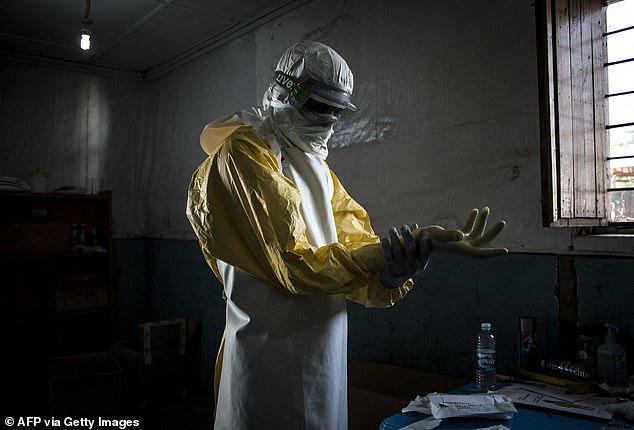
During the 2018 Ebola outbreak in the Democratic Republic of the Congo (DRC), a healthcare worker is shown putting on protective gear before checking on patients.
In the Democratic Republic of the Congo in 2019, a healthcare worker is shown loading a syringe with an Ebola vaccination. Vaccines are not usually available to the public and are only utilized when there is an outbreak.
The World Health Organization (WHO) said in a statement, “The Ervebo vaccine is safe and protects against the Zaire ebolavirus species, which has been confirmed as the cause of the ongoing outbreak.”
Ebola has been in the DRC since 1976. This is the 16th outbreak in the country and the seventh in Kasai province.
In 2018 and 2020, there were outbreaks in eastern Congo that killed more than 1,000 individuals each.
The biggest outbreak of Ebola was in West Africa from 2014 to 2016, when more than 28,600 cases were documented.
“It’s a crisis, and cases are multiplying,” Francois Mingambengele, the administrator of the Mweka area, which contains Bulape, told Reuters earlier this month.
Ebola can spread through touching the blood or body fluids of an infected person, as well as through touching things or animals that are affected, such bats or primates.
A fever, headache, muscle discomfort and weakness, diarrhea, vomiting, abdominal pain, and unexplained bleeding or bruises are all signs of this illness.
Ebola can make you very sick, and without treatment, it can kill up to 90% of those who have it.
The Zaire ebolavirus species is to blame for the present outbreak. It kills between 36 and 90 percent of those who get it. It is the most frequent type of virulent ebolavirus, and it is assumed to spread from animals, probably bats, to people.
To stop the spread, some people have been put in jail. Local authorities have also set up many checkpoints along the border to keep people from entering or leaving the Kasai area.
A healthcare worker in the DRC is shown during the 2018 Ebola outbreak.
As concern over the Ebola pandemic “crisis” develops, towns are closed down and mass vaccinations are going on.
The two FDA-approved medicines for Ebola are Ebanga and Inmazeb, which is also a monoclonal antibody.
The World Health Organization said that the first confirmed case in the current outbreak in the DRC was a pregnant lady who went to Bulape General Reference Hospital on August 20 with a high fever, bloody stool, too much bleeding, and weakness.
Five days later, she died from organ failure, and tests on September 4 showed that she had Ebola.
In Uganda, there was another outbreak this year, with 12 confirmed cases, two suspected cases, and four deaths. In April, the outbreak was called off.
The outbreak was caused by the Sudan Virus, a rare virus that causes a very bad type of Ebola hemorrhagic fever.
In addition to the usual Ebola symptoms, it can also cause bleeding from the eyes, nose, gums, and other regions of the body, as well as organ failure and death.
Officials in New York thought that two patients at an urgent care center in Manhattan might have had Ebola earlier this year since they had just come back from Uganda, where there was an outbreak of the disease at the time.
Earlier this year, officials in New York thought that two people who went to an urgent care center in Manhattan might have had Ebola since they had just come back from Uganda, where there was an outbreak of the disease at the time.
In February of this year, two people in the US were thought to have Ebola. After showing signs of the sickness, patients were taken from an urgent care center in New York City to a hospital.
Officials thought the patients might have had Ebola because they had just come back from Uganda, where there was an outbreak at the time.
Later, it was verified that they did not have Ebola, but it was not made clear what ailment they did have.
In 2014, a guy from Liberia became the first person in the US to have a confirmed case of Ebola. He went to the US and started having symptoms that were similar to Ebola.
He was the first person in the US to get the disease after tests showed he had it on September 30, 2014. A week later, he died.
About the Author