
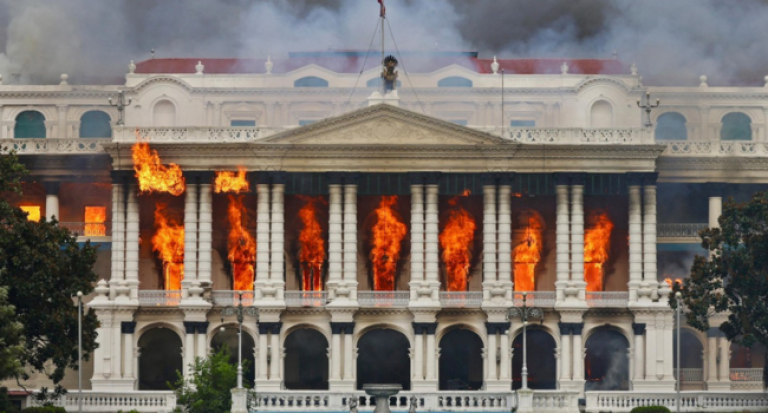
A “Gen Z” protest movement started by a ban on social media took over the Himalayan country of Nepal yesterday. Demonstrators set parliament on fire, and veteran Prime Minister Sharma Oli quit.
At least 19 people died during protests the day before, making it one of the worst crackdowns in years, according to AFP.
Yesterday, the streets of Kathmandu, the capital, were full of protesters. Some were happy and rejoicing, while others set fire to government buildings and waved automatic guns.
Many people were astonished by how quickly things fell apart, and Nepal’s military warned against “activities that could lead the country into unrest and instability” in the country of 30 million people.
Amnesty International says that protests started on Monday, with people calling for the government to repeal the ban on social media and fight corruption. Police tried to break up the protests, even using live ammunition.
Even after the government took back its decision and the applications came back online, protests started up again yesterday. They expanded from the capital to many other locations around the country.
Sudan Gurung, a key figure in the protests, wrote on Instagram, which has now come back online, “The Nepal government has fallen, the youth have won the protest.” “The future is ours.”
President Asks for “Restraint”
Gang members stormed and set fire to the house of KP Sharma Oli, the 73-year-old leader of the Communist Party and four-time prime minister. No one knows where he is.
Ekram Giri, a spokesman for the Parliament Secretariat, told our correspondent that demonstrators broke over the barrier and “torched the main building,” which sent up plumes of smoke over Nepal’s parliament.
President Ramchandra Paudel, whose offices were also set on fire by crowds, asked “all parties to exercise restraint, to not allow further damage.”
India, which lies next door, echoed the demand. Prime Minister Narendra Modi said, “The stability, peace, and prosperity of Nepal are very important to us.”
Volker Turk, the UN’s rights chief, said he was “appalled” by the violence and asked for negotiations.
It didn’t seem like such appeals were heard.
Reporters Without Borders (RSF) claimed that the headquarters of the Kantipur Media Group, a big publisher, was on fire and told “protesters not to target journalists.”
People who were protesting, largely young guys, were spotted waving the country’s flag while avoiding water cannons.
The International Crisis Group said it was a “major inflection point” in the country’s troubled history with democracy.
Rinji Sherpa, a spokesman for the airport, stated that Kathmandu’s airport is still open, but several flights were canceled because smoke from the flames made it hard to see.
“Gen Z Movement”
Oli wrote in his resignation letter that he had stood down to make “steps toward a political solution.”
His time in politics lasted about six decades. During that time, there was a civil war that lasted ten years. In 2008, Nepal became a republic and got rid of its absolute monarchy.
He was first elected prime minister in 2015, then again in 2018, and then again temporarily in 2021. In 2024, he took power when his Communist Party formed a coalition government with the center-left Nepali Congress in the often-volatile parliament.
It’s not obvious what will happen next.
Dipendra Jha, a constitutional lawyer, told our reporter that “the protesters, leaders they trust, and the army should work together to make way for a caretaker government.”
Ashish Pradhan, an analyst at the Crisis Group, agreed, adding that a “transitional arrangement will now need to be charted out swiftly and include figures who still retain credibility with Nepalis, especially the country’s youth.”
Balendra Shah, a 35-year-old engineer-turned-rapper who was elected mayor of Kathmandu in 2022, is a well-known figure in the transition ahead. He used Facebook to ask people to “be restrained.”
Shah stated when Oli stepped down, “We had made it clear: this is purely a Gen Z movement,” meaning that it was mostly made up of persons in their 20s.
“Your generation needs to take charge of running the country.” “Get ready!”
According to government data, people between the ages of 15 and 40 make up around 43% of the population. The World Bank says that unemployment is around 10% and GDP per capita is only $1,447.
On Friday, the authorities barred access to 26 unregistered platforms, including Facebook, YouTube, and X.
TikTok, which wasn’t restricted, has since seen films comparing the problems of regular Nepalis to the kids of politicians showing off their luxurious vacations and luxury items.
A 26-year-old protester who didn’t want to be named said, “This anger has been building for more than 20 years, and corruption is to blame.”
“Right now, what you see is just a spark from social media.”
About the Author