
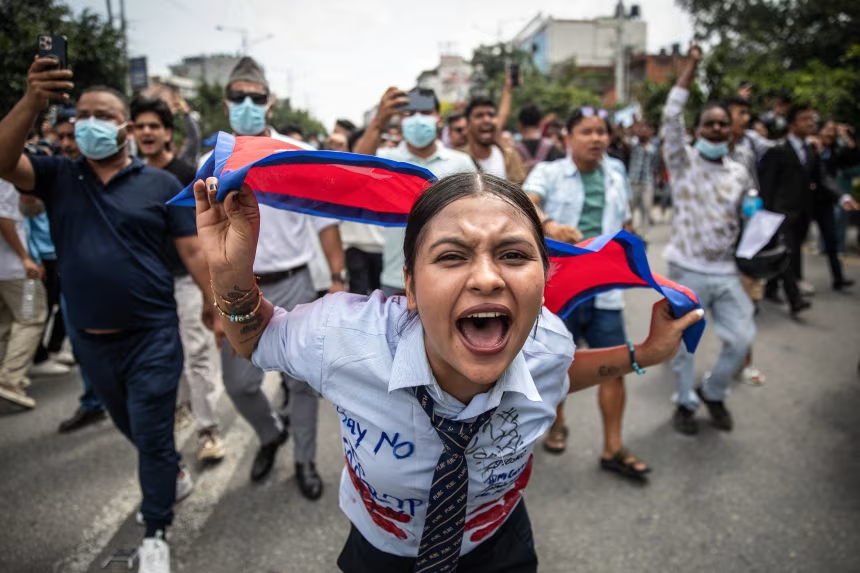
More than a dozen people have died and hundreds have been hurt in youth-led protests in Nepal. The rallies were spurred by the government’s ban on social media, pervasive corruption, and a lack of good job possibilities.
According to news agency Reuters, authorities stated that at least 19 people were murdered amid rallies in multiple towns where security forces used live bullets, water cannons, and tear gas.
Nepal is a Himalayan country with 30 million inhabitants. Its politics are sometimes unstable, and since it became a republic in 2008 after a decade-long civil war that ended the 239-year-old monarchy, it has had more than a dozen governments.
The most recent protests, which are spearheaded by people between the ages of 13 and 28, known as Generation Z, are the worst in Nepal in decades and could bring down another government.
Protesters flocked to the streets again in the capital on Tuesday, even though there was a curfew in the city center and the government had removed the ban on social media. Reuters news agency photos showed demonstrators setting fire to a police booth and furnishings outside the office of the Nepali Congress, the biggest political party in Nepal.
A local official told CNN that police fired into the air after demonstrators broke curfew to congregate in Chandrapur, which is south of Kathmandu. The source added that protesters also set a police car on fire.
This is all we know about the unrest in Nepal.
On September 8, 2025, riot police in Kathmandu used tear gas to break up a rally outside the Parliament.
During a rally outside the Parliament in Kathmandu on September 8, 2025, riot police use tear gas to break up the crowd. Prabin Ranabhat/AFP/Getty Images
What made people protest?
People were already angry with the government because they thought there was a lot of corruption in Nepal that had been going on for decades. Last week, when the government blocked social media sites like Facebook, Instagram, WhatsApp, YouTube, and X, people took to the streets in the capital. Rights groups widely condemned the move.
The government wrote new guidelines that it said were necessary to stop hate speech and fake news. It also said it would prohibit any social media businesses that didn’t register.
Local news says that by midnight on Thursday, 26 platforms had gone dark.
But the people who planned the protests claim they are not just about the ban on social media; they also show how frustrated young people are with the lack of good job options.
The World Bank says that in 2024, 20.8% of young people aged 15 to 24 in Nepal were out of work.
At the same time, a popular internet movement against “Nepo Kids”—politicians’ kids displaying off their affluent lifestyles—is making people even angrier by revealing how different the lives of those in power are from those of normal Nepalis.
Nepal’s economy depends a lot on money that Nepalis living abroad send home. The World Bank says that personal remittances made up more than a third (33.1%) of Nepal’s GDP. This number has been continuously rising over the past 30 years.
“All the Nepali people are sick of corruption.” All the young people are leaving the nation. A protester told Reuters, “We want to protect our youth and make the economy better.”
An aerial image shows protesters outside Nepal’s Parliament during a protest in Kathmandu on September 8, 2025.
On September 8, 2025, protesters gathered outside Nepal’s Parliament in Kathmandu. This is an aerial picture of the scene. Prabin Ranabhat/AFP/Getty Images
Protests become deadly
On Monday, the protests turned violent as demonstrators and police fought at the parliament complex in Kathmandu.
Reuters said the police shot rubber bullets and tear gas at thousands of teenage demonstrators, many of whom were wearing school or college uniforms.
Reuters, quoting a local official, said that protesters set fire to an ambulance and threw things at riot police who were protecting the legislature.
One protester told the Indian news agency ANI, “The police are firing at random.”
Hospital officials say that at least 17 people died in Kathmandu and two more in the eastern city of Itahari.
Nepal’s health ministry says that more than 400 individuals, including security forces staff, were taken to the hospital after getting hurt on Monday.
International groups quickly spoke out against the deadly police crackdown and asked for an impartial probe.
The UN human rights office said it was “shocked” by the killings of the protestors and called for a probe that was “open.” It claimed it had gotten “several deeply worrying allegations” that security forces used force “unnecessarily” during the protests.
Amnesty International said in a statement, “Using deadly force against protesters who are not posing an immediate threat of death or serious injury is a serious violation of international law.”
Government under stress
After the violence, Nepal’s Home Minister Ramesh Lekhak stepped down on Monday, Communications Minister Prithvi Subba told reporters late Monday.
They also said on social media that Nepal’s ministers for agriculture and water had quit because of how the government handled the protests.
The administration also took down the ban on social media sites.
Nepali Prime Minister KP Sharma Oli claimed his government was “not against the demands of the Gen Z generation” and that he was “deeply saddened” by what happened on Monday.
He said in a statement that “infiltration by various vested interest groups” was to blame for the violence, but he didn’t say who those groups were.
Nepal’s biggest-selling daily called for Oli to resign on Tuesday. Its editorial board said he “cannot sit in the PM’s chair for a minute longer” following the violence on Monday.
About the Author