

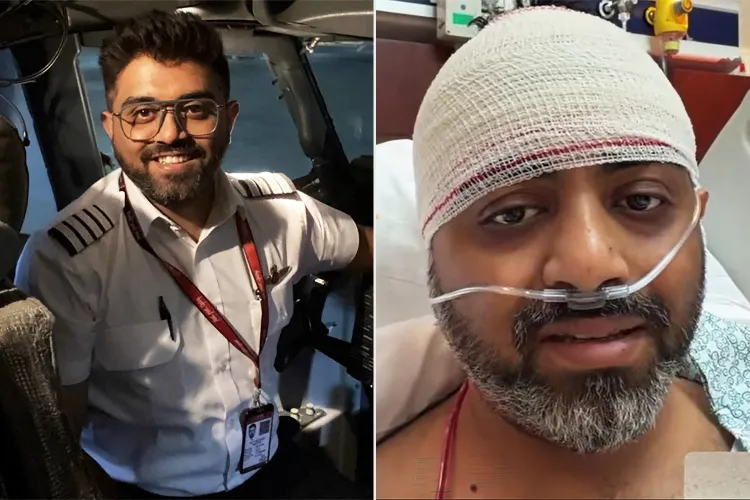
The captain of a Flydubai passenger aircraft has told how he struggled to keep the plane airborne when his co-pilot attacked him on a journey from Dubai to Tel Aviv.
Captain Smit Machchhar, who remains in hospital with injuries from the incident, told the BBC he was lying on the floor of the cockpit when he recognised the aircraft was fast losing height.
Machchhar stated in a video conversation with Indian Prime Minister Narendra Modi on Friday that he made one last try to open the cockpit door, despite his injuries.
“I was lying on the ground injured but I told myself to get one last push to open the door from inside,” he added.
Machchhar said his goal was his own life and that of the lives of everyone on board the aeroplane.
“Of course I was fighting for my own life but I knew that I was not going to let other people die,” he claimed.
The incident happened on September 30 on a Boeing 737, a Flydubai plane, FZ1073, flying from Dubai to Tel Aviv with more than 170 persons on board.
The aircraft was sailing at roughly 34,000 feet when it plummeted unexpectedly, according to flight-tracking data and reporting from Reuters and AP. The jet dropped more than 16,000 feet in seconds, then began a series of strange shifts in altitude, Reuters reported.
It is believed the co-pilot stabbed Machchhar with a knife during the incident. Israeli sources said the co-pilot appears to have tried to crash the plane but authorities were still probing the circumstances and motive for the occurrence.
Machchhar opened the cockpit door despite his wounded. Passengers and staff then entered the cockpit and assisted in restraining the co-pilot, while two other pilots travelling on the aircraft assisted in regaining control.
The plane then diverted to Tabuk, Saudi Arabia, where it landed safely. Flydubai said the flight had been diverted following an incident and all passengers were safe and accounted for.
The captain was first treated in Saudi Arabia, then transported to Abu Dhabi for further treatment. Enquiries persisted and the co-pilot was also arrested.
The incident set off emergency protocols onboard the aircraft, including the declaration of 7700, the international transponder code for a general emergency, and subsequently 7500, a declaration of unlawful interference or hijacking crisis.
Investigations are under way with authorities in numerous countries. The exact motive for the purported attack has not been fully proved and accusations concerning suspected terrorism or radicalisation are still being investigated rather than being confirmed conclusions.
The case has also reignited discussions about aviation security and the threats that come from within the crew of an aeroplane. Aviation experts contacted by the AP said the incident might lead to more scrutiny of cockpit security and the way crews are vetted.
But for the passengers of FZ1073 the immediate result was a safe landing after an incident that had briefly devolved into what could have been a terrible catastrophe.
About the Author