
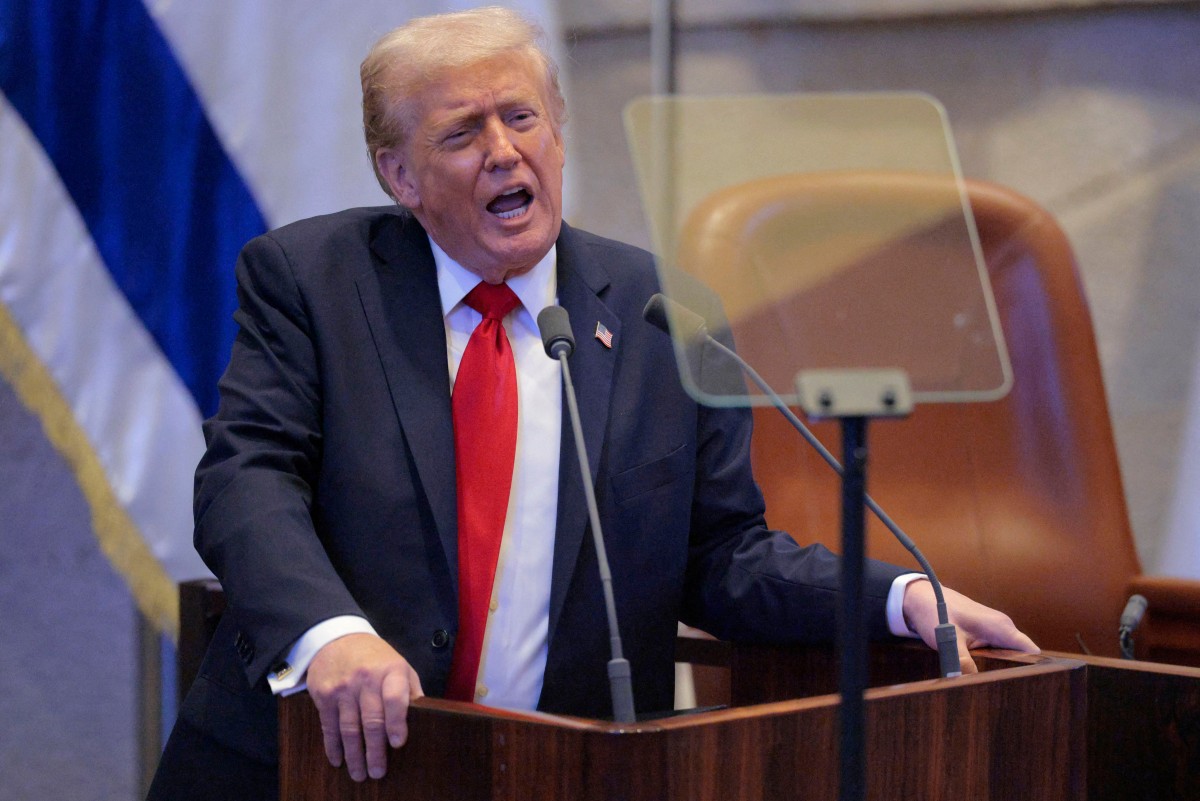
US President Donald Trump speaks at the Israeli parliament, the Knesset, in Jerusalem on October 13, 2025. Hamas handed over the 20 surviving Israeli hostages on October 13 under a ceasefire agreement, as the US president and other world leaders geared up for a summit on Gaza. The releases are part of a ceasefire agreement brokered by the US president, with Israel due in return to free nearly 2,000 detainees held in its jails in exchange. (Photo by Chip Somodevilla / POOL / AFP)
Yesterday Hamas said it has accepted a compromise presented by US President Donald Trump to end its war with Israel, under which it would hand up its weaponry to a Palestinian governing committee and Israel would gradually withdraw its forces from Gaza.
Israel has not responded publicly to the declaration, but a political source informed our correspondent that “there will be no withdrawal whatsoever” from the current lines of Israeli soldiers “unless Hamas undertakes a genuine disarmament”.
AFP said far-right National Security Minister Itamar Ben Gvir slammed the deal as “unacceptable”, claiming it was “tantamount to agreeing to Hamas organising for the next massacre”.
One of the biggest sticking points in implementing a ceasefire accord in place since October has been the weapons of the Palestinian Islamist organization, but Trump declared late Thursday an agreement for Hamas’s “complete disarmament,” calling it a significant step toward a new Palestinian government in Gaza.
“The issue of Gaza did not come up” in the meeting this week between Trump and Israeli Prime Minister Netanyahu in Washington, the Israeli source added.
Hamas officials told our correspondent that a body set up by Trump’s Board of Peace to manage Gaza would oversee the process of storing the Islamist movement’s weaponry.
The group said it expects mediators and the Board of Peace to ensure that Israel abides by the conditions of the pact, including departure from Gaza.
Israel has always insisted on full disarmament of Hamas before its forces pull out, and the political source had mentioned “the removal of weapons from Gaza and full demilitarisation of the Strip as a precondition for any process” before the statement.
Hamas negotiator Ghazi Hamad said the movement was making “concessions for the sake of our people in the Gaza Strip, to save them from death and displacement”.
“On the question of disarmament, Israel will not enter into. The National Committee will perform this task,” he said, referring to the National Committee for Administration of Gaza (NCAG).
Health officials said violence has resumed in Gaza despite an October ceasefire, with Israeli strikes killing at least four people, including two children, on Thursday.
Now, let’s focus on implementation
The Board of Peace said on X that Hamas had “agreed to a detailed Roadmap for implementing the next phases of the Gaza ceasefire”.
The agency said, “We are now focused on implementation” and the NCAG will “soon begin a phased transition to full authority”.
In a previous social media post, Trump said that “once Hamas is disarmed, Israeli forces will withdraw and the International Stabilisation Force will work with a new Palestinian police force to take responsibility for Gaza being safe for its residents and its neighbors.”
“This agreement took months of very difficult negotiations,” stated yesterday Nickolay Mladenov, the Board of Peace’s high representative for Gaza.
“What happens next is even more important. “Implementation and verification must be real,” Mladenov said on X.
“Withdrawal must go hand in hand with decommissioning,” he stressed.
Kaja Kallas, the EU’s foreign policy leader, praised the pact but said success “depends on the full commitment of all parties”.
“It is a difficult process,” Kallas remarked in a post on social media.
“You are going to have a big challenge to make sure Hamas is complying. Israel would have to pull out of Gaza at some point.”
‘No exclusions’
Cairo will soon host a conference of the truce’s mediators, which also include the United States, Qatar and Turkey, focusing on the second phase of the ceasefire plan, Egypt’s state-linked Al-Qahera News stated yesterday.
Earlier, a diplomatic source told our correspondent that the roadmap “offers a balanced and pragmatic way forward, with all weapons decommissioned and a phased transfer of responsibilities” to the new authority.
‘There will be no carve outs for specific weapons or certain people,’ the source, who asked not to be identified because he was not permitted to talk publicly on the topic, told Reuters.
The insider added the roadmap would set up “a process for the elimination of all tunnels, depots of weapons and any weapons production facilities”.
A verification method would guarantee compliance by either side, the insider claimed.
Earlier, a source within Hamas, who is aware with the talks, informed our correspondent that the movement is “waiting for the Israeli response to the amendments that we submitted to the mediators recently”.
The revisions are to two articles in the roadmap submitted by the Board of Peace, the source said.
The source from Hamas told The Times that “some points were removed and alternatives were suggested” in the article on weapons.
About the Author