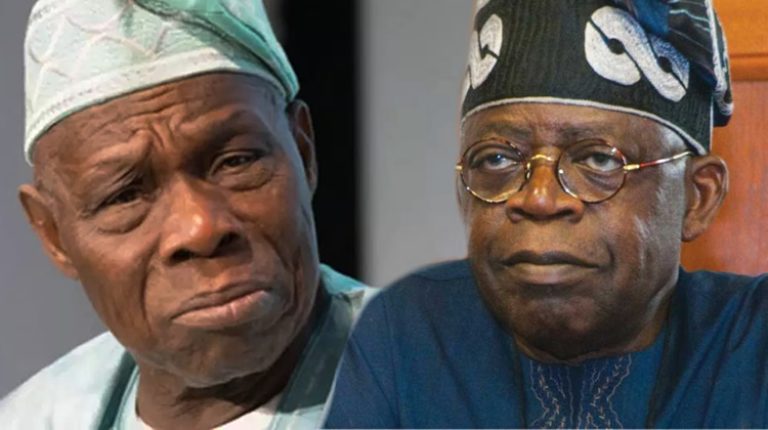

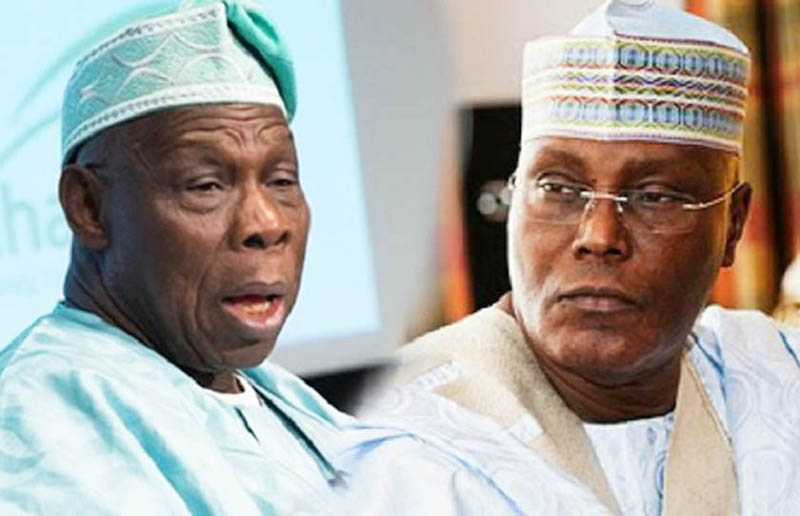
Former President Olusegun Obasanjo has said that the worst mistake he made during his presidency was choosing former Vice President Atiku Abubakar as his running mate in the 1999 presidential election.
Obasanjo said this at the public presentation of Charly Boy’s foundation and memoir, 999: A Memoir in Tribute to Late Justice Chukwudifu Oputa, in Lagos during a fireside chat with veteran entertainer and activist Charles Oputa, popularly known as Charly Boy.
The former President who served with Atiku from 1999 to 2007, said that while every leader made mistakes while in office, his choice of vice president was the one decision he regretted most, saying that he would never have chosen him if he knew then what he later found out about his former deputy.
Reflecting on his years in office, Charly Boy asked Obasanjo to name the biggest mistake he made as president in a video of the event later broadcast by iWitnessLive TV on YouTube.
“I’ve found in my own life that mistakes that could have been fatal, God had taken care of for me,” he said.
Asked to name one error, the former President said: “The man I picked for my vice president, my number two. “If I had known him as I came to know him later, I would not have chosen him.”
Obasanjo said, “My Vice President. ” When Charly Boy asked for clarity if he meant Atiku, Obasanjo said, I don’t know what you want to call him but my vice president, I mean that.
In hindsight, he said, he would have picked differently.
“Of course, what I know of him later on… I wouldn’t have chosen him. “Thank God that God did not allow his actions and reactions to overwhelm me, to divert my focus from Nigeria or to harm Nigeria,” he stated.
But the former president said he has no personal bitterness against Atiku despite their rocky political relationship.
“There’s no bitterness because he did what he thought he had to do, and God did what God had to do, which allowed me to accomplish what I was able to accomplish,” he added.
Yesterday’s statement is one of the most frank personal reflections the former president has ever offered in public regarding his choice of Atiku as vice president, bringing a political rivalry that has defined the country’s democratic landscape for more than two decades back into the open.
Obasanjo and Atiku became the first democratically elected President and Vice-President after the end of military rule in 1999, winning the election on the platform of the Peoples Democratic Party.
Much of the administration’s first term was characterised by a strong political alliance, with Atiku having a key role in the National Economic Council, the National Council on Privatisation and other economic reform efforts.
However, ties between the two leaders soured badly during the second term of Obasanjo in power.
The crisis worsened when Atiku resisted efforts by associates of the former President to change the Constitution to allow for a third term for Obasanjo.
The 2006 rejection of the controversial constitutional amendment deepened the rift between the two and sparked one of the bitterest power confrontations in Nigeria’s Fourth Republic.
The feud spiralled into court challenges over the powers of the vice president when Obasanjo declared Atiku’s position void for defecting from the PDP to the erstwhile Action Congress ahead of the 2007 general election.
Eventually, the Supreme Court determined that the President did not have constitutional authority to sack an elected vice president and Atiku was allowed to continue his mandate.
Since leaving office the two men have constantly swapped charges of corruption, misuse of office and political treason.
In his 2014 memoir, My Watch, Obasanjo accused Atiku of corruption, treachery and putting personal ambition before national benefit.
Atiku denied the charges, accusing his former boss of trying to rewrite history and portraying himself as a victim of political persecution in the dying days of the Obasanjo administration.
Obasanjo briefly made up with the two politicians ahead of the 2019 presidential election when he backed Atiku’s bid against President Muhammadu Buhari, but the truce was short-lived as both men returned to their different political paths.
Obasanjo has since been one of Atiku’s most vociferous detractors, pushing Nigerians to choose competence, integrity and national interest over all else in selecting future leaders.
About the Author