
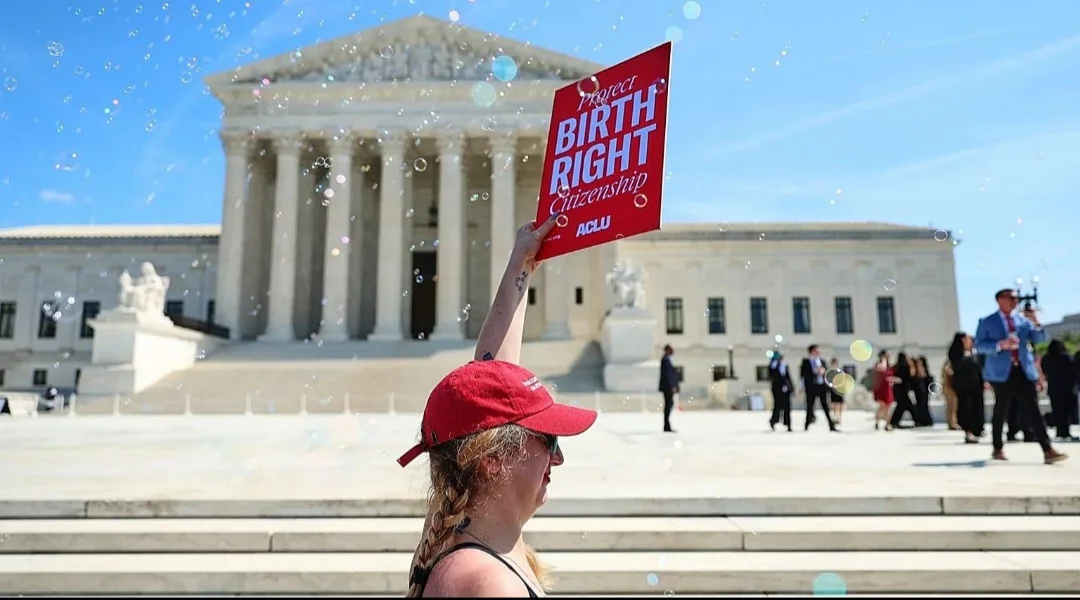
In a landmark decision, the U.S. Supreme Court reaffirmed the constitutional right to birthright citizenship, rejecting President Donald Trump’s executive order aimed at denying automatic U.S. citizenship to children born in the United States to parents present in the country illegally or on a temporary basis. The judgement is one of the most severe legal blows to Trump’s second-term immigration policy and reaffirms a constitutional norm that has existed for more than a century.
In a 6-3 verdict, the justices said the executive order violated the 14th Amendment to the U.S. Constitution, which says “all persons born or naturalised in the United States, and subject to the jurisdiction thereof, are citizens of the United States.” In a decision by Chief Justice John Roberts, the court found children born in the United States to parents who are unlawfully or temporarily present meet the constitutional requirements for citizenship at birth.
The executive order, signed by Trump on his first day back in office in January 2025, was part of a wider crackdown on immigration. The order would have removed citizenship from children born in the United States unless at least one parent was a U.S. citizen or lawful permanent resident. The measure would have impacted more than 250,000 infants each year, including offspring of undocumented immigrants, foreign students, temporary workers and others legally living in the nation on temporary visas, immigration groups said.
The administration defended the policy on the grounds that children of undocumented immigrants and temporary visa-holders were not completely “subject to the jurisdiction” of the United States and hence not entitled to citizenship under the Constitution. The Court, however, rejected such view, relying on the text and history of the 14th Amendment and the historic 1898 United States v. Wong Kim Ark ruling, which found that everyone born on U.S. soil is automatically a citizen.
The opinion also maintains lower federal court rulings that had prevented Trump’s order from going into effect nationally. Justices across the ideological spectrum showed scepticism about the administration’s constitutional claims during oral arguments earlier this year, foreshadowing Tuesday’s conclusion.
The ruling was hailed as a triumph for constitutional safeguards and the rule of law by civil rights organisations, immigrant advocacy groups and many Democratic politicians. They contended that letting a president define citizenship through executive action would overturn one of the nation’s most basic legal precepts.
President Trump condemned the verdict, saying it encouraged illegal immigration and so-called “birth tourism.” His administration had argued for a more restrictive reading of the Constitution but legal experts said the Court’s ruling provides little room for future administrations to implement similar limits through executive edict alone. Any significant alteration to birthright citizenship would likely require a constitutional amendment or new legislation that could withstand judicial review.
The result is the latest in a Supreme Court term that has seen a number of key decisions on presidential power, immigration, elections and executive authority. The Court has sided with Trump at times during his second term. But Tuesday’s decision is a clear constitutional restriction on presidential power, reiterating that the executive branch cannot overrule rights granted by the Constitution.
For millions of immigrant families and future generations, the decision affirms a fundamental principle that has defined American citizenship since the 14th Amendment was adopted in 1868. Legal analysts think the ruling will be one of the defining constitutional decisions of the Court’s present age, and is likely to shape immigration law and civil rights issues for decades to come.
About the Author