
How things have changed since that fateful night of June 13, 2025. Are the survivors of the massacre safe and healed, or still bound by terror, poverty and traumatic memories? Our correspondent was in Yelewata on Saturday and the PUNCH writes that the community was still hunting for answers.
In Yelewata, memories are not just in the images, but in the burning walls, the deserted compounds and the tears of survivors who are still trying to comprehend why hundreds of their neighbours did not live to see another sunrise.
The tears were sudden.
Saaondo, a middle aged guy, stood before the burnt remnants of a house in Yelewata and could no longer keep back the memories.
He was surrounded by prayers from a memorial Mass held in remembrance of the victims of the June 13, 2025, atrocity. To him the tragedy was not history; it was a wound that bled anew at every sight of the wreckage.
A year earlier fate had spared him. He had left the community just hours before armed assailants assaulted Yelewata, killing hundreds and burning down houses. He never released those he left behind.
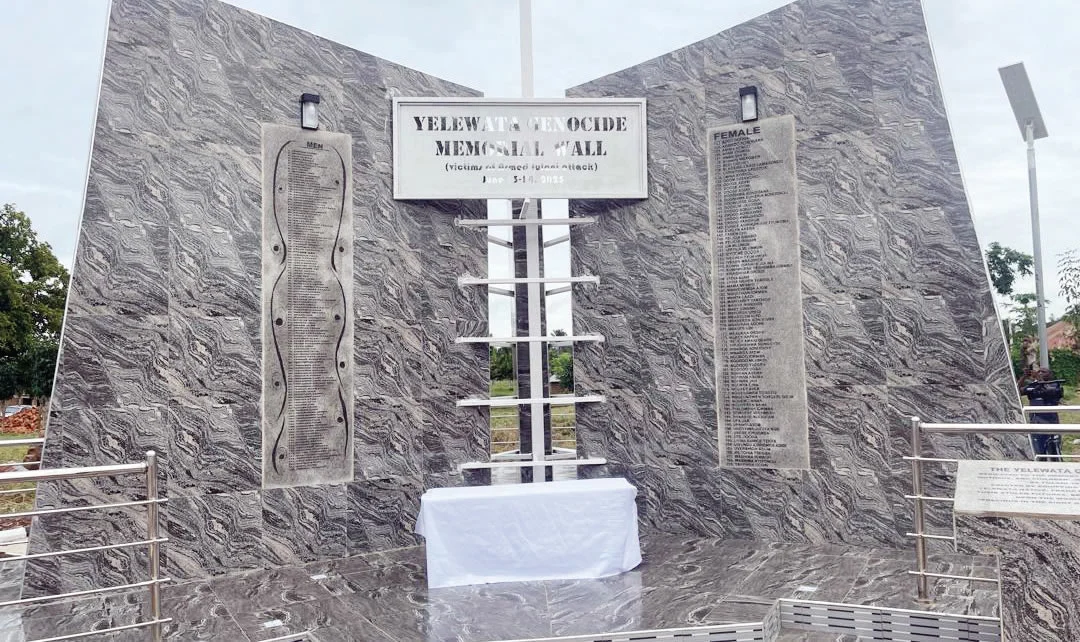
Last Saturday the community observed the first anniversary of the attack and the pain was palpable. The speeches, the prayers and the dedication of a monument carrying 272 names hid a harsh truth. For while the dead were being recognised, many survivors claim they have yet to reconstruct their lives.
Matthew Mnyan, one of the Yelewata village leaders, observed Saaondo standing alone and silently moved towards him. He appeared distressed, asking why he had walked out of the memorial Mass.
The man replied in a way that might have melted the coldest heart.
‘I would have died too’
“I left this house especially for Makurdi the night before June 13,” Saaondo added, gesturing to the charred remnants of a nearby dwelling. But the marauders raided Yelewata and slaughtered and destroyed all the inmates of the house. “If I had been there that night, I would have been one of those we are remembering at this memorial today.
Last Saturday the small community of Yelewata once again hosted guests from all walks of life and sorrow was the atmosphere. They were not here to celebrate a holiday or to pay homage to a great figure. Instead they had assembled to commemorate the first anniversary of the devastating attack that tore through the village.
June 13, 2025: Yelewata, along the Lafia-Makurdi Federal Highway in Guma Local Government Area of Benue State was brutally attacked. The assault, said to have lasted almost four hours, attracted national and international attention. Initial reports said the death toll was about 200.
But the first anniversary observance saw the installation of a memorial monument to the dead, which officially put the number murdered at 272, including 67 children.
“The Yelewata Genocide Memorial Monument was born out of the idea that the victims should never be forgotten,” said Franc Utoo, a community member and Director of Advocacy for the US-based non-profit group Equipping The Persecuted, which funded the project.
“With this monument the organisation is saying that those who were killed in Yelewata should never become a passing headline or anonymous casualty figures. “They must be commemorated with dignity, permanence and honour,” he urged.
He said: “It occupies a historic place in the moral landscape of remembrance as the first monument of its kind in Benue State. The names of the 272 members of the Yelewata community slaughtered – 67 children, 83 women and 122 men – are preserved and a mournful record of lives violently taken is placed before the world.”
Clearly still struggling to come to terms with the catastrophe, Yelewata locals and visitors marked the anniversary. A year on from the incident and the wounds are still apparent, the pain far from faded.
memorial service.
Most Rev. Wilfred Anagbe, Catholic Bishop of Makurdi Diocese, has called on government at all levels to adopt a deliberate policy of resettling displaced persons in their ancestral communities, instead of keeping them indefinitely in makeshift Internally Displaced Persons camps.
The bishop said housing displaced persons in camps out of fear of more assaults is a defeatist attitude and gives the impression that the government is helpless in the face of insecurity.
He stated that the incarceration of otherwise productive members of communities in camps where they depend heavily on charity is harmful to their physical and psychological well-being and eventually undercuts their dignity.
Anagbe also blamed the Benue and Nasarawa State governments over what he termed negligence, alleging that they failed to act on intelligence reports that reportedly indicated the planned attack on Yelewata.
Despite the catastrophe, the bishop applauded the tenacity of the people of Yelewata, saying they had remained firm in the face of huge physical and psychological anguish.
He told them that the Christian community around the world continues to be united with them in prayer and support.
Moro hits back at FG
In his speech, Senate Minority Leader, Abba Moro, slammed the Federal Government and the political elite in Nigeria for not fully appreciating the enormity of the insecurity facing the country.
Moro criticised the government of avoiding hard truths and said refusing to face the issue head-on will not make it go away.
Taking a swipe at the country’s political class, he asked: “Can we, in all honesty, go around during campaigns and ask the people to vote for us again when the mandate already entrusted to us has not been effectively deployed for their well-being? We have to wake up.
How are the survivors doing?
For many people, the first anniversary of the attack was not just a time to memorialise the dead but also to focus attention on the misery of the surviving.
One year after the disaster, many survivors are still fighting to reconstruct their lives, community leader Matthew Mnyan said, painting a gloomy picture of life in Yelewata.
“The community has become poorer, and insecurity is still a big problem,” he said.
The people are still living in dread and cannot travel far from the community or freely access their crops due to persistent security threats,” he said.
Mnyan highlighted the story of a young girl who was allegedly sexually raped while she went to collect firewood in a neighbouring jungle.
“Yelewata and neighbouring communities, especially Udei, are still in fear. “Due to the repeated attacks in the area, they are unable to access their farms,” he stated.
“There’s a case of a young girl I’m still following up on. She was sent to go and get firewood in a neighbouring jungle, and was reportedly molested by four suspected herders. Incidents like this illustrate that our people are still vulnerable.”
“The level of poverty has also increased because many people who depended on small scale businesses and other means of livelihood has not been able to recover from the attack.
Mnyan equally condemned the Technical Committee on Donations for Internally Displaced Persons, chaired by the Secretary to the Benue State Government, Deborah Aber, for not doing enough to alleviate the suffering of the survivors.
“While the government may think they’ve done a lot, a lot of people in the community don’t think so,” he said.
The community leader said residents had advised the state government on the best way to use donations received from individuals and organisations including the contribution made by the First Lady Oluremi Tinubu, but alleged that the funds had not been effectively deployed for the benefits of victims.
The committee had in March this year revealed that it had received about N1.25bn donations from various sources, including N1bn contributed by the First Lady after the incident.
Mnyan said the community suggested that a large part of the monies be used for resettling displaced people and helping them economically recover.
“We recommended that some of the money should be given to affected persons as start-up capital for small businesses and also markets and other facilities that would help restore livelihoods should be provided,” he said.
He further claimed that some of the recipients selected by the committee were not in the list presented by the community.
Residents complained that the list used to distribute assistance did not reflect those affected by the incident, he said.
Mnyan also questioned the quality of some of the housing projects being undertaken for displaced persons, saying some of the constructions had already developed fractures.
He called on Governor Hyacinth Alia to visit the community personally and see for himself what was going on.
“I don’t think the governor knows what’s going on. “I am appealing to him to come and see for himself, to inspect the projects, to get the information from the people of Yelewata,” he said.
Mnyan also expressed worry that several of the directives given by President Bola Tinubu during his condolence visit to Benue State had not been executed.
But the Benue State Emergency Management Agency had a different tale to tell.
“Some of the displaced people from Yelewata have already been resettled and others are still at the IDP camp at the International Market,” said the agency’s Information Officer, Tena Ager.
He said more than 1,000 completed housing units have been earmarked for displaced residents, while the government has also acquired other property in the town for the construction of social facilities such as mosque, church, hospital and market.
“The government also provided cash assistance and other relief materials to the people of Yelewata,” Ager stated.
About the Author