
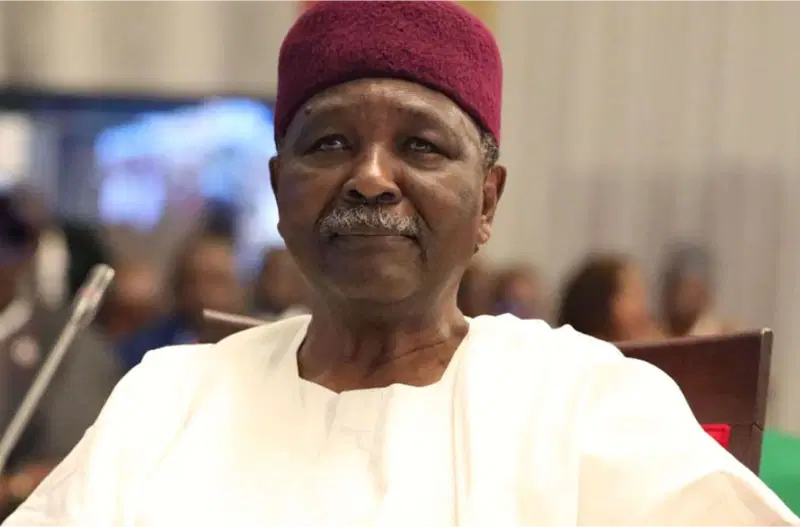
How Late Sage, Chief Olusegun Awolowo Stepped In To Save Late Military Ruler, Gen. Murtala Mohammed Former Head of State, General Yakubu Gowon (rtd), has resurrected some of the deepest disputes of Nigeria’s Civil War.
He also said that he never wanted the late Biafran commander, Chukwuemeka Odumegwu Ojukwu, to be captured or killed, reports Vanguard.
The revelations are contained in Gowon’s autobiography, ‘My Life of Duty & Allegiance’ and offer unique personal insights into the rivalries, combat mistakes and political tensions that defined the 1967–1970 war.
Gowon, in the biography, looks at the roles played by Ojukwu, ex-President Olusegun Obasanjo, Chief Obafemi Awolowo, Colonel Benjamin Adekunle and other top personalities who steered the conflict on both sides during the war.
‘Murtala’s idea was quite suicidal’
One of the most illuminating discoveries in the biography concerns the unsuccessful Federal attempt to cross the River Niger from Asaba into Onitsha, which has always been regarded as one of the most contentious military decisions of the war.
Gowon stated Murtala ignored numerous warnings about the operation due to rivalry with another commander and his eagerness to earn combat glory.
“As C-in-C I considered his plan very suicidal,” Gowon wrote.
Army Headquarters had warned that the rebel forces could demolish the Onitsha Bridge and imprison federal troops during the passage, he said.
Gowon said he counselled Murtala to enter Onitsha via alternative land routes previously secured by federal forces but the commander refused.
“He said his pride didn’t want to go through 1 Division area because of his rivalry with Colonel Shuwa.
The ex-Head of State said the operation ended in disaster when Murtala proceeded with the river crossing.
“Murtala did not heed my advice and did exactly as he had proposed, to cross the River Niger by boats and barges, but with catastrophic consequences of the loss of men and equipment during the failed river crossing,” he wrote.
Still, Gowon commended the bravery of Murtala under fire. “His audacious exploit showed his courage even in the disaster as the Field Commander,” he added.
The signal that almost cost Murtala his command.
The fighting also revealed serious splits within the federal command.
Gowon said that Murtala had once sent him what he termed an insulting signal from the battlefield during fierce combat.
“He sent me, his Commander-in-Chief, an impertinent signal in a moment of anger, beyond the bounds of reason or military decorum, that I should get my fat backside off my chair to go and sort out things in the battlefield rather than giving orders from the comfort of my office in Dodan Barracks,” Gowon wrote.
The message infuriated the previous wartime leader sufficiently that he thought of removing Murtala from Command immediately.
“I was angry enough to consider removing him from Command with immediate effect, because of his unconscionably rude signal to me from the war front,” he said.
But Gowon maintained it was Awolowo who intervened before he could act. “Chief Awolowo saw how furious I was with Murtala, when I got the signal. He immediately substituted him and begged that I not react the way I wanted to,” he recalled.
Gowon said he felt Murtala’s behaviour warranted punishment but he had to overlook it because of the lack of experienced officers during the conflict.
“I could have been more stern and handed out more punishment for Murtala’s behaviour and action,” he wrote, “but I chose to overlook his infractions and I let him go back to his base.
‘But kill Ojukwu? No never.
Gowon also looked back on the eventual fall of Biafra and Ojukwu’s departure into exile in Ivory Coast in the dying days of the conflict.
Despite the severity of the fight, the former military dictator stated he never wanted Ojukwu tracked down or killed.
“I am always grateful to God that we did not get him before or during the war. But kill him? “No, never, except on the battlefield where the first lucky shot wins!” he wrote.
Many people erroneously believed that the Federal Government sought to personally eliminate Ojukwu, but the war was fought to protect Nigeria and not to settle personal grudges.
“There were those who wanted him crushed totally. “But I thought there was meant to be a future after the war,” he said.
That kind of thought, he said, was subsequently to inform the federal government’s ‘No Victor, No Vanquished’ pronouncement when the war ended in January 1970.
“We needed to reconcile and reconstruct and rehabilitate. That was the only path ahead for Nigeria,” he said.
How peace talks went off the rails
The book also deals with the unsuccessful peace efforts that preceded the commencement of full-scale conflict, especially the collapse of discussions after the Aburi meeting in Ghana.
Gowon implied that distrust and the hardening of political positions slowly undermined chances for agreement between the Federal Government and the Biafran leadership.
“Ojukwu was undoubtedly a brilliant officer. But he grew to believe that secession was the only answer,” he said.
The former head of state admitted that the massacres of Igbos in sections of Northern Nigeria after the 1966 coups had raised the level of fear and suspicion all over the country.
But he insisted attempts to avert war were still underway even after tensions rose substantially.
‘We tried everything to avert conflict. But after secession was declared, the unity of Nigeria had to be defended,” he said.
Armistice debate nearly leads to surrender
Gowon stated the final surrender negotiations that ended the war almost were complicated by differences over a planned armistice.
He stated he was still dubious of temporary ceasefire ideas since previous deals with Ojukwu had frequently broken down and he believed Biafran forces may use any halt in battle to regroup.
“I wasn’t inclined to any notion that would give the rebels a little more time to regroup and recommence a conflict that we all wanted to see over,” he said.
He said arguments over the subject nearly wrecked the surrender talks in Lagos between Obasanjo and the Biafran team.
Incidentally, the demand for an armistice was also one of the difficult points between Colonel Obasanjo and the Biafran delegation which he led to Lagos to sign the instrument of capitulation. It nearly sank the peace process,” Gowon wrote.
He also stated the surrender broadcast by the acting head of Biafra, Gen. Philip Effiong (rtd), backed the federal government’s long held position that efforts to bring about peace were hindered by hardliners within the Biafran leadership throughout the conflict.
“The bloodletting occasioned by the war must stop,” Effiong had proclaimed. He confessed that those within the former Biafran leadership who had made negotiations and reconciliation difficult had willingly removed themselves.
“These admissions corroborated all I had been insisting on from the very beginning, wrote Gowon.
Battle exhaustion in the 3rd Marine Commando
The biography also deals with the internal crises that later consumed the previously feared 3 Marine Commando of Colonel Benjamin Adekunle.
Gowon lauded Adekunle’s initial achievements on the battlefield, including as operations that severed Biafran access to important coastal lines and large towns.
He wrote: “Col. Benjamin Adekunle, as the Commander of 3 Marine Commando was extremely good.
But he said the division was ultimately undone by the weariness of the battlefield.
Adekunle seems to have grown tired of fighting. “Some of his officers started reporting to me that he was acting really irrationally,” he said.
Gowon said morale among soldiers had plummeted so low that some deliberately hurt themselves in order to leave the frontlines.
“The morale of soldiers in the Division began to go down and it soon got so low that they began to shoot themselves in the foot and the fingers so that they could be medically evacuated from the war front,” he disclosed.
He listed the ultimate fall of Owerri as one of the most serious defeats experienced under Adekunle’s command.
“The earlier winning 3 Marine Division gradually and steadily became a battle losing Division. The loss of Owerri was one of Adekunle’s most prominent disasters,” wrote Gowon.
Looking back, the former military ruler confessed he should have done more.
“I really think I should have relieved Adekunle of his Command long ago,” he said.
New discourse on old sores
Throughout the memoir, Gowon attempted to balance criticism of wartime leaders with recognition of their courage and contributions on the battlefield, especially in Murtala’s case.
About the Author