
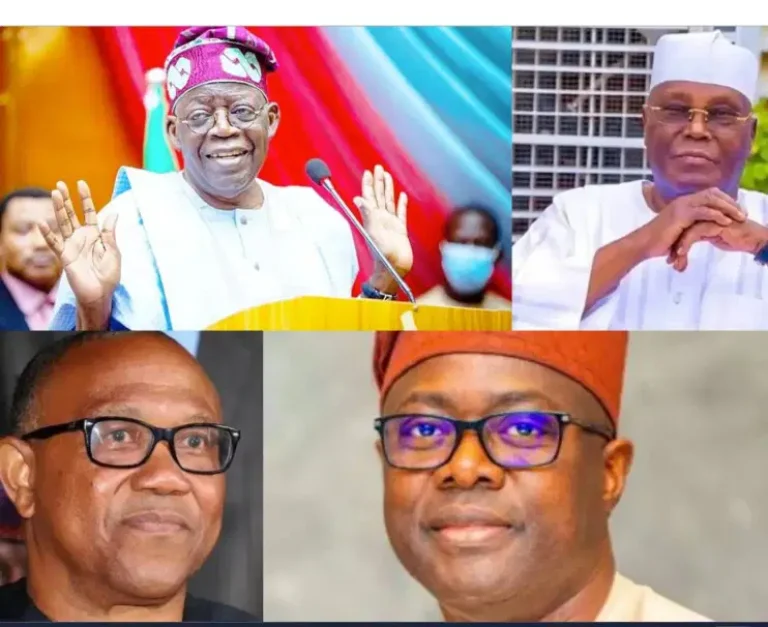
With just over eight months to go until Nigerians go to the polls, the struggle for Aso Rock is becoming less about the contenders and more about the formidable forces aligning themselves behind them.
Across Abuja, governors flit between private meetings and public endorsements with greater intensity.
Old alliances are being secretly rebuilt by former ministers. The networks of political funders are coming to. Regional blocs are re-evaluating their interests – Sunday Vanguard
Civil society groups and youth movements are reviving their internet infrastructure. The talk has moved beyond who is running to the more profound question of who has the apparatus to win, too, in elite circles.
Slowly the growing fight is shaping up as a bigger political struggle between structure and emotion, incumbency and coalition politics, elite power and grassroots fury.
Around President Bola Ahmed Tinubu still stands possibly the country’s most potent political apparatus. On the other side is an opposition field animated by public anger at economic suffering but hampered by rival aspirations, overlapping coalitions and unsure alliances. That friction may end up defining the election.
Because in today’s Nigerian politics, popularity makes a noise. Structure turns noise into ballots. And the defining question of 2027 could not just be who is running. It might be who, and what, is standing behind them.
TINUBU: The Incumbent in the Midst of Power
President Bola Tinubu joins the contest with the backing of the strongest political alliance in Nigeria today.
Surrounding him is a sprawling political structure that ranges from 31 governors and a huge network of federal officials to hundreds of congressmen, thousands of party members, powerful economic interests and deeply embedded Southwest political networks decades in the making.
His re-election attempt faces little resistance inside the APC. Most governors are either politically linked with him directly, or are commonly thought to be working within the greater orbit of the ruling party’s influence. It matters so very much.
Governors are one of the most powerful and decisive elements in Nigerian elections, controlling state infrastructure, local mobilisation networks, party agents, grassroots patronage systems and huge political influence within their states.
Apart from governors, Tinubu is enjoying the huge privileges that come with incumbency itself. The APC is in power at the federal level.
Ministers, special advisers, board appointments and senior political office-holders all have a political interest in the continuation of the administration. The president also has vast power in the National Assembly, because to the dominance of party and elite alliances that have been formed over decades.
His long-standing connections to parts of the business elite also help the president financially and strategically.
Even many opposition lawmakers admit privately that Tinubu’s greatest strength is not popularity, but structure.
There are also residual beliefs that incumbency inherently produces institutional advantages in everything from security cooperation to regulatory confidence. Critics have sometimes argued that dominant parties tend to have indirect structural advantages, since state institutions tend to function more comfortably with entrenched control.
There is no public proof of inappropriate conduct on the part of institutions like INEC, the courts or security agencies. But such a notion of institutional affinity for incumbents is widespread in Nigerian opposition politics.
Another strategic reality that works to Tinubu’s advantage is zoning sentiment. However, there was still much unhappiness with the economy and many Southern political actors still believed that power should stay in the South for more than one term. That feeling might subtly undermine the chances of Northern contenders trying to remove him.
For the APC, it’s easy mathematics. If the opposition is weakly united in different competing camps, Tinubu may not require overwhelming popular enthusiasm to win. He may simply need the opposition to stay divided long enough.
Atiku: The Old Bridge Of The Northern Establishment
Perhaps the opposition politician most closely tied to Nigeria’s traditional political system is former Vice President Atiku Abubakar.
He has, over decades, built his contacts across Northern political networks, old PDP structures, economic circles and elite negotiating blocs that still have great impact.
Still, Atiku is the go-to guy for major political actors who see him as a familiar bridge between clashing interests, even after he left the PDP.
Around him are experienced negotiators, ex-governors, defectors and long-serving political administrators and operatives who understand the mechanics of national coalition-building.
Other figures like Senators David Mark, Aminu Tambuwal and Dino Melaye, ex-Osun governor Rauf Aregbesola, ex-Imo governor Emeka Ihedioha, ex-Cross River governor Liyel Imoke and Chief Dele Momodu have all, at different times, been linked to broader opposition calculations involving Atiku’s political camp or coalition talks around the ADC space.
His admirers say no opposition politician today has a wider network of elite contacts across the regions.
Atiku still enjoys the reputation among older political networks in parts of the North of being a tried negotiator who can balance competing interests in a fragile union.
But the forces behind him also reveal his biggest vulnerability. The very establishment ties that reinforce his elite significance are increasingly eroding his appeal with younger voters seeking generational change.
Even some opposition sympathisers have quiet reservations about whether Atiku is the future of opposition politics or is simply its most known face.
His road is also blocked by resistance in parts of the South to yet another Northern administration. Even those politicians favorable to Atiku admit privately that the strongest anti-Tinubu coalition may ultimately require a Southern candidate to neutralise zoning politics.
That mathematics is already providing the basis for whispered conversations in sophisticated Northern circles. There have been reports of growing talk in segments of the Northern elite as to whether 2027 may ultimately necessitate strategic consolidation behind one viable candidate rather than numerous competing Northern leaders.
If this happens, Atiku can still be relevant. If it doesn’t, the anti-Tinubu vote could be too divided to really damage the APC.
Peter Obi: The Candidate Powered by Emotion, Southern Sentiment
Tinubu is structure and established power. Peter Obi is emotive political energy. The level of organic passion Obi was able to generate during the 2023 election cycle is rare amongst politicians in modern Nigerian history.
Despite splitting from the Labour Party, momentarily joining the ADC and eventually siding with the NDC, Obi’s support base remains emotionally charged, digitally active and extremely suspicious of established political systems.
Behind him is the Obidient movement, a loose but formidable alliance of youngsters, urban professionals, reform-minded middle-class voters, diaspora sympathizers and anti-establishment Nigerians disillusioned with the old political order.
In many metropolitan locations, Obi’s attraction is less about party loyalty, and more about emotional identification. To admirers, he is a symbol of restraint, caution and competence against what they see as elitist excess in mainstream politics.
That feeling has been reinforced by economic hardship. The appeal of anti-establishment politics has widened, particularly among young people, as the growing cost of living, unemployment and public discontent with governance have created a perfect storm.
Southern presidency sentiment also quietly strengthens Obi’s position. In sections of the South-East and South-South many voters do not see his candidacy as mere political competition but symbolic regional inclusion.
But emotional popularity and electoral mechanism are not the same things. That’s Obi’s biggest challenge.
He does not have the extensive network of governors, entrenched party structures and long-standing patronage systems at state level that Tinubu has to maintain nationwide election operations.
Some APC strategists privately believe Obi’s best weapon is his ability to ignite dissatisfaction. But they also calculate that emotional momentum alone may struggle against institutional machinery on election day.
The question about Obi is not whether he can excite the electorate. The question is whether inspiration can be turned into electoral protection on a national scale, the organisation of polling units and the political penetration across regions that is strong enough to withstand a much more established controlling system.
That is partially why Obi’s calculations of alliances are now so vitally important. His support is likely to be passionate but geographically patchy, without any major reinforcement from the North. Enter Rabiu Kwankwaso.
Kwankwaso: The Northern Mobiliser Everybody Wants
Rabiu Musa Kwankwaso is one of the most strategically important figures in the opposition scene because he commands something many do not: an organised political movement with actual grassroots mobilizing strength.
The Kwankwasiyya movement is still hugely influential throughout Kano and most of the Northwest, meaning that Kwankwaso remains relevant well beyond the national size of his party.
No opposition route is viable nationally without a significant Northwest penetration, and few politicians have Kwankwaso’s current potential for political mobilisation across the region.
The numbers from the North are still key to any viable path to the presidency, thus almost all the big opposition coalitions want him as a partner.
He is important not just in votes, but in structure. Kwankwaso has loyal networks of grassroots mobilisation that can influence turnout, local co-ordination and political momentum across critical Northern states.
This is why he is seen as politically vital by both Obi’s camp and opposition negotiators at large. But his alliances are also risky.
Some Northern political elites still harbor reservations about Obi’s outsider political identity and the uncertainty of his proposed one-term arrangement, while parts of his Southern reform-minded supporters are concerned that traditional elite bargaining could dilute the Obidient movement’s anti-establishment image.
Yet many opposition strategists privately believe that no genuine anti-APC coalition can afford to overlook Kwankwaso’s Northern value.
Makinde: The Silent Southwestern Alternative
Oyo State Governor Seyi Makinde has a politically sensitive but increasingly interesting place in the growing opposition map.
While some challengers are powered by big emotive movements or old establishment networks, Makinde’s attraction is more about government perception, technocratic branding and quiet elite calculations.
Some of the Southwest political class are quietly curious whether another Southern personality would someday emerge outside Tinubu’s dominant regional organization.
Makinde’s more moderate political image, business background and record of governance in Oyo State have helped him to garner favor among professionals, moderate reformists and parts of the business community seeking a less combative alternative.
He is also viewed by some younger political actors as a figure of generational transition without the volatility of outsider populism.
But the forces behind Makinde are still rather restricted nationally. He lacks the vast network of governors that Tinubu enjoys, the passionate support base that Obi commands, or the deep-rooted ties to the Northern establishment that Atiku possesses. His only difficulty is visibility. It’s scale.
Like a number of Southern hopefuls, his candidature poses another challenging strategic challenge for the opposition: will several Southern aspirants eventually assist Tinubu by dividing anti-APC votes across overlapping constituencies? That worry is more and more weighing on opposition calculations.
Amaechi: The Southern Fighter Looking for Space
Former Minister of Transportation and ex-Rivers governor, Rotimi Amaechi remains one of the most seasoned political actors in the opposition.
Behind him are vestiges of old APC alliances, technocratic governance advocates and elements of the South-South political class seeking an alternative Southern power bloc outside Tinubu’s orbit.
Amaechi still markets himself as a competence-driven leader with administrative experience and national exposure. Supporters often cite his track record on infrastructure projects during his time in office and his reputation for political pugnacity.
But the political space around him is shrinking. Obi has taken much of the emotive Southern opposition energy. Tinubu has the most formidable political machinery in the Southwest. Atiku has a wider influence inside the Northern establishment.
So, Amaechi is seeking strategic space in an increasingly congested arena. But his privileged connections and aggressive political style and experience mean he cannot be ignored altogether.
Adebayo: The Machine-less Outsider
Adewole Adebayo continues to cut a unique political niche inside the SDP. His appeal resides less in institutional strength and more in intellectual coherence and outsider credibility.
Adebayo’s critique of mainstream opposition politics and the APC still resonates with educated urban voters and politically dissatisfied Nigerians.
But in today’s Nigeria, it is uncommon that a presidential candidate wins without governors, financiers, entrenched party structures and statewide mobilisation systems. And those are precisely the things Adebayo doesn’t have.
ADC and NDC: Coalition Dreams, Competing Ambitions
The loss of early ADC coalition momentum showed one of the oldest difficulties in Nigerian opposition politics: everyone wants unity until the issue of leadership comes up.
The ADC seemed at first to be the broad anti-Tinubu platform that would unite established leaders, reformists and youthful opposition voters.
But competing objectives, conflicts over zoning and internal power struggles soon undermined that endeavor.
The NDC is now trying to fill that coalition space with the Obi-Kwankwaso alignment. The difference might be one thing: discipline. That may be the key to success where the ADC failed.
Nigerian opposition coalitions generally fail not because of a lack of shared concerns but because of opposing calculations about who should inherit power at the end of the day.
PDP: Former Giant on the sideline
Perhaps, no phenomenon more illustrates the shifting political scene than the slow decline of the PDP from a dominant national force to a fragmented observer.
The once powerful political organization in Nigeria has been decimated by internal battles, opposing factions and disputes over leadership. Figures like Senator Sandy Onor still show up at Nyesom Wike camps as a presidential hopeful but the party is increasingly seeming like intersecting camps striving to be relevant rather than a coherent presidential machine. Its decline has helped opposition leaders to move onto newer coalition platforms. But the problem is the same outside the PDP. Too many rival blocs chasing the same anti-APC energy.
And that could eventually decide the race. For the defining war of 2027 may not be merely Tinubu versus the opposition.
Rather, it may become a bigger battle between established political structure and whether a fractured opposition can channel public dissatisfaction, economic rage and emotional energy into a single, unified national coalition before election day.
For now, the ruling party controls the deepest machinery of power, while the opposition controls much of the popular frustration.
The unspoken question looming over Nigeria’s upcoming presidential contest is whether discontent can overcome structure.
About the Author