

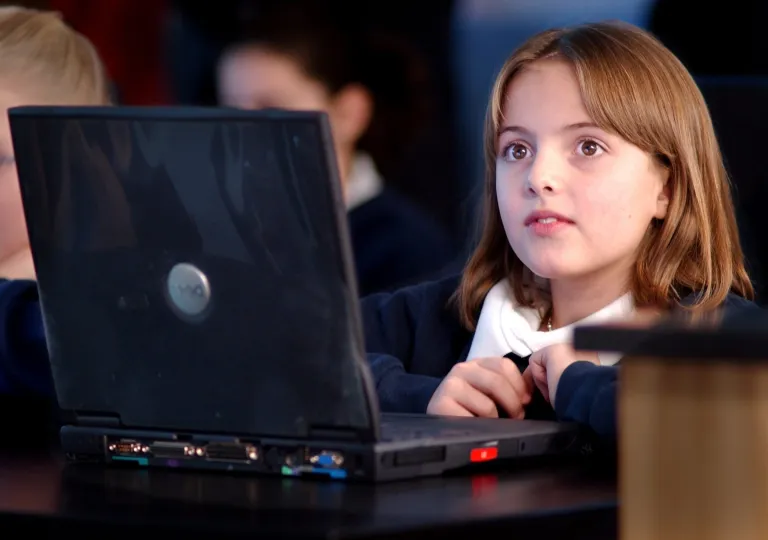
In 2002, Maine was the first state to give some grade levels laptops statewide. Angus King, who was governor at the time, thought the initiative would give more kids access to the internet, where they might learn a lot.
That fall, the Maine Learning Technology Initiative gave out 17,000 Apple laptops to seventh graders in 243 middle schools. By 2016, those numbers had grown to 66,000 laptops and tablets given to schoolchildren in Maine.
People all throughout the country have copied King’s first steps. The U.S. spent more than $30 billion in 2024 to put computers and tablets in schools. But more than 25 years and many new types of technology later, psychologists and educators perceive a different result than what King wanted. Instead of giving the generation more knowledge, the technology did the opposite.
Jared Cooney Horvath, a neurologist, told the U.S. Senate Committee on Commerce, Science, and Transportation in writing earlier this year that Gen Z is less smart than prior generations, even though they have never had access to so much technology. He added that Gen Z is the first generation in a long time to do worse on standardized tests than the one before it.
Horvath said that cognitive ability has been going down over the past ten years or so, even though skills measured by these tests, like reading and writing, are not always a sign of intelligence.
Horvath used data from the Program for International Student Assessment, which tests 15-year-olds from all over the world, and other standardized tests to show that not only were test scores going down, but there was also a clear link between scores and time spent on computers in school: the more time students spent on computers, the worse their scores were. He said that students’ unrestricted access to technology hurt their ability to learn instead of helping them. The iPhone’s release in 2007 didn’t help either.
Horvath remarked, “This is not a debate about rejecting technology.” “Aligning educational tools with how people really learn is the issue.” Evidence suggests that indiscriminate digital proliferation has compromised learning environments rather than enhancing them.
The writing may have already been on the wall. In 2017, Fortune said that Maine’s public school test scores had not gotten better in the 15 years since the state started its technology push. Paul LePage, who was governor at the time, termed the initiative a “massive failure,” even though the state was spending a lot of money on contracts with Apple.
Now Gen Z will have to deal with the consequences of their declining ability to learn. The changes brought forth by the 21st century’s other technology revolution, generative AI, have already had a big effect on the generation.
A first-of-its-kind Stanford University study published last year concluded that AI improvements have a “significant and disproportionate impact on entry-level workers in the U.S. labor market.” Horvath warned that a less skilled population means more than simply fewer employment opportunities and promotions. It also puts at risk how people will be able to deal with existential problems in the future.
“We’re facing problems that are more complicated and have a bigger impact than any in human history, like overpopulation, diseases that are changing, and moral drift,” he told Fortune. “Now, more than ever, we need a generation that can deal with nuance, hold multiple truths in tension, and come up with creative ways to solve problems that are stumping the smartest adults of today.”
How technology affects learning
In the last several years, the use of technology in the classroom has grown a lot. A poll of 846 teachers by the EdWeek Research Center in 2021 found that 55% of them stated they spent one to four hours a day using educational technology. Another 25% said they used the digital tools for five hours a day.
Teachers may want these tools to be only for learning, but students typically have other ideas. A 2014 study that looked at 3,000 college students found that they were doing things that weren’t related to schoolwork on their laptops almost two-thirds of the time.
Horvath said that this habit of getting off track was a big reason why technology makes learning harder. It takes time to get back on track when your attention is broken. Switching tasks also makes it harder to remember things and makes mistakes more likely. Horvath noted that dealing with a difficult single subject is hard. It should be that way for the finest learning to happen.
He added, “Sadly, ease has never been a defining characteristic of learning.” “Learning takes work, is hard, and is often uncomfortable. But it’s the friction that makes learning profound and useful in the future.
Jean Twenge, a psychology professor at San Diego State University who studies generational differences and wrote 10 Rules for Raising Kids in a High-Tech World, says that focusing on one thing for a long time is not how technology is used today. Spending more time on screens doesn’t help you learn; it really makes things worse.
Twenge told Fortune that “many apps, like social media and gaming apps, are made to be addictive.” “Their business model is based on getting users to spend as much time as possible on the apps and check back as often as possible.”
A study led by Baylor University and published in November 2025 found out why this is: TikTok was the easiest to use, even easier than Instagram Reels and YouTube Shorts, because it mixed videos that were relevant with ones that were startling and unexpected.
There are so many worries about social media addiction that 1,600 people from 350 families and 250 school districts have sued Meta, Snap, TikTok, and YouTube, saying they made platforms that are addicting and cause mental health problems with kids, like despair and self-harm.
Fixing the tech problem
Horvath came up with a lot of ways to help Gen Z with their tech problems, at least when it comes to using it in the classroom. He said that Congress might set standards for effectiveness to pay for study on which digital tools really work in the classroom. The legislature might also put strict rules on tracking behavior, establishing profiles, and gathering information about kids who use technology.
Some schools have decided to take matters into their own hands. As of August 2025, 17 states have made it illegal to use cell phones in school, and 35 states have regulations that limit how phones can be used in the classroom. The National Center for Education Statistics says that more than 75% of schools have rules against using cell phones for nonacademic reasons. However, enforcing these rules has had mixed results.
Horvath claimed that losing critical thinking and learning abilities is less of a personal failing and more of a policy failure. He called the generation of Americans who learned with gadgets victims of a failed teaching experiment.
“Whenever I work with teens, I say, ‘This is not your fault. Horvath remarked, “None of you wanted to sit in front of a computer for all of your K–12 schooling.” “That means we messed up, and I really hope Gen Z figures that out and gets angry quickly.”
About the Author