

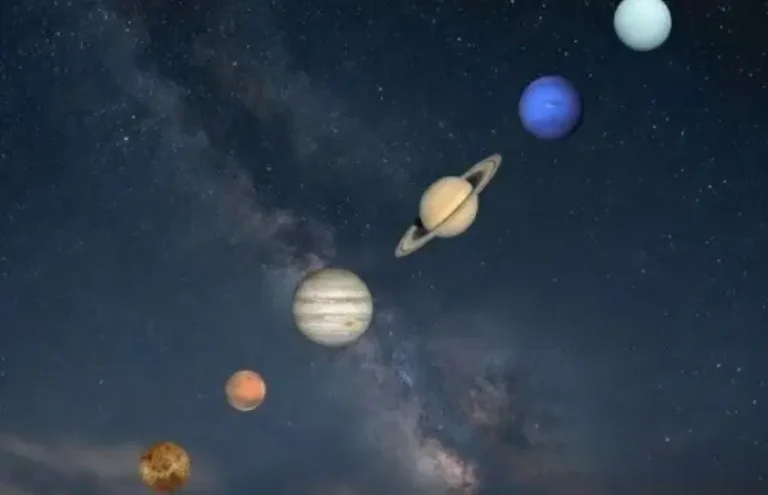
Experts say that this weekend, six planets will move across the sky in a unique cosmic event.
In the night sky over the next several days, you will be able to see Jupiter, Saturn, Venus, Mercury, Neptune, and Uranus all at once. However, you will need binoculars or a telescope to see the latter two.
NASA has published new sonifications for Jupiter, Saturn, and Uranus to celebrate the event. These are sounds made from astronomical data from the Chandra X-ray Observatory.
Dr. Megan Argo, a reader in astrophysics at the University of Lancashire, stated that seeing so many planets in the sky at once is an uncommon event.
“We can see this alignment now because the planets’ orbits have brought them all to about the same place in the sky from where we are on Earth. Because each planet moves around the sun at a different pace, they are always moving in relation to the stars. “Only sometimes do their paths cross in a way that puts a few of them together in our night sky,” she remarked.
It’s not very frequent to view six planets at the same time, but it’s not very typical to see four or five. Last year, all seven were visible at the same time, but the next full lineup won’t happen until 2040.
Argo predicted that all six planets would be visible on February 28 and for a few days before and after that. However, Mercury would be tougher to see by midweek, while Jupiter and Venus would be easy to see for months.
Argo added that anyone who want to see the planetary procession should go outside in the early evening, around 5:45 PM in the UK and 6 PM in the US, and choose a place with a clear view to the west, like atop a hill with no trees in the way.
The planets will look like they are in a curving line across the sky. If you live in the northern hemisphere, you may see Jupiter high in the southeast. Mercury, Saturn, Neptune, and Venus will all be near to the horizon in the western sky.
Venus will be the brightest of the three. Mercury will be considerably fainter to the right, while Saturn and Neptune will be a little higher up.
Argo added that Uranus will be hard to see since it will be below the Seven Sisters, a collection of stars. He also said that a stargazing app on your phone can assist you find the planet. Argo suggested that binoculars would also help, but that people should never look at the sun via binoculars or a telescope since it could hurt their eyes for good.
Dr. Ed Bloomer, an astronomer at the Royal Observatory in Greenwich, said that the event would also be visible in the southern hemisphere and follow a similar pattern. However, the parade will look different in the southern hemisphere than in the northern hemisphere.
Argo remarked, “In Australia, Jupiter will be in the north, and Uranus will be in the north-west, just above the Seven Sisters.” “Right now, the Sun sets a little later in Australia, therefore you should go outside after 6:45 p.m. local time. But Mercury is so close to the horizon at sunset that it probably won’t be seen in Australia. Venus will set by 7:15 PM, so you’ll need to be quick to see it.
She also said, “We actually have the moon in the mix tonight and for the next few days.” We can see a lot of the solar system.
About the Author