
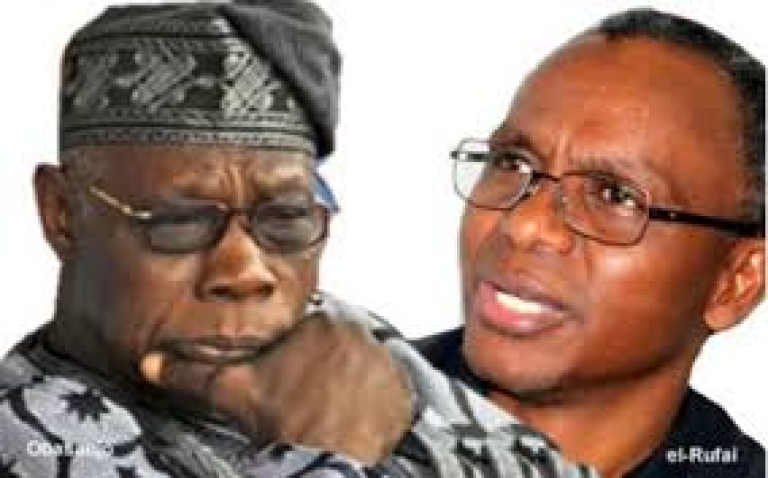
Former President Olusegun Obasanjo said yesterday that he didn’t want to make Nasir El-Rufai, the former governor of Kaduna State, his successor in 2007 because he wasn’t mature enough.
Obasanjo said this in Abeokuta, Ogun State, during the second annual symposium of the Ajibosin Platform, which was called “Importance of Leadership in Governance.”
Saturday PUNCH says that he said that Osita Chidoka, the former Minister of Aviation, had suggested El-Rufai as his replacement, but he turned it down.
El-Rufai worked for Obasanjo as the Director-General of the Bureau of Public Enterprises and then as the Minister of the Federal Capital Territory from 2003 to 2007.
When Obasanjo left office in 2007, he supported the late President Umar Yar’Adua as his successor.
Chidoka, who was the main speaker at the occasion, talked about how El-Rufai suggested him to Obasanjo when he was 34 years old. This pushed him closer to the presidency and finally led to his appointment as the Corps Marshal of the Federal Road Safety Corps.
Obasanjo playfully made fun of Chidoka for not telling the El-Rufai anecdote when he spoke to the group.
“Let him tell you.” He didn’t say anything about that. “Obasanjo claimed, “He was lobbying for his pal El-Rufai to be my successor when I left the cabinet.”
Obasanjo asked Chidoka, who was sitting among the panelists, “No be so?” What does that mean?
The old minister nodded his head in agreement.
Obasanjo then said that he didn’t follow El-Rufai’s advice to make him his successor because he thought his former minister needed to grow up.
The ex-president said, “I didn’t give in to the pressure.” He said later, “I suggested this person. Why didn’t you agree?” I told El-Rufai that he needed to grow up. Do you remember? When I left the administration, and many years later, he witnessed El-Rufai’s performances, he came back to me and said, “You’re right.” “El-Rufai needed to grow up.”
Obasanjo, on the other hand, praised Chidoka, El-Rufai, and others for their “special attributes,” which he said were what made his government work.
The former president talked more on leadership and said that good leaders have good character, exposure, experience, and training.
He said, “I only learned that there is no training for leadership in politics.” I heard that even armed robbers have to go through an apprenticeship. But politics is the only field where people don’t learn how to be leaders. That’s not good enough.
Chidoka said that Nigeria’s problems were caused by what he called “excuses” and the “politics of alibi” during his keynote speech earlier.
“Leadership is not about speeches or charm; it’s about the systems it leaves behind.” Moral commitment must turn into the rules, rituals, and institutions that make up the everyday workings of government. These should make competence predictable and corruption hard to find.
He added, “Nigeria’s problem has never been a lack of ideas; it is the lack of systems strong enough to outlive their authors.”
He said that people should stop making excuses and start taking action and being responsible.
Chidoka said, “We need to hold leaders accountable not just for what they say, but for what they do. We can do this by making national dashboards and accountability systems that keep track of every promise, every budget, and every outcome.” Strengthen the institutions that check how well the government is doing and expose laziness.
The person who organized the symposium, Aare Olanrewaju Bakinson, said that the presentation was meant to talk about how important good leadership is for building society and nations.
“Being a leader isn’t just about having power; it’s also about having a vision, being responsible, and serving others.” He said, “As we look into this theme, we’ll talk about what makes good governance, how leadership affects development, and how to encourage ethical leadership.”
Senator Shuaibu Salis from Ogun Central, Oba Saka Matemilola from the Olowu of Owu Kingdom, Oba Adeyemi Obalanlege from the Olota of Ota, and Mrs. Olufunsho Amosun, the former First Lady of Ogun, were some of the most important people at the occasion.
About the Author