
ERELU TÚNWÀṢẸ SERIES
SPECIAL EDITION — PART 1
A REVIEW OF THE RELATIONSHIP BETWEEN ILÉ-IFẸ̀, HER DESCENDANTS KNOWN AS THE YORÙBÁ, AND THEIR IGBO, HAUSA AND FULANI NEIGHBOURS
30 September 2026
BÍ ỌMỌDÉ BÁ ṢUBÚ, YÓÒ WO IWÁJÚ; BÍ ÀGBÀLAGBÀ BÁ ṢUBÚ, YÓÒ WO Ẹ̀HÌN.
When a child falls, the child looks ahead; when an elder falls, the elder looks back.
The elder looks back to understand what caused the fall. As we consider what is happening to our people and the situations in which we now find ourselves, we too must look back.
FIRST, LET US CALL A SPADE A SPADE
THE YORÙBÁ ARE THE DESCENDANTS OF ILÉ-IFẸ̀.
I speak boldly, without mincing words or keeping a stiff upper lip, as we say in England.
My position is clear: stop treating Ilé-Ifẹ̀ as though her identity can simply be absorbed into the name “Yorùbáland”. Let the areas known as Yorùbá acknowledge the name of their ancestral source: ILÉ-IFẸ̀.
For anyone hoping that a day will come when Ilé-Ifẹ̀ loses her distinct identity, my answer is firm:
IFẸ̀ REMAINS IFẸ̀.
ILÉ-IFẸ̀ IS THE FATHER. ILÉ-IFẸ̀ IS ALSO THE MOTHER.
This is how I express our ancestral relationship and the responsibilities that come with it.
I WRITE FROM DIRECT EXPERIENCE
My initial involvement in Ifẹ̀ affairs came unexpectedly through the immediate past Ọọ̀ni, after he met me as a politician in the United Kingdom.
His message to me was clear: IFẸ̀ REMAINS IFẸ̀. He was equally clear that Odùduwà remains in charge as the ruler of all those called Yorùbá. This was the ancestral understanding he conveyed to me.
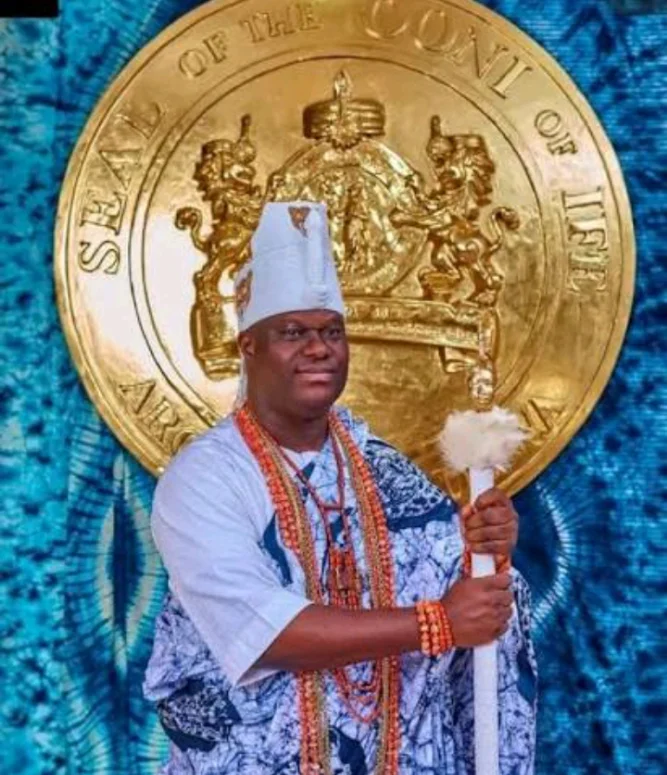
Every day for the past ten years, I have had the opportunity to witness, at close quarters—not through newspaper reports—the current Ọọ̀ni, Ọba Adeyeye Enitan Ogunwusi, Ọjájá II, enabling and maintaining what I describe as the effective parenting of the areas known as Yorùbá.
To me, this means continuing guidance, care and responsibility towards the descendants of Ilé-Ifẹ̀.
“IFẸ̀ OÒYE, Ẹ JÍ GÌRÌ, KÍ Ẹ GBÉ IFẸ̀ GA!”
“Ifẹ̀ Oòye, arise and lift Ifẹ̀ high!”
These are words from a song I hear every day in Ilé-Ifẹ̀. To me, they are a call to awaken, uphold our ancestral identity and take responsibility for the honour of Ilé-Ifẹ̀.
Quick question, my friend 😂: Is Ifẹ̀ male or female?
In Yorùbá thought, Ifẹ̀ is often personified as a mother—an ancestral source, nurturer and origin of her descendants. So, in this context, Ifẹ̀ is female.
When I speak of Ilé-Ifẹ̀ as both father and mother, I am describing the fullness of that parental role.
IFẸ̀ REMAINS IFẸ̀. WE ARE HER DESCENDANTS.
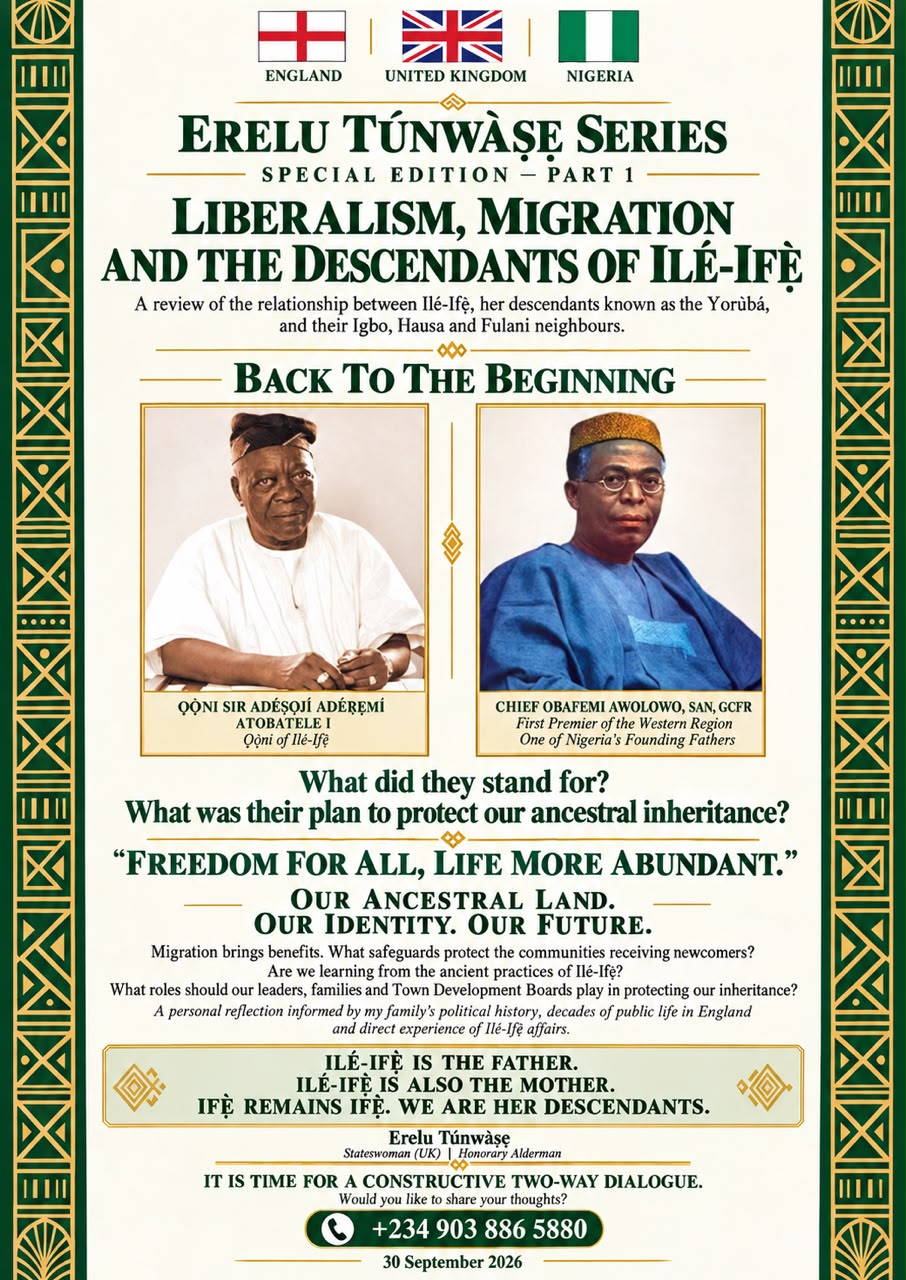
BACK TO THE BEGINNING — THE AWOLOWO DAYS
A fascinating discussion on the Yorùbá Referendum programme prompted this reflection.
Alàgbà compared the open expression of an Arewa agenda and an Igbo agenda with the inclusive outlook associated with Chief Obafemi Awolowo:
“FREEDOM FOR ALL, LIFE MORE ABUNDANT.”
He described this outlook as liberalism and drew a comparison with British society.
His argument raises an important question: does our concern for everyone make us hesitant to speak openly about our own interests?
To answer that fairly, we must ask what our earlier leaders stood for.
WHAT WAS AWOLOWO TRYING TO ACHIEVE?
Chief Obafemi Awolowo, SAN, GCFR, was the first Premier of the Western Region and one of Nigeria’s founding fathers.
In his April 1951 address as President of the Action Group, he set out four aims: freedom from British rule, ignorance, disease and poverty. His programme concerned Western Nigeria in particular and Nigeria as a whole.
These aims had practical meaning. His government pursued free primary education and healthcare for children. A more abundant life meant giving ordinary families better opportunities.
But Awolowo also recognised that Nigeria contained distinct peoples with different languages, histories and interests.
In Path to Nigerian Freedom, published in 1947, he described Nigeria as “a mere geographical expression”. He argued for federalism and warned of the dangers of centralised government in a country made up of different peoples.
His plan included regional self-government and greater protection for minority groups. He sought an arrangement in which people could work together while retaining substantial control over their own affairs.
We should therefore examine his concern for everyone alongside his commitment to the interests of distinct communities.
ỌỌ̀NI SIR ADÉṢỌJÍ ADÉRẸMÍ, ATOBATELE I
Ọọ̀ni Sir Adéṣọjí Adérẹmí, Atobatele I, was Ọọ̀ni of Ilé-Ifẹ̀ from 1930 to 1980 and Governor of the Western Region from 1960 to 1962.
He supported educational development, including Oduduwa College, and advocated for the University of Ife to be located in Ilé-Ifẹ̀.
Both he and Awolowo took part in the 1953 constitutional conference.
Here was an ancestral ruler helping to shape modern government while occupying the throne of Ilé-Ifẹ̀.
What can we learn from that relationship between ancestral responsibility, education and political leadership? We must examine their recorded decisions carefully rather than assume that they held identical views on every matter.
WHAT WAS THE PLAN TO PROTECT OUR INHERITANCE?
Awolowo and Adérẹmí did not create the British amalgamation of 1914. Their generation negotiated how the inherited country would be governed as colonial rule ended.
Regional self-government formed part of that arrangement. The Western and Eastern Regions attained internal self-government in 1957, followed by the North in 1959.
Yet a question remains:
WHAT SAFEGUARDS WERE PUT IN PLACE FOR THE ANCESTRAL LAND WITHIN THOSE REGIONS?
Joining a federation did not automatically mean surrendering ownership of ancestral land. But regional government alone does not explain how each town, family and lineage would protect its inheritance.
Who could authorise a sale? Who would keep the records? Who would protect sacred places? Who would consider the needs of children yet unborn?
These are the practical questions I want us to address.
THE BRITISH COMPARISON — MY OWN EXPERIENCE
I moved to the United Kingdom at the age of 17 to join my parents, who came from a political family in Lagos involved in negotiating Nigeria’s independence, both in Nigeria and in England.
My involvement in British political life dates back to the days of Sir Edward Heath as British Prime Minister.
Over the years, I joined a political party, contested elections and won. Today, I am a stateswoman, holding the lifetime English civic title of Honorary Alderman.
I therefore write from my family’s political background, decades of living in England and my own participation in its public life.
I recognise the concern about political correctness: people may feel they must soften their words, or remain silent, for fear of being labelled prejudiced or tribalistic.
Liberalism concerns freedom, rights and tolerance. Political correctness concerns how we speak and behave towards others. They are different, but both enter this discussion about whether people feel able to raise concerns about their own communities.
We must be able to speak honestly and examine what is said fairly.
MIGRATION: THE BRITISH DEBATE
In January 1978, Margaret Thatcher, then Leader of the Opposition, spoke about fears of being “swamped” by a different culture. She supported the prospect of ending immigration on the scale then occurring.
In his 1968 Birmingham speech, Enoch Powell called for immigration to stop or virtually stop, and for people to be encouraged to leave through re-emigration. His speech also treated immigrant-descended populations as a danger. That sweeping judgement must be distinguished from a careful examination of migration policy.
These statements show how long the argument has existed. They do not prove that every warning was correct.
My concern is practical: how does a welcoming society protect its land, identity and future?
MIGRATION HAS BENEFITS. WHAT ABOUT THE DANGERS?
Migration can bring skills, trade, investment, workers and new opportunities.
It can also increase demand for land, housing, schools, water, roads and healthcare. Where planning and investment fail to keep pace, communities feel the pressure. National financial benefits do not automatically provide each neighbourhood with the services it needs.
The benefits may also be uneven. A landowner may gain from higher prices while a local family can no longer afford to live in its own town.
Our language, sacred places, history and institutions also require care. Their survival should not be left to chance.
International migration into England and movement within Nigeria take place under different arrangements. Even so, both raise questions about how communities manage change and retain a voice in their future.
OUR ANCESTRAL LAND, OUR IDENTITY, OUR SPACE
We hear complaints that ancestral land is being “taken over”.
We must listen and establish what is happening. Does a particular case involve force, fraud, a disputed sale, rising costs or poor planning?
Who authorised the transaction? Did that person have the authority? What role did local families, leaders and agents play?
Who benefits today, and who will bear the consequences tomorrow?
These questions should guide our examination of relationships with Igbo, Hausa and Fulani neighbours. We must examine particular actions on their evidence, rather than assume that an entire people acts with one intention.
Protecting our inheritance requires clear knowledge of how it is being managed.
ILÉ-IFẸ̀ DEVELOPMENT BOARD — SOMETHING I KNOW PERSONALLY
During the Ọlọ́jọ́ Festival, I sat next to one of the officials of the Ife Development Board.
I therefore know of its existence through firsthand, direct experience. It is real, not a myth.
My experience also suggests that Ilé-Ifẹ̀ retains practices that help protect ancestral land. We should examine how those practices work and what other communities can learn from them.
The Board’s existence gives us a practical starting point. We can establish its responsibilities, understand its work and examine its relationship with land and heritage protection.
ARE WE LOOKING MORE TO THE WEST THAN TO ILÉ-IFẸ̀ FOR GUIDANCE ON PROTECTING OUR INHERITANCE?
FROM WORDS TO PRACTICAL ACTION
Should every town of Ilé-Ifẹ̀’s descendants have an accountable development board, or strengthen an existing one?
Could a land and heritage committee help to record landholding, monitor transactions, protect historic places and raise concerns about improper dealings?
Such work would require honest records, community involvement and clear responsibilities. The people entrusted with protection must themselves be accountable. Any binding powers would need a proper legal basis.
Families, traditional institutions, women, young people and relevant professionals should all have a voice.
Our responsibility is to protect what we have inherited and consider what we will leave behind.
“FREEDOM FOR ALL, LIFE MORE ABUNDANT” SHOULD INCLUDE THE FREEDOM AND WELL-BEING OF THE COMMUNITIES WHOSE ANCESTRAL HOMES MAKE THAT SHARED LIFE POSSIBLE.
ILÉ-IFẸ̀ IS THE FATHER. ILÉ-IFẸ̀ IS ALSO THE MOTHER.
IFẸ̀ REMAINS IFẸ̀. WE ARE HER DESCENDANTS.
Erelu Túnwàṣẹ
Stateswoman (UK) | Honorary Alderman
IT IS TIME FOR A CONSTRUCTIVE TWO-WAY DIALOGUE.
Would you like to share your thoughts?
+234 903 886 5880
About the Author