
A civil society group and three other plaintiffs have filed a suit before the Federal High Court in Abuja challenging what they described as the alleged procedure taken by the House of Representatives in approving the constitutional amendment bill aimed at establishing State Police in Nigeria. JoinNetworks Diaspora
The suit, with number FHC/ABJ/CS/2191/2026, was filed in line with Order 3, Rules 2 and 9 of the Federal High Court (Civil Procedure) Rules 2019.
As of Friday, Daily Trust gathered that the complaint has not been assigned to any judge.
The plaintiffs, Abuja School of Social and Political Thought, Speak-Out Africa, Ushakase Agwa and Abdullahi A. Sani, are requesting the court to declare that the supposed enactment of the State Police Bill is illegal, invalid and of no effect.
The Abuja School of Social and Political Thought is a Nigerian policy and human rights organization of legal practitioners, academics and policy professionals dedicated to the advancement of the rule of law and constitutional administration.
The claim, brought against the House of Representatives and its Speaker, is based on the interpretation of Sections 9(1), 9(2) and 56(1) of the 1999 Constitution.
The plaintiffs argue that a bill to amend any section of the Constitution should be supported by at least two-thirds of the members of the House present and voting, and such support must be proven by real voting by individual members, not by a voice vote.
They are also seeking the court to decide whether the constitutional requirement for a two-thirds majority can be met without the text of the amendment bill being read clause by clause.
The plaintiffs disputed, in particular, the putative passage of the Constitution (Sixth Alteration) Bill, 2026, relating to the establishment of State Police, by the House of Representatives on 23 July 2026.
In the originating summons filed on 21st August, 2023 by their counsel, Sam Amadi of Logosphere Attorneys, Abuja, the plaintiffs argued that the bill sought to amend a host of constitutional provisions, including Sections 84, 89, 121, 124, 129, 153, 157, 158, 160, 197, 201, 202, 204, 214, 215 and 216, amongst others.
The plaintiffs want the Court to declare that the provisions of the Constitution relating to changes of the Constitution require the House to accept such adjustments by a two-thirds majority of the members present and voting.
They are also seeking a ruling that passage of a constitutional amendment must be determined by clause-by-clause consideration of the proposed legislation and actual votes of members, not by voice vote.
The plaintiffs also demand a declaration that a measure for a constitutional amendment passing without explicit clause-by-clause examination is null and illegitimate and one that passes without an actual tally of the votes that secured the two-thirds majority is also invalid.
In another relief, they are assailing Order 11, Rule 2 of the Standing Rules of the House of Representatives, saying that the provision is inconsistent with the Constitution to the extent that it supposedly allows for the approval of a measure through voice vote.
They are also seeking a declaration from the court that the purported passage of the State Police Bill on July 23 was unconstitutional, null and of no effect as they say it was passed without clause-by-clause reading of its provisions and without an actual two-thirds vote of members.
Plaintiffs: We challenge processes, not bill
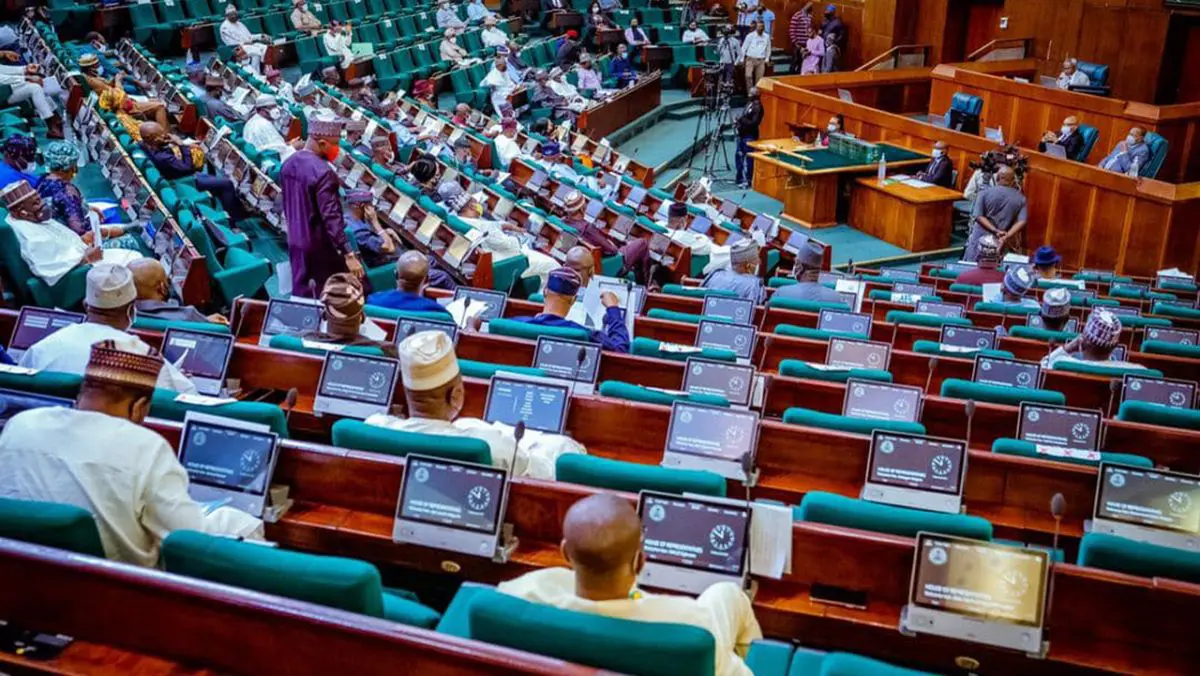
The case arises after the State Police constitutional amendment was passed at the federal level by the National Assembly. The Senate passed the bill on June 24, 2026, while the House of Representatives passed it on July 23, 2026.
Then the amending process has to be considered by the State Houses of Assembly.
The plaintiffs are not challenging the merits of establishing the State Police but the mechanism the House used to amend the nation’s ultimate legislation, as required by the Constitution.
They are asking the court to establish whether the legislative process used by the House was in accordance with the provisions of Sections 9(1), 9(2) and 56(1) of the Constitution.
The originating summon is supported by a 14-paragraph affidavit.
The plaintiffs, in an affidavit sworn to by Ushakashe Agwa, the communications officer of Abuja School of Social and Political Thought, said they read newspaper reports and watched video clips of the House proceedings during the passage of the bill on July 23, 2026, and became concerned about the legislative process. Subscribe to New
They said the Speaker who chaired the proceedings did not allow the bill to be read and studied section by clause before it was allegedly passed through voice vote.
“The plaintiffs want the court to determine whether the procedure adopted by the House was in accordance with the constitutional provisions for the amendment of the 1999 Constitution.
In an affidavit sworn to at the Registry of the Federal High Court, Abuja on September 10, 2026, the plaintiffs – defined as politically concerned Nigerian citizens – wanted to know how their representatives voted on the plenary discussion of the bill.
The plaintiffs were also worried that while their case is pending in court, further legislative work could be done on the law.
The plaintiffs therefore sought a court order restraining further action on the bill and directing the House of Representatives to follow what they regarded as the legally authorised procedure.
They argued that the way in which the bill was approved was unlawful and subverted the rule of law and constitutional democracy.
Minority Caucus Resistance
Recall that the Minority Caucus in the House of Representatives walked out of session on July 23, 2026 to protest the passing of the constitutional amendment bill that seeks the establishment of State Police Services across Nigeria. Join Diaspora Networks
The opposition MPs said their move was not a rejection of state police but a protest against what they said were abuses of constitutional rules and parliamentary procedures during the bill’s approval.
Speaking to journalists after the walkout, Minority Leader Fredrick Agbedi accused the House leadership of “ignoring the provisions of Section 9(2) of the 1999 Constitution as it conducts the amendment process.
“Constitutional amendment bills are to be considered clause by clause and approved by two-thirds majority of members and the procedure that was adopted for the state police bill did not meet those requirements,” Agbedi said.
The members said the Speaker, Abbas Tajudeen, just read the long title of the bill and put it to a voice vote without allowing a full discussion of the individual clauses.
But then the House of Representatives revealed that the amended bill was passed with the backing of 311 lawmakers.
Abbas said that 276 members voted physically, while 35 others participated digitally.
The bill titled, “A Bill for an Act to Alter the Constitution of the Federal Republic of Nigeria, 1999, to Provide for the Establishment of State Police Services and for Related Matters (HB. 2797),” seeks to establish state-controlled police formations as part of a broader effort to improve security and policing across the country. Join Diaspora Networks
‘Two thirds not established’
The plaintiffs’ counsel, Dr Amadi, stated that a video of the adoption of the State Police measure on the floor of the House proved that there was no clause-by-clause review of the measure and the voice vote was not tabulated to identify who voted for or against the proposed alteration.
When asked to comment on the Constitution’s silence on whether the members should be physically present or not, the counsel said, “The argument is that: first you have to establish that two-thirds, whether they voted electronically or they voted in person, have voted for the bill. The evidence that we gave in the video that is connected to the report is that there was no voting. It was a voice vote.
We don’t know about suit — Reps
When contacted, deputy spokesperson of the House of Representatives, Philip Agbese, stated the House was not aware of the suit.
“The House is not aware of any such suit. The House has not been served with any court processes,” Agbese added. I am only reading about it now from your message.
“The separation of powers is a bedrock principle of our democracy. You cannot utilise the courts to block the National Assembly from executing its constitutional functions.
There is no foundation whatever for the charge that the House violated its own rules in approving the State Police law.
“The 10th House fully complied with its Standing Orders and the Constitution in considering and passing the bill.”
About the Author