
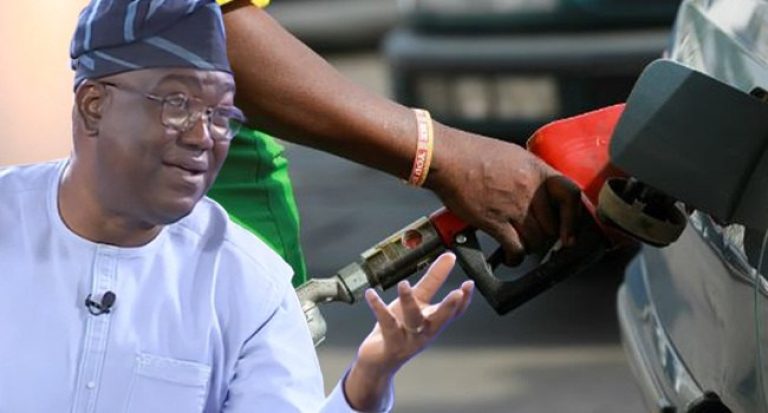
The presidential aspirant of the Accord Party, Gbenga Olawepo-Hashim, has branded the long-running discussion about fuel subsidy in Nigeria as “accounting magic”, stating that the high price of petrol is mostly the outcome of the way the government accounts for and prices locally produced crude oil.
Hashim, while speaking on Channels Television last nite, said Nigerians have been persuaded to feel that the country cannot afford lower petrol while in his judgement, the actual cost structure shows otherwise.
He said the price of petrol is currently inflated because Nigeria prices its petroleum at a level he believes exorbitant in the country.
“The reality is that right now the price is inflated. Who by? “By the government,” Hashim said.
The local crude price, he said, is roughly $30 per barrel, according to Nigerian National Petroleum Company Limited (NNPCL) figures. That compares to Saudi Arabia where the cost of production is around $10 a barrel, he noted.
The cost of producing a barrel of oil is $30, and adding a $15 margin, $5 for refining and $7 for shipping and insurance, would bring the total to nearly $57 a barrel, Hashim added.
He said this may amount to a petrol price of about 34 cents, or about N501 per litre at the exchange rate of N1,400 to the dollar, according to his computation.
“So, the proposed pump price of N605 per litre will comprise an additional energy tax of about N100, which can be used to develop alternative energy sources,” Hashim stated.
The current system of fuel subsidy should be viewed from the angle of accounting and domestic pricing of crude, he said.
“What you have had really has never been a subsidy, even when we had lower pump petrol prices. “The subsidy issue is more of an accounting magic,” he remarked.
The Accord Party chairman, who spoke, said Nigeria should not sell crude to its home market at the same rate as it sells crude to the international market.
“International crude pricing is an opportunity price and should not be the automatic basis for the pricing of crude allocated for domestic consumption,” he said.
“You cannot price your local products at international price,” Hashim stated.
He highlighted Saudi Arabia and Kuwait as examples of oil-producing countries that do not apply international crude prices to their domestic markets the way Nigeria does.
He said the gap should lead to a closer look at Nigeria’s oil production expenses and suggested “a lot of over-invoicing” may be involved. He said the high price of crude oil at home needed to be explained.
“If anyone else has another idea, they should bring their books. “Let’s see what it is, how much does it cost to produce a barrel of crude in Nigeria,” he remarked.
About the Author