
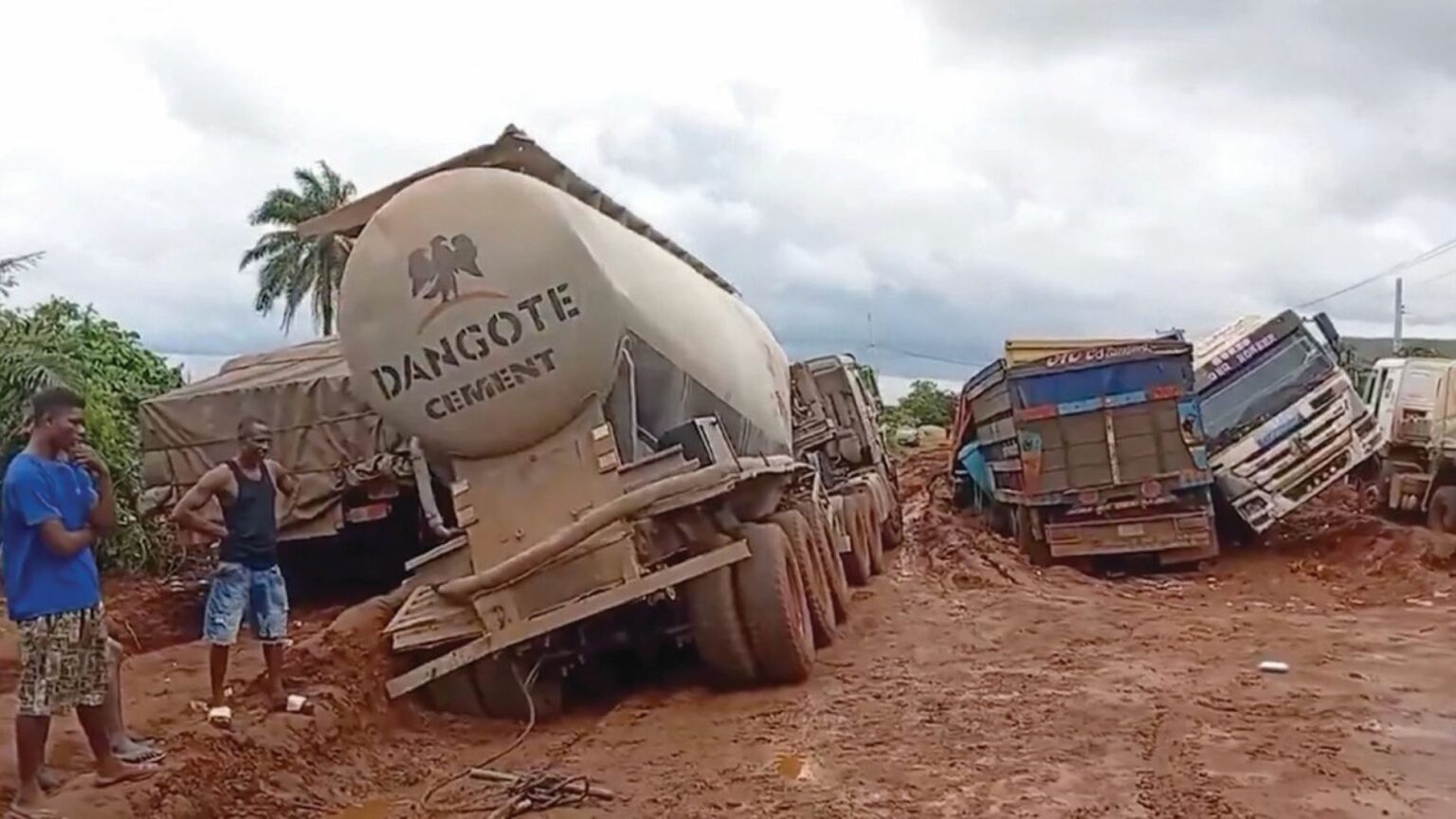
The worsening circumstances on main roadways led to a five-day jam that has stymied activities across the South-South, a development that has immobilised enterprises in the zone and ground the economy to a halt.
The Guardian notes that while it is difficult to gauge the whole impact of the crisis, manufacturers have lost over N500 billion in industrial closures, detained and destroyed raw supplies.
The figure does not include the millions of naira traders and distributors lose to perishable commodities that would have been disposed of when they eventually got to their destination.
The extended traffic snarl, especially on the Benin-Sapele-Effurun Road, has left travellers delayed for days with thousands of vehicles carrying raw materials, finished products and crucial consumables stranded on the roadways.
Commuters have been seen leaving their automobiles and travelling great distances while commercial motorcyclists have become the primary means of escape from the bottleneck, as shown in social media videos.
Reports have emerged of truck drivers being on the road for as long as a week with some goods already damaged or spoilt.
The bottleneck has hit the Edo State capital and key towns across the state, dislocating businesses in the historic metropolis of Benin.
Other routes such as the Benin-Auchi Road (linking Ondo/Edo to the Federal Capital Territory (FCT) and the Benin-Agbor-Onitsha Road (linking the South West and South East) are not spared.
Across the country, families have raised safety concerns as people travelling from the South East to South West now spend up to 24 hours on the road compared to the previous six to 10 hours.
Two major inter-state transport companies have suspended services on the road after their buses that left for Lagos three days ago were still to return as at press time, it was revealed.
GUO was claimed to have upped Lagos-Warri price to N55,000 on Sunday but ceased service yesterday until when normalcy returns.
The gridlock caused by damaged roads has further shrunk the travelling alternatives for millions of poor Nigerians who cannot afford flight tickets that go for as high as N300,000 for a roundtrip trip. Africans’ & Diaspora
The Benin-Sapele-Effurun Road, which was built during the administration of President Olusegun Obasanjo, was described as one of the best in the country after its delivery. But over the years it has become a death trap with years of neglect and zero care.
After years of pain, the Delta State Government has granted a N35 billion contract for the repair of 10 km at the Effurun end of the road to China Civil Engineering Construction Corporation (CCECC). But many who know the area say only a total restoration of the whole route can save the road.
Yesterday the federal government announced it was coming in to intervene in the problem.
Olufemi Dare, Assistant Director, Federal Ministry of Works, said the Minister of Works would visit the damaged corridor today to examine the situation.
He will reach the place and palliative work is also going to commence tomorrow (today). “That’s all I can say at this point,” stated Dare.
Nigeria is at a crossroads concerning new road demands and the demand for upkeep, a dilemma making for interesting debate ahead of the 2027 election. Africans & Diaspora
Peter Obi, a leading presidential candidate in the race, has said the country has to pay more attention to repairing hundreds of impassable routes across the country.
He tweeted yesterday that the Benin bottleneck had vindicated his position that the country did not need “new projects just for the headlines” but functional roads that promote economic operations. He called on the government to focus on rebuilding and maintaining existing roads and other infrastructure, rather than building new ones.
‘There’s not simply poor roads. It is about lost man-hours, travellers sleeping on highways, wasted gasoline, damaged vehicles, delayed products and businesses losing millions of naira… Obi, who bemoaned the experience of a relation who spent two days between Onitsha and Lagos, maintained that a government must appreciate that infrastructure is not necessarily about the scale of the project; it is about the number of lives and livelihoods it improves.
The Minister of Works, Dave Umahi, has said the Bola Ahmed Tinubu administration has transformed Nigeria into a construction site as it races against time to rebuild crumbling roads across the country. The government said it has finished more than 260 palliative and regional road projects and is actively constructing or dualising more than 80 federal highways, covering over 6,000 km across the country.
Manufacturers, traders and commuters are counting their losses as they seek urgent attention to address the situation.
The Immediate Past Chairman of the Manufacturers Association of Nigeria (MAN), Edo-Delta, Okwara Udensi, said the situation has hindered industrial activities in the region, warning that the businesses may experience additional distress if the roads were not promptly restored.
“We’ve been crying out for two years since this road became a write-off. “Previously, it was 45 minutes from Effurun roundabout to Benin. But now it takes us four hours. It has been taking us one week since this bottleneck started.
We’re getting worse and worse. The road is in horrible condition. “A major problem with our roads is that because of the bad condition of the road, if a caravan falls, it becomes impassible.
He said the bypass has been in a sorry state for a long time and successive attempts by the government to remedy the situation did not bring about any positive change.
He claimed the economic impact of the recent backlog had become huge, with firms unable to get inputs or to transport finished products.
“If I have to quantify our losses, we have lost more than N500 billion since this gridlock began. Factories are closed down; they are not working because they cannot get in their raw materials or get out their finished products.
We can’t even send marketing the ones we have.” Everything is locked down. We have no income coming in and the ones we have paid for are not coming in either. They are getting a little spoilt on the roadways. “It’s a big blow for us.
Udensi warned that the gridlock could spark an energy supply crisis with vehicles carrying petrol, diesel and petrol stuck on the roads affected.
But he added the situation may worsen if the products become scarce in the wake of rising fuel and diesel prices and the factories remained largely dependent on petroleum products because of the poor supply of electricity.
“We can’t run our industries on solar no matter what the government is claiming. “We are not getting electricity from the government so we still need petrol and diesel to run our machinery,” he said.
He said the situation was untenable, adding that firms could not thrive under the pressure of weak infrastructure, unpredictable power and escalating logistics costs.
“It’s a shame we’re still stuck like this in 2026. People have been stranded on roads for days, taking their lives and limbs in their hands to get off the road. We can’t do this anymore.” “The suffering is too great,” he remarked.
Udensi also condemned the silence of the elected members of the affected constituencies, accusing them of not pressurising the federal government to resolve the problem.
The route has been closed for a long time and it was already impacting transport, logistics, manufacturing and trade, he added, adding that if action is not taken soon, more enterprises could go into difficulties.
A former Director-General of the Lagos Chamber of Commerce and Industry and Chief Executive Officer, Center for the Promotion of Private Enterprise (CPPE), Dr Muda Yusuf, said the issue was a big economic disturbance and not a transportation problem.
“This is not a transportation problem, but an investment, security, food security and production problem because raw materials are stuck in gridlock,” he added.
“Prolonged gridlock exposes people and cargoes to security risks and disrupts contractual obligations and supply chains,” Yusuf said.
“Imagine lives and goods abandoned in the middle of nowhere, at the mercy of bandits and thieves for a week. “This is a very very serious thing and it should never happen,” he stated.
He said companies might be hit with extra costs through contractual penalties where delayed deliveries breached supplier agreements.
“Transporters who are stuck there also lost millions of naira in terms of trips they should have made but are stranded on the road. “The implications are enormous and it is a shame that we have allowed our roads to degenerate to this terrible level where goods and humans are stranded for almost a week.
Yusuf called on the federal government to expedite road maintenance and establish rail infrastructure to remove heavy cargo off the country’s highways.
‘Heavy goods should not be moving on the roadways and this is why our roads do not last. “The government should fix the rail system so we can move more goods by rail and our roads will last and maintenance costs will be reduced,” he stated.
He also condemned the response time of the Federal Ministry of Works, saying the authorities should have acted far earlier.
“We have a road maintenance agency, they should have reacted faster to this disaster. The reaction time is too slow. “We are getting to a week of gridlock and there is no solution and it shouldn’t take this long to fix it,” he added.
The crisis is still threatening Nigeria’s food supply system, but perishable items are especially suffering from being stuck on the roadways. Africans & the Diaspora
Poor rural infrastructure, including inadequate roads, transportation and storage facilities, were some of the key contributors to Nigeria’s post-harvest losses, the African Development Bank (AfDB) said.
The Bank’s Nigeria Country Food and Agriculture Delivery Compact had put Nigeria’s annual post-harvest losses at N3.5 trillion, saying better roads might minimise the losses by connecting farming communities to markets.
It attributed the rise in food prices to poor infrastructure, high transport costs and post-harvest losses of over 50 per cent for some commodities while eating into farmers’ profits.
Food inflation in Nigeria rose to a multi-month high of 20.31 per cent last month. The Guardian said near-zero and negative food inflation in certain of the north’s food-producing regions indicated a strong correlation between food prices and the cost of haulage.
About the Author