
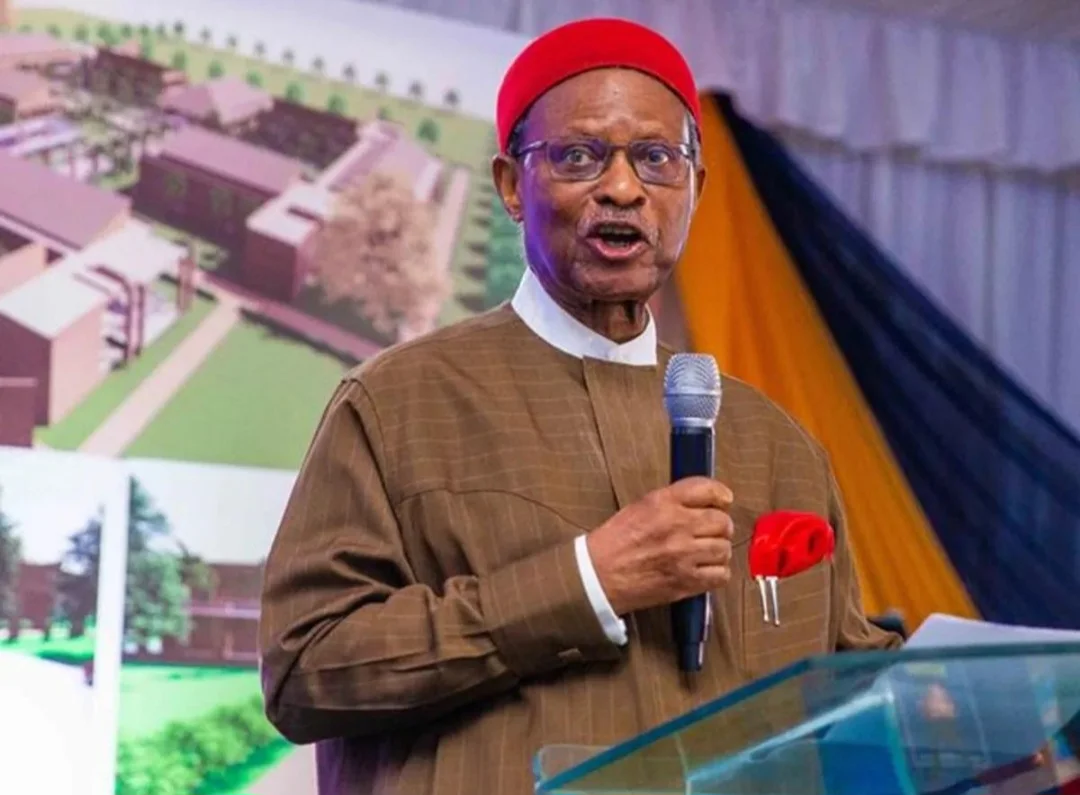
Former Secretary-General of the Commonwealth, Chief Emeka Anyaoku, has again urged Nigeria to produce a new constitution promptly, saying that any further delay will only exacerbate the country’s political and governance difficulties.
An elder statesman and leading voice for constitutional reform, Anyaoku told Nigerian media that the next administration that comes into being following the 2027 general elections should start producing a new constitution immediately.
Anyaoku told reporters in an interview on Wednesday that Nigeria’s current constitution is inherently faulty and cannot provide an effective framework for the country’s diversity and chronic governance difficulties.
He said the answer is not another round of piecemeal revisions to the 1999 Constitution which he described as incapable of providing the structural improvements Nigeria wants.
“The 1999 Constitution (as amended) is unamendable,” Anyaoku argued, arguing against the continued amendment of a text he sees as fundamentally flawed.
Anyaoku suggested the creation of a Constituent Assembly made up of representatives of Nigeria’s ethnic nationalities, spiritual and traditional institutions, professional associations and other interest groups.
He said the assembly should come out with a constitution that embodies the aspiration of Nigerians after wide engagement with key stakeholders.
Anyaoku said the new constitution should be informed by key articles of Nigeria’s 1960 and 1963 constitutions and recommendations contained in the 2014 National Conference report.
The senior politician has made similar points before. He assured members of The Patriots in 2024 that if the National Assembly completed the appropriate legislation and a constituent assembly was convened, a new constitution could be drafted in six to nine months. He also called for a referendum to lend some legitimacy to the new constitution.
Anyaoku said the new constitutional structure should clearly clarify the connection between the federal government and the federating divisions.
He particularly called for devolution of powers and a clear formula for resource allocation, stating that these problems are crucial to managing Nigeria’s diversity and improving the country’s federal structure.
His latest warning comes as political parties begin campaigns ahead of the 2027 elections, bringing constitutional reform and the shape of governance back into the national political discourse.
He warned that the election itself will not be the biggest challenge.
“We all hope there will be elections in 2027,” he added, adding that the key issue would be what happens after the election.
Country doomed without urgent action
Anyaoku said that failure by the administration that comes out of the 2027 election to immediately tackle the constitutional question could have catastrophic ramifications for Nigeria.
He said the ongoing insecurity, political tensions and developmental challenges facing the country underscore the need for a governance framework that can effectively manage its variety.
His position is in line with his consistent belief that Nigeria’s political and economic problems cannot be effectively handled without significant constitutional transformation. He also said in 2023 that the country required a new constitution to address instability, economic difficulties, polarisation and infrastructure challenges.
The recent contribution is expected to rekindle the discussion on whether Nigeria should try another revision of the 1999 Constitution or embark on the more difficult task of building a new constitutional framework.
About the Author