
Egyptians have celebrated the election of Abdul El-Sayed as the first Muslim member of the United States Senate. Public figures and social media users have praised his historic win, although the development received little coverage on the country’s state-controlled media.
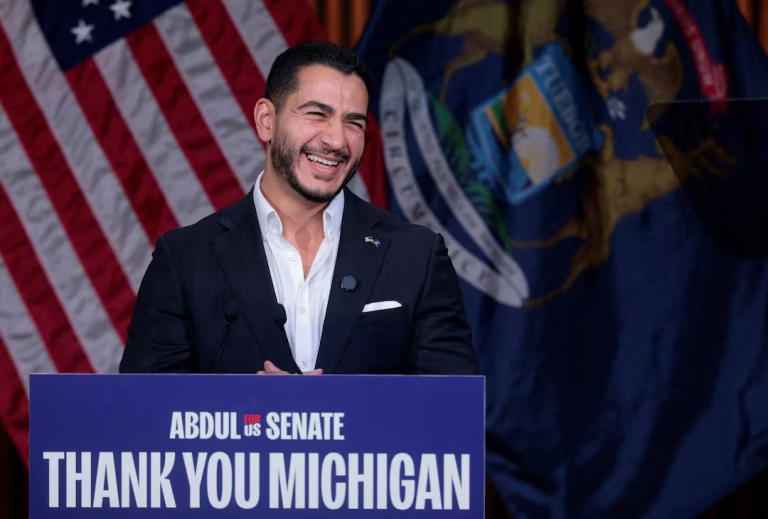
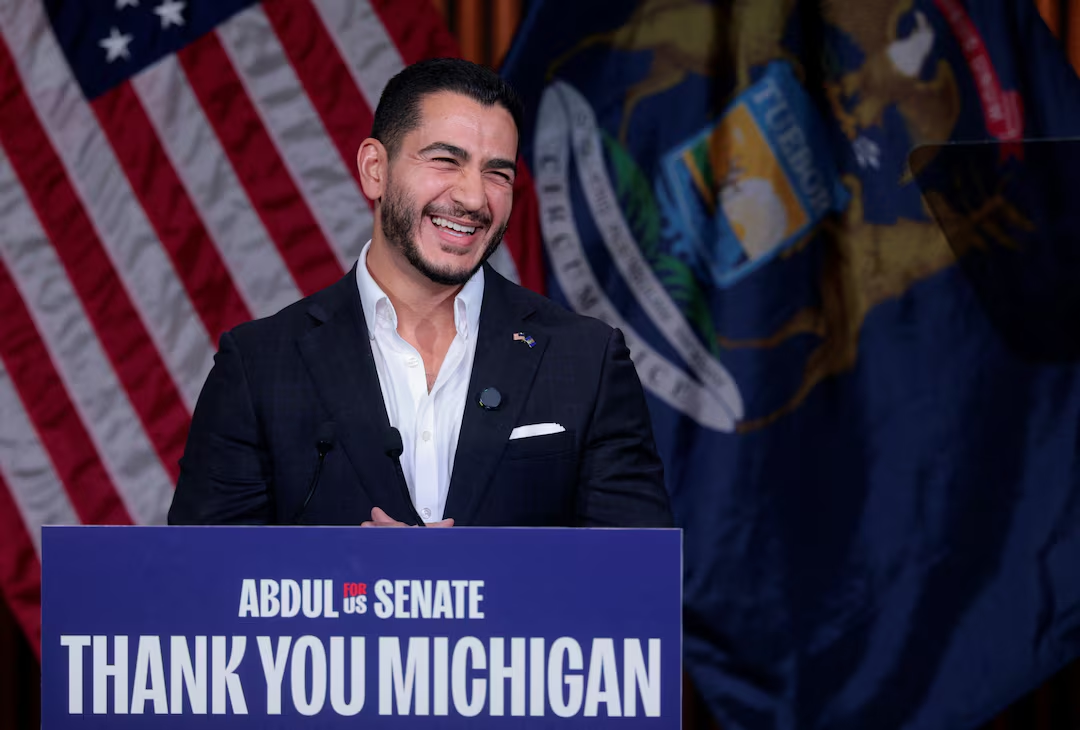
El-Sayed, 42, a Democrat and Egyptian-American, defeated Republican challenger Mike Rogers in the November 3 midterm elections in Michigan to become the first Muslim elected to the U.S. Senate. His triumph has raised eyebrows in Egypt, where his family ties and vocal criticism of the government have made him a politically sensitive figure.
Egyptian television stars and social media users applauded the outcome, calling it a great accomplishment for an Egyptian national and proof of the openings that exist within the American political system.
Television presenter Amr Adib stressed the importance of El-Sayed’s achievement, while another presenter, Yasmine El-Khateib, said the win proved voters could choose a candidate regardless of religious and ethnic divides. A video of El-Sayed’s victory speech, complete with an Egyptian-style ululation, also went viral online.
The result has attracted public notice, with Alaa Mubarak, son of former Egyptian President Hosni Mubarak, sharing a clip from the senator-elect’s remarks.
Egyptian state media, for the most part, treated the triumph similarly. State-aligned media have previously highlighted the achievements of other Americans of Egyptian heritage, Reuters said, making the difference striking.
Egyptian President Abdel Fattah el-Sisi
That attention has been scant amid El-Sayed’s outspoken criticism of Egypt’s political system and President Abdel Fattah al-Sisi. The senator-elect has called Egypt a military dictatorship and asked why American taxpayers should be subsidising its military institution.
Egypt is one of the top recipients of U.S. military finance by Washington, receiving about $1.3 billion a year. El-Sayed has said the U.S. should not give money to regimes who are suspected of cracking down on political dissent and violating human rights.
His criticism has not always been well received in Egypt. His campaign references to the lack of economic possibilities in his parents’ homeland drew fire from pro-government media and public figures.
El-Sayed was born in the U.S. to Egyptian immigrant parents and still has ties to the land his family came from. El-Sayed’s father came to the United States from Egypt in 1978, and El-Sayed has referenced his family’s connection to Alexandria.
His political beliefs have also been controversial in the U.S. He denied Republican opponents and President Donald Trump’s attempts to link him to the Muslim Brotherhood. The issue was around assertions about a 2012 letter supporting Egypt’s democratic transition, but a Guardian analysis concluded the message did not advocate the Muslim Brotherhood.
El-Sayed’s triumph came after a campaign in which he was repeatedly targeted for his Muslim faith, Arab ancestry and political stances. He campaigned on healthcare, affordability, and diminishing the clout of affluent donors in American politics.
His candidacy might provide a more visible platform to contest Washington’s military alliance with Cairo, especially as the Senate plays a key role in approving foreign assistance and scrutinising US foreign policy. But any significant adjustment in U.S. assistance to Egypt would have to have broader political and legislative backing.
The response to his win was complex, highlighting the intricate link between national heritage and political identity. While many Egyptians have hailed the achievement as a moment of pride for the diaspora, his criticism of Egypt’s leadership is a problem for state institutions that may otherwise have embraced the election as a success story.
About the Author