
The spillover of the continuing US-Iran confrontation has officially crossed the African continent and the African Union (AU) has responded quickly and resolutely.
The AU spoke out strongly against the incident a few days after a drone attack set two large energy ships on fire at Egypt’s Mediterranean Port of Damietta, calling it not only a regional clash but a direct attack on African sovereignty.
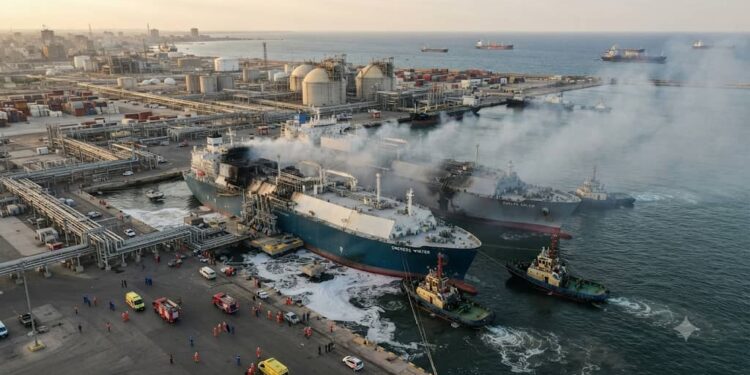
The July 29 incident saw an unidentified drone strike the Energos Winter, a floating storage and regasification unit owned by the U.S., with the fire immediately spreading to a Greek-owned tanker, the GasLog Salem.
The incident sent shock waves across the continent, but Egyptian officials managed to douse the flames without any loss of life.
Damietta is a key center for liquefied natural gas (LNG) exports, close to the very sensitive Suez Canal.
The strike is a dangerous precedent for the Chairperson of the African Union Commission, Mahmoud Ali Youssouf.
“A very clear line in the sand on foreign conflicts affecting the continent was drawn by the AU Commission Chairperson in a statement released on Thursday.
Africa must neither be allowed to become a dumping ground for wars from outside the continent, nor can vital civilian infrastructure be allowed to fall victim to such conflicts’, Youssouf said.
The Chairperson said that the national security of Egypt was intrinsically related to the stability of the larger continent.
By presenting the attack as an infringement of the territorial integrity of an AU member state, Addis Ababa is issuing a message of continental unity against external proxy wars that undermine African trade and energy hubs.
The AU reiterated its dedication to international law and marine navigational security – crucial foundations for a continent relying on global commerce lanes.
Support for Cairo was quick and widespread. For example, Sudan’s Ministry of Foreign Affairs published a statement calling the strike a “hostile act” that undermines regional stability.
Somalia also condemned the incident, warning of the threats to freedom of navigation.
The Damietta strike is the newest hotspot in a fast-expanding Middle Eastern conflict.
The attack came hours after the US and Saudi Arabia conducted coordinated air operations against Iran-backed militias in Iraq and as the Houthi blockade of Saudi warships in the Red Sea intensified.
The threat to the Strait of Hormuz has now spread to the Mediterranean where the attacks have been aimed directly at a country that has played an important mediation role in the situation.
But Egyptian authorities have indicated a polite, cautious response, with eyes on stability in the region, not revenge.
But the outspoken intervention of the AU adds a lot of diplomatic weight to the situation.
As the global powers jostle for position in the region, the African Union has made its position clear: The wars of the Middle East will not be waged on African land.Time and calendars
About the Author