
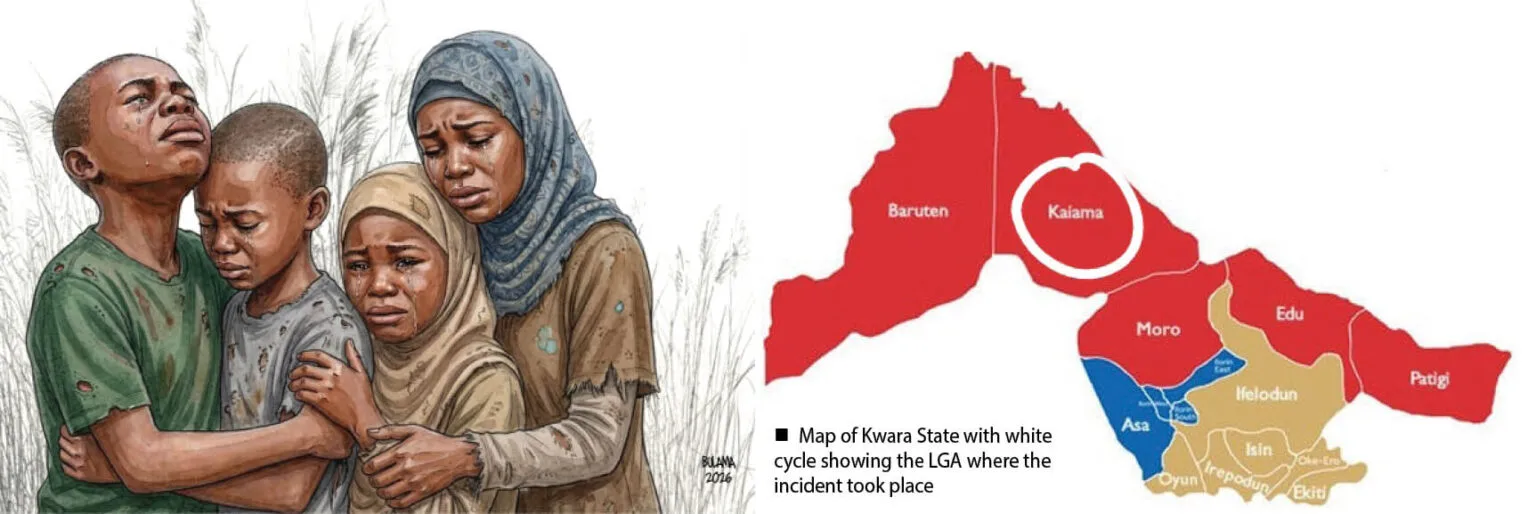
Families in Woro and adjacent areas in Kaiama Local Government Area of Kwara State had mixed feelings at the news of the recovery of kids and teachers abducted from a school in Oyo State after weeks of captivity by security personnel.
The tragedy has reopened the wounds they have been carrying for almost six months, TNT newsonline reported.
The question on the lips of inhabitants of the impacted communities is “if the government could rescue those children, why not ours?”
Mothers who have not seen their children since February 3, fathers whose wives disappeared into the forest with toddlers strapped to their backs, elderly parents still awaiting good news from their relatives, are asking this and other questions hoping to hear a familiar voice on the telephone or news of their release.
For them, the rescue in Oyo was more than just another security achievement. It was proof that persons alive when armed gangs took them could still be found. It renewed hope that some 176 residents seized during the attack on Woro and other villages may be brought home safely if comparable commitment was shown.
But six months on from the attack and with a dismal future ahead, those hopes are slowly being replaced with dread. The victims are still missing and authorities have not yet officially confirmed their location. No rescue has been made public. The quiet has taken the place of the few telephone chats families used to depend on.
It is the silence that is killing us.” Alhaji Salihu Umar Bio, the village head of Woro, told our correspondent, his voice heavy with emotion.
The traditional monarch is not only speaking on behalf of his people, his wife and one of his children are among the hostages who are still being held.
They don’t speak to us any more. We have no contact to them. Nobody is telling us how they are living – whether they are eating or sick,” he claimed.
For Bio, each day is another reminder that his family is not yet complete.
The February attack on Woro wasn’t just about houses and lives lost. It was also about broken families, towns emptied out and hundreds of individuals trying to piece together their lives in the face of uncertainty.
“Residents still remember that day with pain and agony after the death of over 150 persons at the last count.
Gunmen stormed the settlements killing scores of inhabitants before rounding up women, children and other locals into the enormous Kainji forest.
Months later those who stayed behind reported life had never returned to normal.
The farms originally supported many homes, but now fewer visit them.
In some households, people have stopped farming altogether, either because those who cultivated the property are among the abducted, or because the fear of another attack has kept them away.
The attitude of the towns is no longer about farming or economic activity, but about talking about people who never returned.
“Our people were kidnapped on 3 February and they are still there. It’s like no one talks about them anymore. That’s why we had a peaceful protest last Friday. “We wanted the government to know these people were still missing,” Bio said.
“One of the greatest pains for the affected families,” the village chief added, “is not knowing what happened to their loved ones.”
“If you call their phone numbers today, they no longer answer. We don’t know if they’ve fallen sick. “We don’t even know if they’re all still alive,” he continued.
He knew that among the abducted were youngsters who were barely old enough to understand what was occurring around them.
“There were children who were only three, five and six years old. Women who were pregnant, too. ‘Some of those women might have already given birth in the forest. We really don’t know,’ he said.
Another cause of anguish for the family has been every unresolved question.
No one has been spared from the emotional agony, according to Bio.
“Mothers cry for their children, children cry for their parents, every day starts with a prayer and ends with a disappointment because there is still no news,” he said.
Residents say the community’s frustration has also been compounded by the slow erosion of national attention from their tragedy.
The incident initially happened when government officials, security forces and humanitarian organisations visited the area. Public sympathy came in from around the country, but today people say they feel left behind. But for many whose loved ones remain in captivity, the nightmare is a daily reality.
Abductees become farm workers, labourers
Another citizen, Dr Abdul Ibrahim, who has been part of the community’s attempts to gain the release of the detainees, gave further insight on the predicament of the abductees. “Information reaching community leaders was that the abducted persons had become part of an organised system being run by the terrorists,” he said.
“The victims are still at the Kainji forest and the security operatives are very much aware of their location. They have not been relocated somewhere else.”
The most frightening element of the condition, he noted, was the fear that many of the detainees were no longer simply hostages but were being put to work as labourers.
‘Most of the males work on farms within the forest. They farm a fairly wide area of land. The kidnappers even have tiny tractors they are using in cultivation,” he said, adding that the development points to a level of organisation that goes beyond temporary camps established by fleeing criminals.
Ibrahim said the women detainees are forced to make shea butter while enormous quantities of harvested crops are being kept.
He continued, “It will interest you to know that our women are also involved in processing shea butter; and we already have over 2,000 sacks of harvested crops stored.”
The attempt to negotiate with the kidnappers is another tragic chapter in the community’s efforts to liberate its citizens, he said.
Residents, members of the Kaiama community in Abuja and other well wishers apparently sent money hoping it would be a way into debate.
But the effort failed, Ibrahim claimed. “The kidnappers refused the money, saying it was too small and told us to go and meet the government because they were after the government not the communities,” he stated.
“The community members raised over N150 million but the kidnappers rejected the money, saying they have spent more than that feeding the captives,” Ibrahim claimed.
“They told us that we should go and meet the governors of Kwara and Niger states to bring tangible money because the victims are from the two states,” he added.
The failed negotiation ushered in another difficult era for many families. Suddenly the telephone chats which had convinced them that their relatives were still alive were cut off.
“After the second conversation, the kidnappers warned that it would be the last time the victims would speak to us. That was a long time back. Since then, there has been no contact,” Ibrahim added.
The silence has dragged on for months and intensified anxieties after additional threats purportedly made by the kidnappers.
Some of the young girls among the captives could be forced into marriage if the impasse continued, warned armed men, said Ibrahim.
A member of the rescue team from the afflicted neighbourhood, who has been involved in the rescue efforts through negotiation, Dr Aliyu Umar, claimed people have used all available means to obtain the victims’ freedom despite repeated defeats.
He said the community pledged to collect more resources and up the offer to N200 million and N250 million after the first offer of N100 million was turned down by the kidnappers.
But the abductors have not yet accepted the new proposition.
“But we are still in contact through a mediator and that is the only source of information we have,” he continued.
Umar who spoke about the plight of the victims said the only information the community had was from the mediator who told them that the abductees were still alive despite the fact that there was no direct communication.
The mediator says our people are still alive. But we have no direct contact with them. He also told us they are being held in the same camp,” he added.
He also said the mediator told the community that some of the pregnant women taken had delivered their infants in captivity, which increased the number of persons still in captivity to more than 1500.
“The mediator told us that five of the pregnant women abducted have given birth in captivity. “The number of people in captivity has increased from 176 to 181,” Umar added, adding the event has devastated the whole village. Many families have been left shattered and unable to deal with the pain, he said.
He mentioned Wakilin Sarki Hausawa who was left alone after his three wives and all his children were abducted. Umar said the woman seen carrying twins in a widely circulated photograph was the last wife of the man, and one of his sons was slain before the others were taken away in front of the family.
The state Commissioner for Communication, Bola Olukoju, told our correspondent in a text message when contacted that “The state government is judiciously working on it.
Many victims’ families can no longer live normal lives. The safe rescue of our people is our biggest prayer. We did not sure how long this would last.
“We view it as political. “When you look at the reports from Borno State – that out of the N5 billion allegedly paid, only about N1.5 billion got to the bandits – it makes us feel that people’s lives are being used to play politics. That’s how a lot of us see what’s happening,” he said.
‘What is good for Oriire is good for Kaiama
The successful rescue of the Oyo schoolgirls has only increased the idea among many people that their families can also be saved provided enough resources and resolve are deployed.
Ibrahim said: “We saw what happened in Oyo State. Those students were saved, alive. We are thrilled for those families, but it also made us realise that our people deserve the same effort. We keep asking ourselves, why our folks are still there.”
‘Govt in progress
The government has not remained idle since the February assault. But the initiatives have not been able to satisfy the citizens who are demanding more collaboration with the federal government to repeat the Oyo scenario in Kwara.
The principal response was Operation Savannah Shield, a joint security operation by the Nigerian Army and other security agencies to expel armed groups operating around the Kainji forest and the Kwara/Niger border.
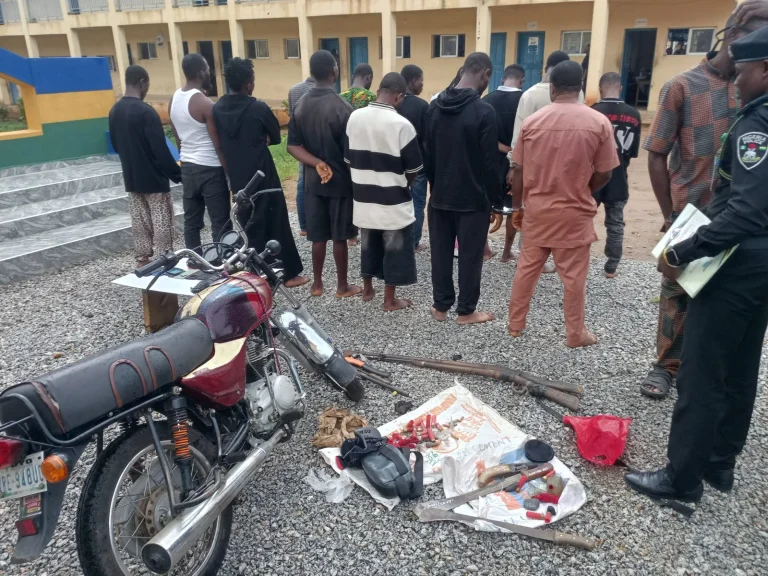
The operation has since recorded a number of successes with troops carrying out clearance operations in identified criminal enclaves, rescuing kidnap victims, recovering weapons and motorcycles, destroying camps used by armed groups and increasing military presence in several vulnerable communities across Kwara north.
The state government has also been consistent in its statement that it is giving logistics support to security agencies, boosting intelligence gathering and working closely with the Office of the National Security Adviser and the federal government to stem the growing activities of kidnappers and other criminal groups.
Governor AbdulRahman AbdulRazaq has at various occasions told locals that his administration will continue to help security authorities until normalcy returns to the afflicted communities.
But even with those efforts, Woro villagers said, the other triumph was eclipsed by the prolonged incarceration of their loved ones.
Of all, every successful rescue somewhere enhances their anticipation that comparable efforts should generate results in Kaiama.
“The security agencies know where the captives are being held. “That is why we keep calling on the authorities to increase efforts to rescue them as fast as possible,” added residents.
The head of the hamlet also said similar things. “We were expecting a proper search and rescue inside the forest. We thought that would be the case following the attack. But instead months have passed and we are still waiting.”
“I don’t know the exact amount that was raised and whether it had been taken to the kidnappers,” the village head who acknowledged members of the community contributed money remarked on the money rejected by the terrorists. What I know is that the community – at home, Abuja and other locations – donated because every body wanted these victims to regain their freedom.
He said the community had exhausted almost all peaceful options and added that the peaceful protest it planned recently was not to shame the government but to remind the authorities that the tragedy was not finished yet.
“Our people were taken away in February,” he stated. They don’t appear to talk about them anymore. “We organised the protest because we wanted the government and the country to remember that they are still there.
About the Author