
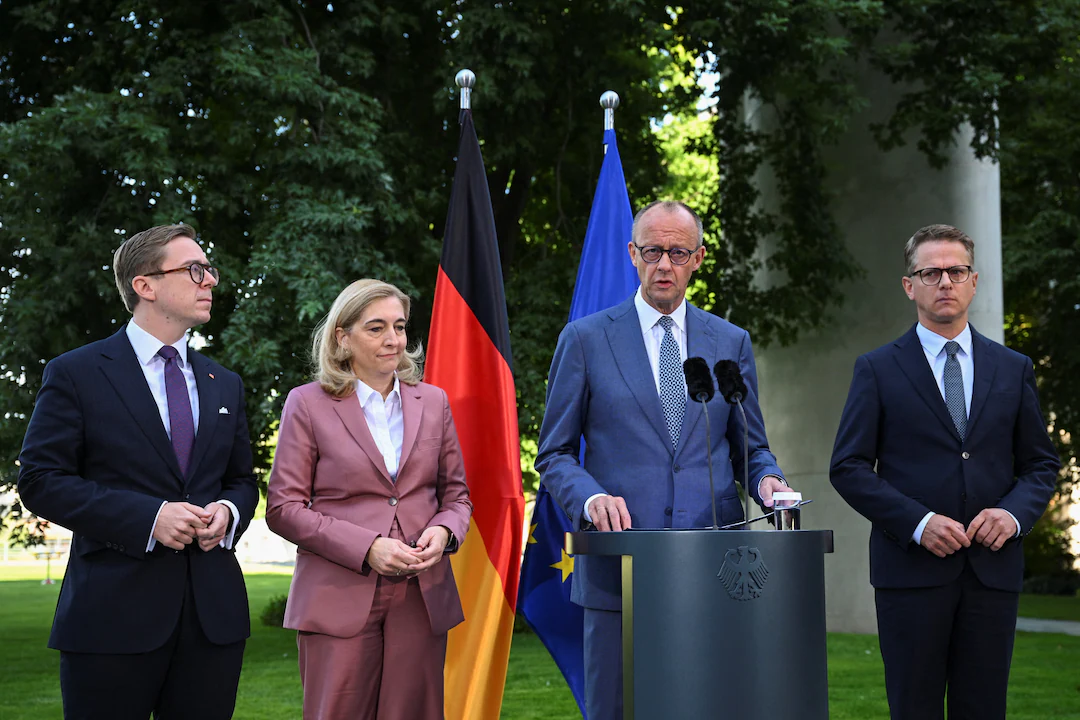
German Chancellor Friedrich Merz is under increasing political pressure after a divisive cabinet reshuffle that divided his conservative alliance and revealed rising dissatisfaction with his leadership ahead of key state elections in the coming weeks. What was meant to reboot his faltering government has instead drawn condemnation from parliamentarians and prompted additional questions about the viability of Germany’s governing coalition.
The move came after senior conservative Jens Spahn resigned as parliamentary head of the CDU/CSU coalition following controversy over his use of surrogacy. Merz moved fast to regain control, promoting close confidant Thorsten Frei to lead the parliamentary group and appointing former Health Minister Nina Warken as Germany’s first female chief of staff. Carsten Linnemann was picked to succeed Warken as health minister, and further staff changes were on the way.
But the revisions have provoked a storm of opposition inside Mr Merz’s own party. A key flashpoint was the sacking of Transport Minister Patrick Schnieder, a move that infuriated many parliamentarians from his home state of Rhineland-Palatinate. Several CDU MPs in the region reportedly declined to see the chancellor, claiming they had lost faith in the handling of the reshuffle.
The confusion was compounded when Merz’s preferred choice for the transport portfolio reportedly declined the job before eventually settling on another candidate, further fuelling complaints that the reshuffle had been poorly planned and communicated. The episode has raised questions about the chancellor’s political judgement from opponents and even some allies.
The internal turmoil comes at a politically delicate time. Germany is gearing up for crucial state elections in September, especially in the east of the country where the far-right Alternative for Germany (AfD) is steadily making gains. Recent opinion surveys show the AfD ahead of the CDU/CSU nationally, but Merz’s personal popularity ratings have dropped drastically, with only around 15% of Germans satisfied with his work.
Political observers say Merz is under pressure not just from the reshuffle but from broader popular worries about Germany’s slow economy, migration and the pace of promised changes. Critics say the administration hasn’t delivered visible changes since taking office, allowing the AfD to pitch itself as the main alternative to the governing coalition.
But Merz has defended the personnel reshuffle, saying it is needed to bolster his administration ahead of the September election campaign. He has said he is certain that tensions within the CDU will lessen in the coming weeks and that the administration will be able to refocus on economic reforms, infrastructure investment and national security.
The coming weeks could be key for the chancellor. The shakeup may ultimately be seen as a necessary reset if Merz can reunite the party and restore public faith. But if the infighting continues and the AfD continues to grow, the cabinet reshuffle could turn out to be a turning moment that further weakens both his leadership and the conservative bloc ahead of Germany’s most carefully watched regional elections in years.
About the Author