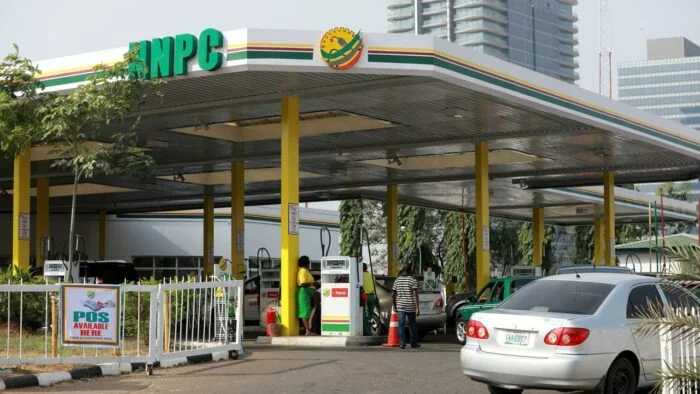

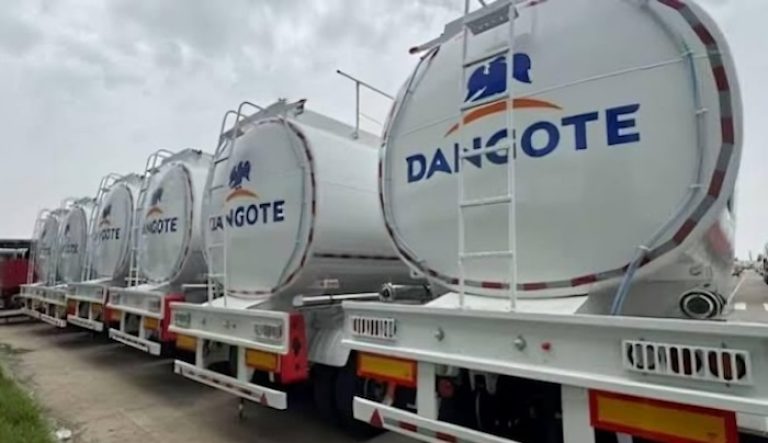
Nigeria’s downstream petroleum market is under fresh pressure as Dangote Petroleum Refinery resumed gantry loading of Premium Motor Spirit (PMS) in naira yesterday after a week’s suspension, but increased its ex-depot price by N140 to N1,215 per litre, a development that is expected to spark another round of pump price adjustments across the country.
The hike, an increase of 13.02% from the previous N1,075 per litre, comes barely one week after the refinery suspended truck loading and temporarily switched to dollar-denominated sales, a decision that disrupted supply, pushed marketers to private depots and drove ex-depot prices above N1,300 per litre, according to The Guardian.
Our correspondent sighted a placard stating that loading at the gantry had resumed under a revised naira pricing template, where all pending truck loading volumes will be repriced at N1,215 per litre with immediate effect.
The refinery hiked the price of the gantry from N1,075 per litre to N1,215 per litre, an increase of N140 per litre.
Customers were informed that the revised gantry and coastal prices are now in force and that all unloaded gantry volumes will be repriced at the new rate.
While the return to naira transactions is expected to ease supply bottlenecks, the new ex-depot price is expected to cascade through distribution chain, with marketers likely to pass extra cost to consumers through retail prices.
The refinery had reverted to coastal loading a day earlier, pushing up its coastal PMS price to $1,161.23 per metric tonne from $1,044.62/MT, up 11.2 per cent.
The current development effectively resolves the uncertainty created by the refinery’s brief period of dollar-pricing. The development also suggests that another hike in pricing at the filling stations may not be spared for motorists as marketers begin to incorporate in the cost of loading, transportation and operating margins in their retail prices.
But the National President of the Independent Petroleum Marketers Association of Nigeria (IPMAN), Shettima Maigandi, who spoke with our correspondent, described the decision to revert to naira transactions by the refinery as a welcome development that brought certainty to the domestic market after days of supply disruptions.
He said, “Though the new ex-depot price is higher than the previous rate, it is still lower than what independent marketers were made to pay after Dangote stopped loading.
“With what is happening worldwide with the Middle East crisis, the price is fair. “We were buying petrol from private depots at about N1,300 per litre when Dangote stopped selling. It is now N1,215. “It is fair with respect to what we were buying and we are happy that he has come back to naira sales,” he said.
He however, declined to forecast a new pump price, saying it would depend on marketers calculating transportation costs to their various destinations before changing retail prices.
The Petroleum Products Retail Outlets Owners Association of Nigeria (PETROAN) observed that while the refinery’s return to naira sales was expected and appreciated, the latest hike has once again demonstrated the growing pricing clout of a dominant supplier in the deregulated market.
Speaking, PETROAN National President, Billy Gillis-Harry said the earlier decision of the refinery to migrate to dollar sales was unsustainable, hence its return to Naira “the common-sense business thing to do.
He however warned that the market would remain vulnerable to unilateral price adjustments unless the Nigerian Midstream and Downstream Petroleum Regulatory Authority (NMDPRA) and the Federal Competition and Consumer Protection Commission (FCCPC) ensured effective competition in the downstream sector.
“Until the NMDPRA and the FCCPC rise up to implement and enforce market reflective pricing, we will continue to have this kind of situation where one dominant player will, at will, fix prices, jack them up and jack them down,” Gillis-Harry added.
He said Nigeria required greater refining capacity from facilities such as the Port Harcourt, Warri and Kaduna refineries to enhance competition and stabilise domestic petroleum prices.
The refinery last week stopped both coastal and gantry loading after the introduction of a dollar-denominated pricing template, citing problems in sourcing enough crude oil under the Federal Government’s naira-for-crude arrangement.
The suspension reduced product supply in the downstream sector and marketers were obliged to source supplies from private depots where ex-depot price jumped by around N200 per litre to about N1,275 reflecting increased replacement costs.
About the Author