
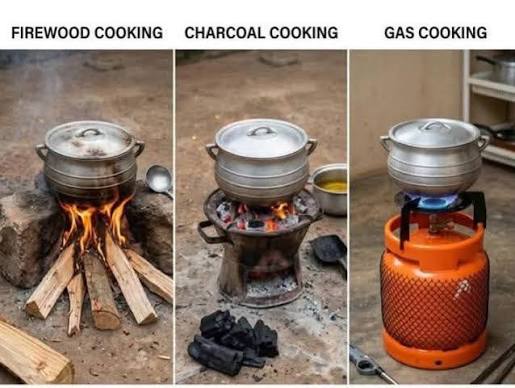
The rising cost of cooking gas in the Federal Capital Territory (FCT) has forced many homes and small businesses to stop using Liquefied Petroleum Gas (LPG) and go back to traditional cooking fuels like charcoal and firewood.
The price of cooking gas has gone up in the last several months, putting huge financial pressure on families, food sellers and other small-scale entrepreneurs who depend on LPG for their everyday activity. What was previously a cleaner, more efficient and inexpensive cooking alternative is quickly falling out of reach for many locals.
NAN’s investigations indicated that the price of cooking gas in Abuja, which was around N1,200 per kilogram earlier in the year, has risen to almost N2,000 per kilogram in several retail locations. Industry stakeholders are attributing the price increase to a mixture of supply bottlenecks, increased depot prices, forex issues, shipping costs and broader economic pressures in the energy industry.
As costs keep rising, consumers say they are being driven to find cheaper options to make ends meet.
Among those affected is Mrs. Mayo Akinpelu, a food vendor who operates in the Gwarimpa district of Abuja. With the constant hikes in petrol prices, she said, it was impossible for her to continue using LPG for her business.
“Refilling a gas cylinder has become very costly and my profit margin has been greatly reduced and this is putting the sustainability of my business at risk,” she said.
“The price kept going up and I found it difficult to fill my petrol cylinder. “I couldn’t afford it and still make a reasonable profit,” she explained.
Akinpelu said she has primarily converted to charcoal and firewood, which she buys in smaller quantities as and when needed.
Currently, 12.5 kg of cooking gas is roughly N25,000. While firewood and charcoal are not as convenient as gas, they help me cut operating costs and keep my business going’, she said.
The alternative fuels do occasionally slow down meal preparation and elicit complaints from consumers, but she thinks they’re still the most realistic option given present economic conditions.
Another food vendor, Ms Victory Samson who sells at Dutse in Bwari Area Council also shared same worries. She said her wages had been directly affected by the growing cost of cooking gas.
“The increase has had a big impact on me. “A good chunk of my income now goes to buy petrol which has cut into my profit margin considerably,” she said.
“It’s time for the government to step in and help stabilise prices, because a lot of small businesses are just trying to survive,” Samson told the government authorities.
At Kubwa, Mrs Grace Oluwatimilehin said she was frustrated after she learnt that the price of petrol had gone up again soon after she bought petrol.
“Last time I bought fuel, it was sold at N1,600 per kilogram. The last time I went to refill my cylinder, the price had risen to N2,000 per kilogram,” she said.
“Because of the increase in prices, I have had to use other means of cooking like electric hot plates and charcoal,” she said.
Now I mix techniques based on what is accessible and economical. “I use electricity sometimes, I use charcoal and firewood sometimes,” she said.
Higher petrol prices have placed a substantial hardship on already tight family budgets for many families.
Mrs Abike Ojo, a mother of one, said the persistent rise in the price of cooking gas is making household management more challenging.
“The last time I bought petrol, it was N1,500 per kilogram but today it is N2,000. I might just quit using petrol altogether if this keeps up since it’s getting too expensive’, she said.
Ojo urged government authorities to take quick action to resolve the situation, warning that continuing hikes could exacerbate the cost of living crisis facing many Nigerians.
The petrol dealers around Abuja also confirmed the sharp increase in pricing and acknowledged its effect on patronage of customers.
Mr Bamishile Bolanle, a petrol vendor in Kubwa, said many consumers now buy smaller quantities than before due to diminished purchasing capacity.
Gas is currently being sold for N2,000 per kilogram. People just can’t afford to buy as much as they used to, and that has damaged our business,” he said.
The price rise appears to be caused by product shortages, which he says is one of the main reasons, although operators aren’t entirely aware of the underlying causes.
Another petrol trader in Dei-Dei, Mr Alfred Orshio said the market has seen a slow but steady rise in prices all through the year.
The price of petrol was about N1,200 per kilo earlier this year. It later raised to N1,400, then N1,800 and now N2,000. “Now it costs about N25,000 to fill a standard 12-kilogram cylinder. “
“Now people are buying only a few kilograms at a time, not filling their cylinders fully,” Orshio said.
As customers turn away from cooking gas, the demand for the marketers of other fuels is going up.
A charcoal distributor in Kubwa, Mrs Amina Yakubu, claimed business had risen tremendously in the last several months.
“A lot of people can’t afford cooking gas anymore, so patronage has gone up,” she remarked.
Yakubu said she buys a bag of charcoal for N6,500 and sells it for about N8,000, adding that the demand keeps increasing on a regular basis.
Another charcoal trader, Mrs Saratu Ibrahim, said sales had gone up considerably.
“Where it would take a week to sell things now they’re selling in two days,” she remarked.
But she said the rising demand has brought many new participants into the charcoal market.
“I was the only charcoal seller on this street. Now there are more than five of us. People recognise the growing demand,” she said.
Firewood sellers also complain about increased clientele.
“Firewood is still one of the cheapest cooking options and many households and food vendors have resorted to it,” Mr Taninu Ibrahim, a firewood salesman, said.
Cooking gas is now quite costly for many homes and small company thus more people are buying firewood’, he said.
With the increased demand, the price of firewood has also gone up.
“Customers could buy six pieces of firewood for N1,000, not anymore. “Today you get only four pieces for the same amount of money,” he remarked.
Rising transit costs and growing demand are responsible for the price increase, according to Ibrahim.
More and more people of Abuja are returning to traditional cooking fuels, raising concerns about the environmental and health consequences of increased use of charcoal and firewood. But environmental experts have long warned that over-reliance on firewood causes deforestation and smoke from charcoal and wood fires can expose users to respiratory diseases.
But despite those concerns, many locals say economic realities leave them few options.
Stakeholders have so called on the government to tackle the supply issues in the LPG sector and to put in place measures to ensure price stabilisation. If that continues, they say, more homes and businesses may turn their backs on cooking gas completely, erasing years of progress in adopting cleaner energy.
Another sign of the increasing economic strains on ordinary Nigerians is the increased cost of cooking gas for many households in the Federal Capital Territory.
About the Author