
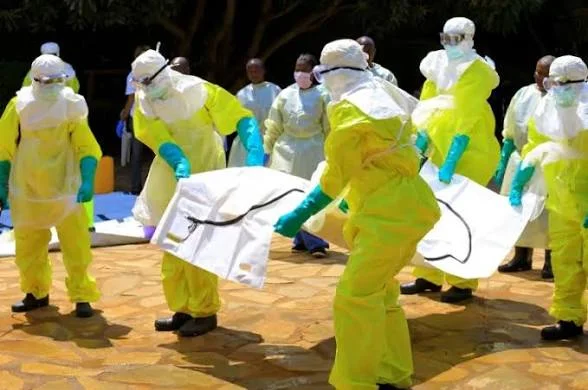
A fresh Ebola outbreak in the Democratic Republic of the Congo has killed at least 80 people and infected dozens more, with health authorities now rushing to contain the virus after a confirmed case traveled into neighbouring Uganda. The epidemic, disclosed in the conflict-hit Ituri Province in the country’s northeast, is the 17th time that Ebola has attacked the nation since the virus was originally detected in 1976.
The National Institute of Biomedical Research in Kinshasa has confirmed 13 of 20 samples taken from suspected cases in the Mongwalu and Rwampara health zones as being the Ebola Bundibugyo strain, following laboratory investigation. The current update shows about 246 probable cases and between 65 and 80 deaths in the community, four of which have been verified in laboratory-positive patients. The suspected index case was a nurse in the Rwampara health zone who died after acquiring symptoms including fever, bleeding, vomiting and severe fatigue.
The World Health Organization said it received an alert about possible cases on May 5, 2026, and immediately sent a mission to Ituri to facilitate investigations. The Director-General of the WHO, Tedros Adhanom Ghebreyesus, said he had released US$500,000 from the organisation’s Contingency Fund for Emergencies to help the initial response. “The Democratic Republic of the Congo has extensive experience in responding to Ebola outbreaks, and WHO is rapidly scaling up support to the ongoing response,” said Dr Mohamed Janabi, WHO Regional Director for Africa. “We are working very closely with the national authorities and partners, and moving fast to deploy additional expertise and resources to stop the spread of the virus and to protect and save lives.”
See also US withdraws South African ambassador over alleged anti-American sentiment
The outbreak has triggered immediate cross-border worries when Uganda verified an imported case of Ebola Bundibugyo in a 59-year-old Congolese male who was hospitalized to Kibuli Muslim Hospital in Kampala on 11 May 2026 and died three days later. “This is an imported case from the DRC. “Uganda has not so far confirmed a local case,” said Diana Atwine, permanent secretary in the country’s Ministry of Health.
Significant risks include the urban context of Bunia and Rwampara, high population movement related to mining activities in Mongwalu, ongoing insecurity in affected areas, gaps in contact tracing, infection prevention and control challenges, and proximity to Uganda and South Sudan. The Africa CDC has called for rapid regional coordination. H.E. Dr Jean Kaseya, Director General of Africa CDC said, “Africa CDC stands in solidarity with the Governments and people of the Democratic Republic of the Congo and Uganda in their response to this outbreak and the imported case reported by Uganda. The issue requires quickness, scientific rigor and regional cohesion. “We are working with DRC, Uganda, South Sudan and partners to strengthen surveillance, preparedness and response, and to help contain transmission as quickly as possible.”
Health experts are particularly worried because the licensed Ebola vaccinations are mostly for the Zaire strain and this outbreak involves the Bundibugyo strain, first identified in western Uganda in 2007. This strain has no licensed vaccine , thus it is difficult to contain . The outbreak is hitting places with major operational obstacles, including armed violence, displacement, poor health services and frequent cross-border migration.
WHO has deployed more expertise in epidemiology, infection prevention and control, laboratory diagnostics, clinical care, logistics, risk communication and community engagement to strengthen the front-line response. The organization is airlifting five metric tonnes of supplies from Kinshasa to Bunia, capital of the Ituri Province, including infection prevention and control products, laboratory sample transport equipment, case management supplies and tents. Priority efforts include boosting disease surveillance, active case detection, contact tracing, infection prevention and control in health facilities, expanding access to safe care, increasing laboratory testing capacity, guaranteeing safe and respectful burials and community sensitisation.
The most recent Ebola outbreak in the Democratic Republic of the Congo concluded in December 2025 with 64 cases and 45 deaths. Ebola virus disease is a serious, often fatal illness transmitted through direct contact with blood, secretions, organs or other bodily fluids of infected patients, or with contaminated things such as bedding and clothing, or the remains of deceased persons who have the disease. Early diagnosis, supportive treatment and timely public health interventions greatly increase survival and are important to halting transmission.
About the Author