
Star Okigwe had his life stall just as it looked to be falling into place. The 28-year-old
He was a National Youth Service Corps, NYSC, graduate and a new recruit at a blue-chip company in Lagos. He had saved for eighteen months to get his first automobile, a foreign-used Toyota he thought would ease his daily journey. Less than three months later, the car broke down on his route to work, Sunday Vanguard writes.
A mechanic’s check showed the vehicle had been in a serious accident overseas and inadequately repaired after being delivered to Nigeria. It cost him hundreds of thousands of Naira to fix it, leaving him in tears and sadness.
Star’s experience is one example of this
In 2025, Ekundayo Japheat, a businessman in his late 50s, went to buy a 2018 Toyota RAV4 at an auto yard in Ondo State. But he was insistent on getting a competent mechanic to check it out before making any purchase.
The move was motivated by increased concern over accident imports, he added, especially as mechanics are now complaining that the vehicles are becoming difficult to spot and are often disguised as accident-free following repairs during this examination.
He told this reporter that “a few months before I bought my car, one of my friends was about buying what looked like a brand new imported Toyota in Akure. The automobile was sleek and polished and handsome. He had fell in love with it, until a good mechanic he took to check the vehicle pointed out that it had been in a terrible accident in the United States. He was not satisfied, but grateful that his money had not been wasted.”
Many naive Nigerians, unlike the buddy of Japheat, have fallen victims to buying reconditioned imported cars with secret accident history, leading them into worry and despair.
What are accident cars?
Industry bodies such as the National Motor Vehicle Title Information System and the Insurance Information Institute define accident vehicles, often called salvage vehicles, as automobiles that have been recorded as substantially damaged and written off by insurers because the cost of repairs is too high.
Car specialists say these cars can suffer from structural integrity failures, abrupt mechanical breakdowns, compromised safety systems, concealed deterioration and corrosion protection breakdown.
Experts say that if these vehicles are serviced incorrectly, they are at a significant danger of unexpected failure while you are driving.
Supporting this worry, a study by Nigerian researchers indicated that car quality could be a major factor of road fatalities, more so than road conditions.
The study titled: ‘A comparative investigation of road and vehicle qualities as causes of road traffic carnage in Nigeria,’ published in 2023 by BMC Public Health, said Nigeria’s death toll from road traffic crashes increased with every decline in the quality of vehicles.
“The quality of the roads decrease in Nigeria,” the researchers write. And, the quality of vehicles falls as the choice of new vehicles that has now become out of reach due to soaring inflation and depreciating poor exchange rate for Naira is replaced by used vehicles (or Tokunbo mostly ‘accidented’, that is, previously involved in a terrible accident and adjudged irreparable by insurance companies).
All these elements combined are the direct cause of the unacceptable levels of increase in the number of road traffic crashes and the very high death tolls that result. “Roads that are in worse condition have a higher mortality toll on the roads compared to the same drop-off in car quality.
Trading Center
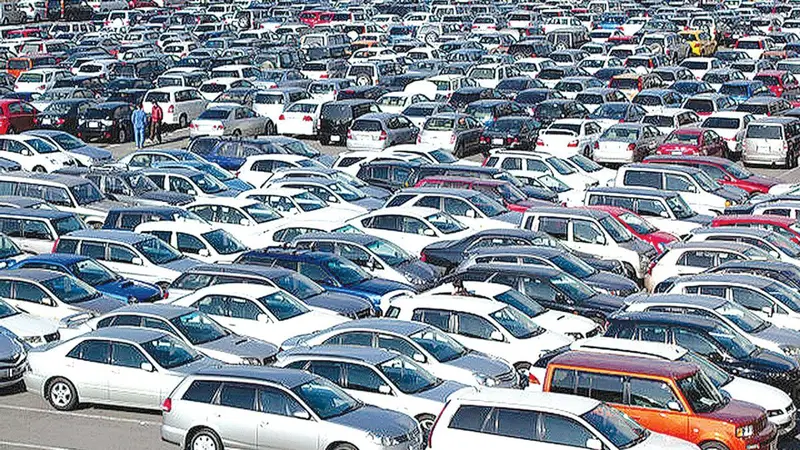
To find out how these automobiles still find their way into the auto market in Nigeria, despite these risks, our reporter visited a major vehicle trade hub in Lagos State.
I got to Berger Yard, a car sales base not far from the Kirikiri Maximum Security Prison in Apapa, where I had arranged to meet several dealers with a friend. It was almost noon on Saturday, April 11, 2026.
The automobile lots, from the old AP filling station up to the bridge that connected the area with Kirikiri, were mostly lethargic in activity.
Neatly parked automobiles stood in rows, and beside them groups of dealers played draughts or chatted casually with colleagues, and were quick to accost any passer-by.
You want buy motor?one shouted in Nigerian pidgin, as others gathered around, hoping to make a deal. “I want to see my friend,” I said.
Disturbing difference
During the tour, the reporter spoke with the Chairman of Higher Dealers Forum, Iyke Onyeka, a veteran in the automobile sector with over three decades of expertise.
Onyeka has categorized imported accident vehicles into two: Major accidents and minor accidents.
Onyeka said that significant accident automobiles involve essential parts of a vehicle and that such cars should not be permitted into the country.
“If you have minor accidents, for example, damage to the headlamp, bonnet or bumper, these are replaceable parts which do not greatly affect the usability of a car,” he said.
“These little ones that come into the country, you fix them up and you have a full car to yourself,” he told our correspondent. ‘Once an automobile has an accident, big or small, it’s cheaper abroad. It is natural. If you have your automobile and you drive it and it has an accident and you want to dispose of it, if you can find a person who is prepared to buy your car, you will undoubtedly sell it at a price lower than what it was worth. I suppose it’s the price that determines the desire for it. “Secondly, the car is not dented in any way, whether major or minor, if there is a complete car out there in the US, the owner will hardly sell it because indigenous Americans are also looking for such cars. They go to the auction sites to buy automobiles and most of the time they go for cars that have not been involved in an accident which they utilize in America provided they fit their standards .
“We in Africa, especially Nigeria, or outside America, will be able to afford more of those accident vehicles. “When we are finished fixing them, we will be able to sell them.” The accident-free ones are rather pricey. “Even if you bring them here the price compared with others that have been repaired is not usually favourable.”
Universal Village
“However, the car dealer cleared up misconceptions that the high exchange rate and biting economy are to blame for the rising influx of accident vehicles.
“Those in the automobile business will always buy vehicles for sale no matter what the exchange rate is,” he said.
The only issue is, if the exchange rate is low and I can afford to buy 20 cars, I will buy 20 cars. If its very high I might buy 10. At the end of the day, it is the consumer who will pay for it.
The world has now become a global village. Many people know their surroundings. Most people will come here and if they find a car they like, they will take the chassis number and check how the car came in from the US and check if it had a little or significant accident. That’s where people decide whether they buy or not. The globe has become a global village therefore you really cannot fool anybody anymore.”
Profitable
The increased inflow is mostly for the profit of another dealer, Christopher Onyebuchi.
However, “We don’t see demand for major accident vehicles,” Onyebuchi said.
“Unless it’s a case where the customer doesn’t know the car had an accident, they don’t go for such cars,” he said.
Control
“They (customers) do checks. Speaking to our correspondent, he said: If there is an accident car, if they find out, the person will leave it. I wouldn’t advise buying it, it’s worthless on the market. There are several ways to check through the VIN number (also known as the chassis number).
You may look up the chassis number on your phone and it will show you the history of the car. But you can manipulate chassis, but only those automobiles that are bought on display in America, because those ones are not in the system.
Accident cars are not up to the quality of non-accident autos. For example, a vehicle that has been involved in an accident, including repairs and shipment, may cost about N7 million as against a typical automobile that may cost about N8.5 million if you are buying a 2006 Toyota Sienna. So the person that sells accident automobiles makes more profit.”
“Yeah, all the time,” he answered, when asked if there are people who will buy significant accident automobiles without knowing.
Influx
Another car dealer who craved anonymity told Sunday Vanguard that European automobiles were in fashion in Nigeria in the 1990s when he started the business but from the 2000s, the US saturated the market with automatic vehicles which led to a proliferation of accident vehicles entering the country.
His comments, “Some accident vehicles are good buys, and some are not, generally. \”Depends on how much damage it is.
The figures
Despite the severity of the problem, there is very little publicly available data on the number of accident-damaged vehicles entering the country every year.
But import numbers reflect the country’s strong dependence on foreign-used autos.
Nigerians spent about N2.3 trillion on such goods from 2017 to 2022, most of which was obtained from the United States.
The National Bureau of Statistics, NBS, said that Nigerians spent N4.31 trillion on importing passenger cars between 2023 and 2025.
It spent N145 billion in 2017, N269 billion in 2018, N580 billion in 2019, N718 billion in 2020 and N617 billion in 2021.
“Passenger car imports will cost N1.47 trillion in 2023, N1.26 trillion in 2024 and N1.58 trillion in 2025.
Systemic deficiencies
However, our correspondent’s findings indicate that Nigeria’s import system does not explicitly ban the importation of salvage automobiles despite the risk.
“We have a standard customs process for the importation of vehicles, whether new or used. It involves documentation like Form M, proforma invoices, final invoice, Pre-Arrival Assessment Report, PAAR, and marine insurance, Chairman, National Association of Government Approved Freight Forwarders, NAGAFF, Dr Segun Musa told our correspondent.
Used cars including accident cars are valued on the basis of the condition and value declared which determines the duty payable, said Musa.
He said: “There is a life span for vehicles that can come in. Again, government also provides place for accident automobiles to come in for repair. So if you have accident automobiles it is easier to clear since the value would degrade more than the one that is not an accident vehicle. Now you can go ahead and repair it when it comes to Nigeria following clearance.
“A lot of people prefer to bring in accident vehicles that can be fixed when they come into Nigeria, because of the cost implications. “When you’re doing your assessment you have to state the position of the vehicle, the state of the vehicle, so justifying the value that you are actually putting on it.”
Asked if clearance agents conceal the accident history of these vehicles, he said: “If the accident is not visible, the agent may not even know. The importer alone will know what state the vehicle is in. Some of them may seem new and look fantastic, but you don’t see the accident portion of it.”
Concealment process
In several mechanic communities in Lagos, accident automobiles are transformed every day.
A three weeks observation by this writer during which such automobiles were taken through an organized chain of restoration in one of the mechanic workshops around the Vanguard Newspapers headquarters.
The method involves mechanical repair, panel pounding and electrical rewiring and generally leaves no visible indications of past damage.
Japan, a repairer with more than seven years expertise, demonstrated how badly damaged vehicles are put back together.
He was short, stout and fair, and pointed to a Toyota with a broken radiator and fender, saying: “The one I’m fixing now is an accident car that was in a big crash. What was damaged in the collision will determine if a wreck can be fixed. Here the radiator and fender is terrible. This automobile has radiator and fender problems which is big work. If you look at it they will cut this chassis which ain’t no little work. They have to do a good job on the cut and replace the fender. If it is serious work, I charge N800,000 to correct it. The person who buys it will have no trouble in it and we’ll have done a good job on it. “It won’t be obvious that the car’s been worked on unless you bring a mechanic with you.”
Nice car
Chukwuka, who is tall, dark and skinny, is a popular auto repairer with over 20 years expertise and this reporter contacted him when he saw him working on a Toyota car that looked beyond repair.
I asked him whether there was a cure for the car and he laughed and answered, ‘100 per cent. The car will be fixed and it will work wonderfully. Before we can fix a serious accident vehicle and make it appear decent we will need to drop the engine and gear, a panel beater will pull it with his crane. This will give them space to work on the car.
‘If the buyer knows how to use Google he can search for the automobile by chassis number. If he doesn’t, he won’t know if the engine was in an accident or not. I won’t take less than 150,000 – 200,000. Panel beaters are also charged individually. I work on Japanese automobiles. If you want to buy an excellent car, I would recommend not to buy in Canada. Their nation is salt; it is acid and eats iron.
So that is why their automobiles are rusting. “If you ship from Canada you will spend more money on repairs.”
Least affected section
Only known as Striker he looked about 30 years old. He had just finished the day’s labor and gone to get water and was getting ready to take his bath when this reporter came up to him. He, unlike the others, was not so keen to talk at first.
“I’ve been doing this for more than seven years,” he said, agreeing to share a few thoughts with our correspondent after a few minutes of back and forth. The part of a car least impacted by a crash is typically the driver’s side, he added.
He said: “This is because the motor driver does not want to be involved in an accident. So he’s trying to save himself. If the owner has the money, a major accident will take roughly two weeks to fix and at most a month. The ability to fix an imported accident vehicle is primarily based on the mechanic’s available tools.
“If you have a crane that can lift iron, it makes your work easier and faster. There are tools for accident cars and you can’t fix such autos without them. And when they bring such vehicles to you, if you have the tools, you will not be terrified. I work on Benz, BMW, Toyota, Chevrolet and more.
But I’ve seen that Benz accidents are not often lethal; it’s commonly just a component that’s replaced. Toyota accidents generally are fatal. Many of the wrecked cars are from Canada. After repairing these vehicles will not show any defect but it depends upon the mechanic who repairs the vehicle. Indeed, the life of such a vehicle will depend on the end user, assuming you have a decent mechanic.”
What the experts say
Experts expressed concern about the situation and told our correspondent pointedly that this flourishing commerce is made possible by regulatory loopholes.
Bamidele Badejo, professor of Transport and Logistics, said systemic failure is why people want to acquire such cars and sell to naive Nigerians as public transit cannot meet the demands of people.
The problem is being exacerbated by insufficient rules and regulations, Badejo said.
However, he cautioned that such cars can be fixed, reconstructed and improved upon but it is the prerogative of the proper regulatory authorities to guarantee that they are submitted to tougher quality assurance, quality control and MOT tests before being allowed on the country’s roads.
Loose regulations
“We have the regulatory agencies that are in a position to check and see if they can allow or disallow such a category of imported vehicle in the country,” he told our correspondent. “If you see there is persistence in the bringing in of these vehicles, it shows those vehicles have failed all MOT tests, quality assurance and quality standards in the United States.
They are not fixable. They are not meant to be fixed. They are to be brought to the junkyard and destroyed. But they now realize that these accident cars still can bring them profits if they are exported to other countries, especially to those countries with weak laws and regulations that do not ban such types of vehicles from entering our country. These automobiles are unlikely to be sold to Nigeria, if they could still satisfy their MOT test quality assurance in the United States.
“The accident vehicles that are now being imported into Nigeria can be repaired, restructured and improved upon, but they must be subjected to stricter standard control, quality assurance, quality control and MOT tests to ensure that such vehicles are roadworthy.
“However, in the case of our MOT test they are only income generating checks. The approach, as is the problem, is multidimensional. I think we should start building our own vehicles like India, Romania, China and some other countries are doing.
“If we can’t produce, let’s put more money into public transit and rail infrastructure development. “If you look at the way things are in the country in terms of bribery, corruption and smuggling, it will be difficult to stop the importation of accident vehicles,” he said.
Covert hazards
Mr. Ossai Jethro, a mechanical engineer, also expressed his opinion on the matter warning that the danger of accident automobiles goes beyond cosmetic fixes.
Hidden electrical flaws, sensor damage and damaged vehicles could offer long-term safety issues, he added.
Speaking to our reporter, Jethro said: “Even after you have repaired something there can be hidden problems which can cause danger in the future. Electrical systems, especially. Some sensors could be damaged, but not fail immediately One risk is that those sensors could fail suddenly.
They can fail suddenly at any time which increases the danger of road accidents considerable. And then accident autos will surely bring down the resale value of all cars massively. What the average Nigerian does not realize is that some of these automobiles are flood cars and not crashed vehicles. Flood automobiles are unsafe since electrical systems are already affected regardless of the big repairs happening. Some of these repairs are even ‘cut and join’ kind. “If there were real regulatory bodies to investigate cases like this, it wouldn’t be running rampant.”
Accountability evaded
Meanwhile, responding to experts’ worries, National Public Relations Officer of the Nigeria Customs Service, Maiwada Abdullahi said: “The issue of quality is not in the purview of the Customs. It is our responsibility to comply with policy. The government can choose that automobiles beyond a certain age are not permitted to enter. That’s a policy choice by government and our job is to deliver it. “We collect it. There is a duty on a certain category of vehicle and it is our duty to see that it is collected.”
When asked if there is a level of damage that a vehicle may have incurred before it is permitted in, he informed our correspondent: “I don’t know that, I only know age, which is 10 years. What the government normally does is to give incentives that would make us improve first our vehicle industry within the country. “Look at our automotive policy; you will see that we charge high duties on imported vehicles to discourage importation so that you import either Semi-Knock-Down, SKD, or Completely Knocked Down, CKD vehicles that will add value locally.”
Evaluation
For his part, Public Education Officer of the Federal Road Safety Corps, FRSC, Ohaeri Osondu, said the FRSC does not have the statutory role of determining the roadworthiness of cars.
That mandate is for the car Inspection Office, VIO,” Osondu said, speaking. “Determining if a salvage or accident-repaired car is roadworthy involves thorough technical and scientific examination, utilizing established standards and equipment for inspection. Without verification it is difficult to ascertain definitively the condition of any car. However, all cars must meet safety criteria before they are allowed on the road.
“Vehicles repaired after an accident can be very dangerous if not properly brought back to standard. Structural weaknesses, defective braking systems, faulty airbags and poor alignment are some frequent problems that are not readily apparent, but can cause a catastrophic collapse on the road. Those faults can increase the chance of crashes and can worsen injuries in accidents, affecting not only the occupants of the vehicle but also other people on the road.
The importation of accident damaged or salvage automobiles is generally governed by the regulation and policy framework of the Nigeria Customs Service in conjunction with other relevant regulatory organizations. The importation role is not for the FRSC but for the enforcement, public education and compliance of the traffic legislation. policies.
Various agencies
“All vehicles on Nigerian roads are expected to have passed the necessary roadworthiness test by the relevant authorities, especially the VIO. FRSC depends on the observance of certain regulatory mechanisms. General crash data is commonly studied, but without certification inspection data on the state of imported salvage vehicles before to usage, it can be difficult to attribute crashes particularly to them.
The monitoring of the entry and compliance of salvage vehicles involves several authorities including Standard Organisation of Nigeria, SON and Nigeria Customs Service. Each has an important role to play in making sure imported automobiles fulfill national standards. “Collaboration between these agencies is key to bridging any possible gaps and ensuring only vehicles that meet the safety requirements are allowed on Nigerian roads.”
SON did not respond to attempts to get remarks.
Our journalist spoke with the Press Liaison Officer of SON, Angela Okisor, who told him she was sick and promised to call back but did not.
She did not answer her calls and further attempts to contact her also failed.
However, an official in the Lagos State Ministry of Transportation informed our correspondent that the clamour for a ban on salvage vehicles might not succeed quickly.
“The government cannot ban all these things until it can give an alternative transportation system,” he said. If you ban particular vehicles now, and you don’t have substitutes for them, it will cause chaos.”
About the Author