
Nigeria has advocated for a new paradigm of global economic involvement with Africa built on sovereign decision-making, strategic autonomy, indigenous industry growth and increasing investment in bankable infrastructure projects.
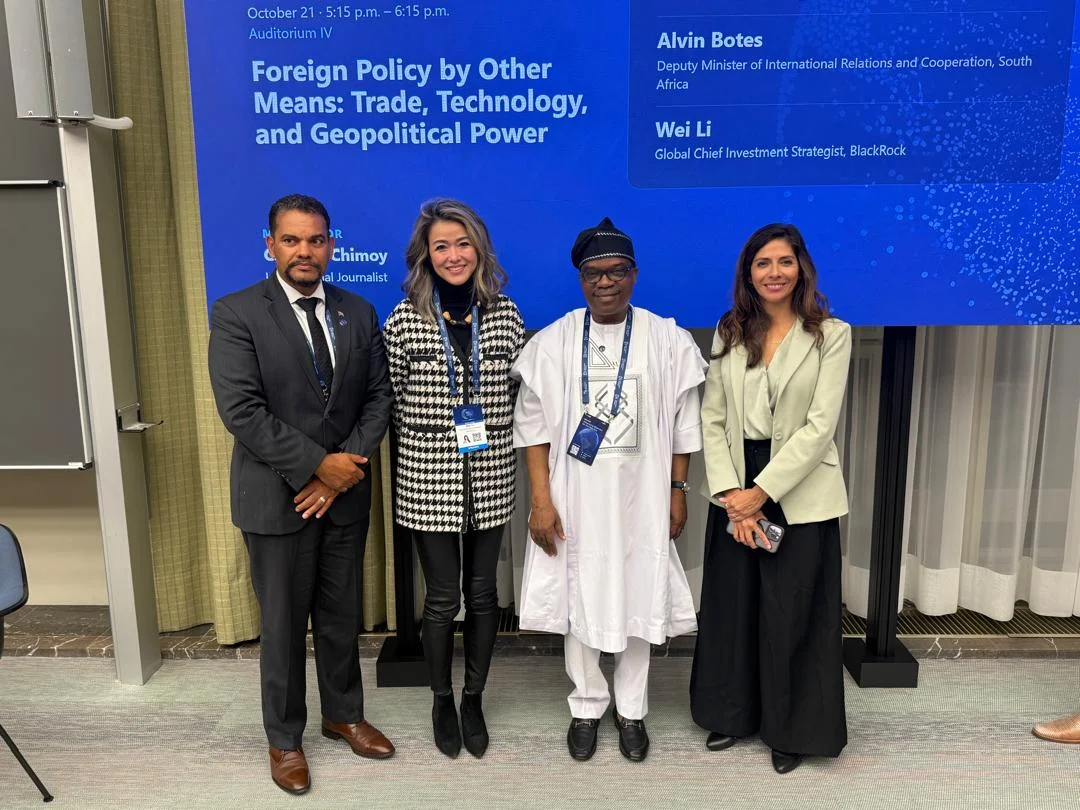
The Minister of State for Foreign Affairs, Ambassador Sola Enikanolaiye made the demand at the Berlin Global Dialogue 2026, where he called for partnerships that respect African goals and promote mutual advantages rather than reliance.
“Africa wants to chart its own development and at the same time engage constructively with the international community,” Enikanolaiye stated at a high-level panel on Foreign Policy by Other Means: Trade, Technology and Geopolitical Power and a policy lab on infrastructure and investment.
“Africa has entered this discussion with great assets, with enormous opportunities and with a determination to shape its own development in partnership with the rest of the world,” he said.
The minister noted that international diplomacy is evolving away from fixed political alliances toward more pragmatic, commercially orientated partnerships based on national interests.
He mentioned a recent policy lab in Abuja sponsored by a foreign embassy with the participation of the President’s Adviser as an example of the evolving approach to international collaboration.
Enikanolaiye studied the historical ties between trade and diplomacy, from the Royal Niger Company to multinational firms operating in post-independence Africa on the nexus between foreign policy, business and strategic autonomy.
He said the continent’s history of economic marginalisation was a reminder of the need to deploy native resources for growth, and that foreign investment should be used to supplement African capital, not supplant it.
Minister of Trade and Investment, Dr. Olusegun Aganga, yesterday stressed the need for creating local investment capacity, citing the public offer of billionaire Aliko Dangote which he said had garnered subscriptions from over 52 countries.
“We need resources of the kind that foreign capital can only complement, not replace,” he remarked.
Enikanolaiye also said governments must establish an enabling climate for private industry to grow, citing Nigeria’s stabilising role in Liberia and Sierra Leone through the Economic Community of West African States Monitoring Group (ECOMOG).
He said that the regional intervention had created an enabling environment which allowed Nigerian businesses including banks to spread their wings across West Africa.
He reiterated Nigeria’s commitment to strategic autonomy amid increased competition among global powers, adding that the country must not lose the capacity to engage with diverse international blocs in line with its national interests.
“It gives us a space of action, irrespective of ideology or political complexion of the various blocs to push our own national interest including those of Nigerian companies.
The minister also called for an end to the extractive model of economic involvement in which African countries sell raw materials without establishing local enterprises to process them.
He said the country’s strategic direction requires that investors in the mining sector create local processing facilities backed by regulatory control to protect the environment and host people.
“We learned from the experience we had in Niger Delta. He said: “We are now doing things differently to give rights to the local communities where minerals are found.
Nigeria woos investors for power, transport, digital infrastructure
On infrastructure finance, Enikanolaiye said Africa’s economic objectives relied on reliable energy, efficient transport systems and expanding digital connection.
Infrastructure sectors are crucial to increase productivity, generate more economic possibilities and fulfil the requirements of the continent’s teeming youthful population, he said.
Revenue creation through electricity metering was also pointed out by the minister as an investment opportunity, stating that increased metering might bolster the financial sustainability of power companies and draw in private investments.
He said African nations had implemented legislative and regulatory reforms, macro-economic stability and deregulation to create the climate for investment.
But he highlighted that long-term capital is attracted only if projects are well-prepared, rules are predictable, procurement processes are clear and investment risk-sharing mechanisms are reliable.
Enikanolaiye recognised the African Export-Import Bank (Afreximbank), African Development Bank, ECOWAS Bank for Investment and Development (EBID) and the newly founded African Credit Rating Agency in Mauritius as key organisations in broadening access to guarantees and blended finance.
He also urged for improvements to the international credit rating system, saying Africa required more equitable appraisals of its investment risks and economic prospects.
He welcomed the formation of the African Credit Rating Agency and said a more balanced assessment of African countries might help eliminate impediments to financing development initiatives.
The minister also connected Africa’s objectives in artificial intelligence to the availability of reliable electricity, stressing that technological progress will depend on appropriate energy infrastructure.
Nigeria Supports Africa’s Trade Integration
Enikanolaiye noted Africa’s average economic growth of 4.3 per cent and the desire to improve the rate to seven per cent on regional economic integration.
He pointed to developments on the proposed ECO single currency, Nigeria’s single-window trading system and the Pan-African Payment and Settlement System (PAPSS) as steps that may enhance economic cooperation and simplify cross-border commerce.
African countries need to enhance intra-African trade to establish competitive industries and gain more benefits from the African Continental Free Trade Area (AfCFTA), he said.
He said intra-African trade was still at 16 percent and that this means removing obstacles to trade and strengthening regional production and payment systems.
He said: “We need to trade more amongst ourselves to build competitive advantages.
Enikanolaiye also stressed that investment in technical education, curriculum reform and skills development are crucial for realising Africa’s infrastructure objectives.
He urged African governments to better use diaspora remittances, particularly as official development support declines, while maintaining reforms to strengthen the business environment.
He also mentioned China’s model of infrastructure cooperation without conditions as one of the many options for international partnerships available to African countries.
To end, the minister called for mobilisation of long term capital to assist development, underlining Nigeria’s commitment to budgetary discipline, transparency, democracy and rule of law.
Nigeria, Lesotho Explore Closer Diplomatic, Economic Relations
On the fringes of the debate, the Nigerian team engaged in activities at the Nigeria House in Berlin on behalf of President Bola Ahmed Tinubu.
The group was led by Enikanolaiye and the Minister of Budget and National Planning, Senator Abubakar Atiku Bagudu.
The Nigerian Ambassador to Germany, Senator Ita Enang, and Enikanolaiye had a bilateral discussion with Lesotho’s Foreign Minister, Limpho Justice Tau, to discuss deeper bilateral cooperation.
Discussions also touched on the idea of Lesotho having a physical diplomatic representation in Abuja to enhance collaboration between the two countries.
Tau lauded Nigeria’s historic role in Africa’s liberation movements and encouraged Nigerian industrialists such the Dangote Group to seek investment prospects in Lesotho.
The summit is planned to enhance further cooperation through the African Union Development Agency-New Partnership for Africa’s Development (AUDA-NEPAD).
About the Author