
ERELU TÚNWÀṢẸ SERIES
ELECTION 2027
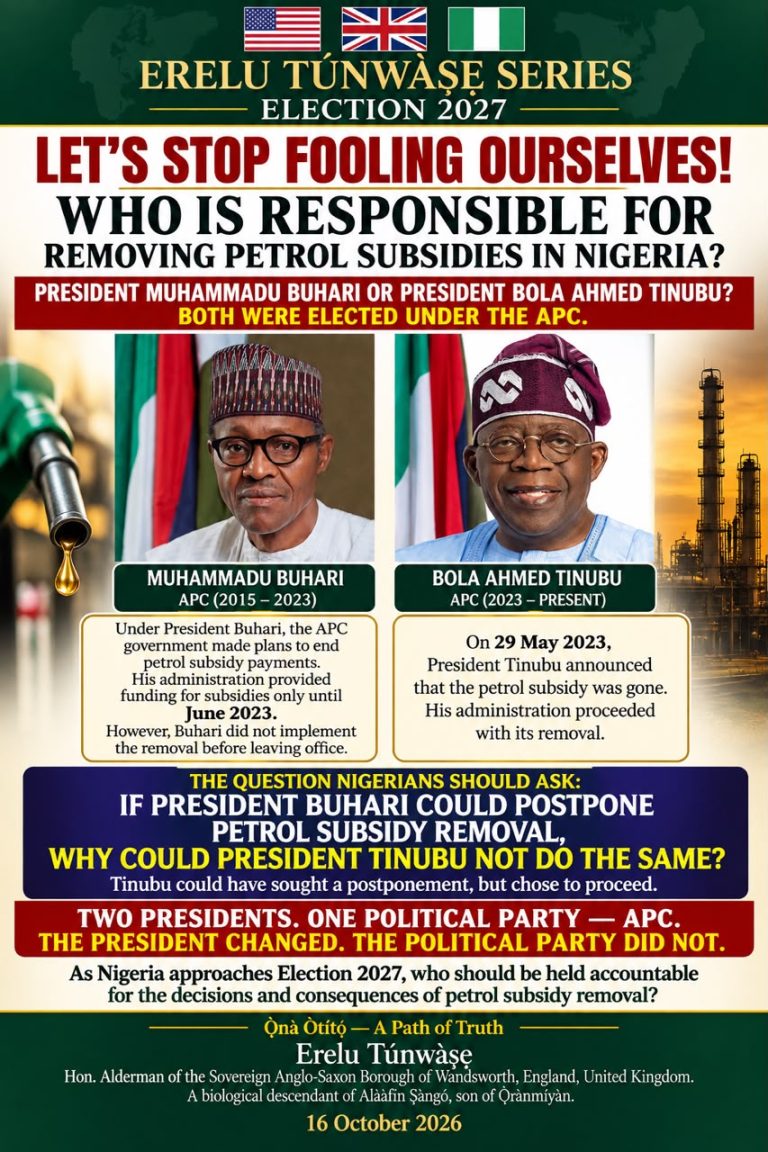
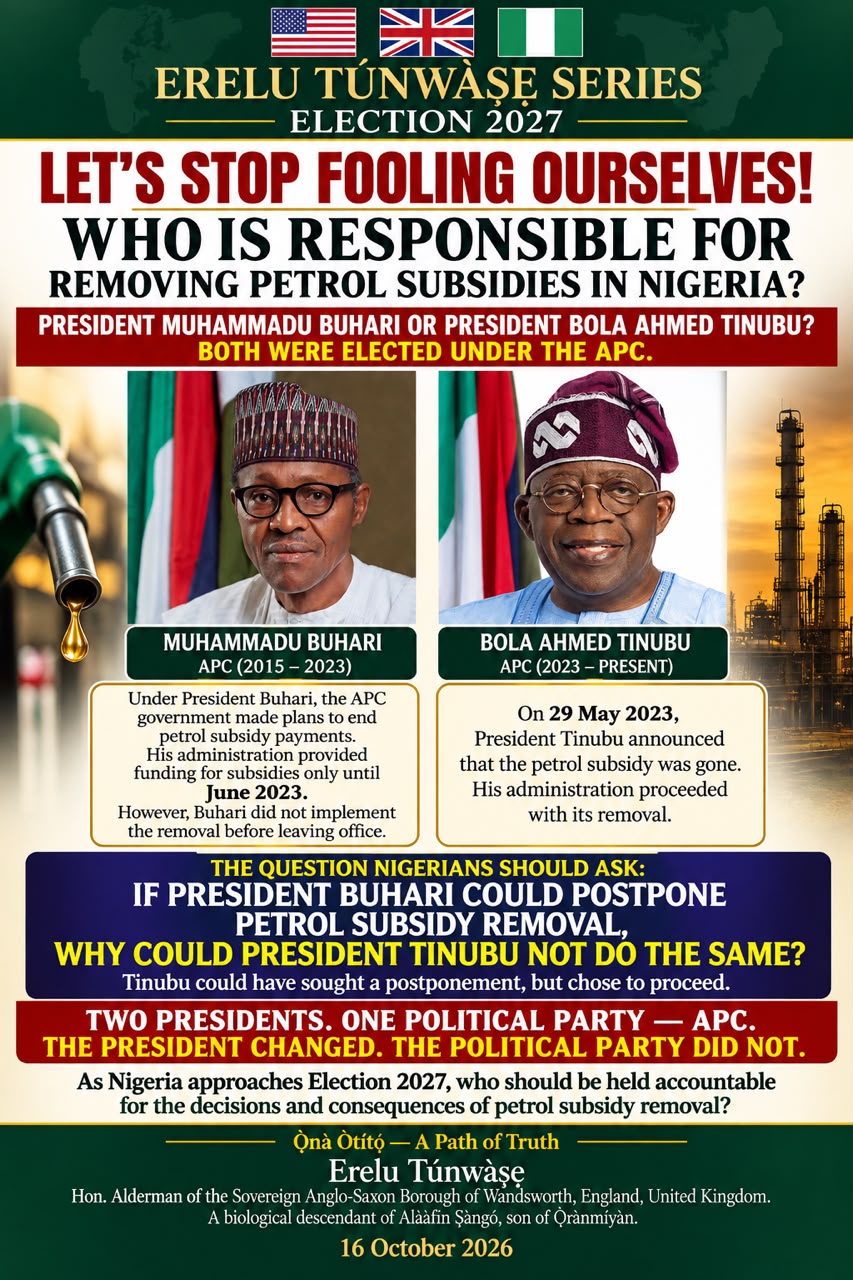
LET’S STOP FOOLING OURSELVES!
WHO IS RESPONSIBLE FOR REMOVING PETROL SUBSIDIES IN NIGERIA?
PRESIDENT MUHAMMADU BUHARI OR PRESIDENT BOLA AHMED TINUBU?
TWO PRESIDENTS. ONE POLITICAL PARTY — THE APC.
As Nigeria prepares for the 2027 general election, I wish to draw attention to an important matter that affects the lives of millions of Nigerians.
The removal of petrol subsidies.
Who made the decision?
Who carried it out?
And who should be held responsible for the consequences?
These questions are important because I have noticed that many Nigerians concentrate on President Bola Ahmed Tinubu when discussing the removal of petrol subsidies.
But how many people have examined what happened under his predecessor, President Muhammadu Buhari?
Both men became President of Nigeria under the All Progressives Congress, APC.
The President changed in 2023. The political party did not.
We must understand the difference between a decision made by a government, the implementation of that decision and the responsibility of the political party that has remained in power.
1. WHAT HAPPENED UNDER PRESIDENT MUHAMMADU BUHARI?
President Muhammadu Buhari governed Nigeria from 29 May 2015 to 29 May 2023.
He was elected under the APC.
During his administration, the government repeatedly discussed ending petrol subsidies.
In August 2021, President Buhari signed the Petroleum Industry Act into law.
The Act introduced major changes to Nigeria’s petroleum industry, including a framework for market-based pricing.
However, the government continued paying petrol subsidies during the transition.
The Buhari administration subsequently announced plans to remove the subsidy, but implementation was postponed.
In the 2023 federal budget, provision was made for petrol subsidy payments only until June 2023.
This was before Bola Ahmed Tinubu won the presidential election held on 25 February 2023.
The plan to end petrol subsidy payments was therefore already part of government policy before Tinubu became President.
That is an important historical fact.
The decision did not suddenly appear on 29 May 2023.
2. WHY DID PRESIDENT BUHARI NOT REMOVE THE SUBSIDY BEFORE LEAVING OFFICE?
This is a question Nigerians should examine carefully.
President Buhari had eight years in office.
His government had already made plans to end petrol subsidies.
Yet the administration did not complete the removal before leaving office.
In April 2023, the Buhari government confirmed that it would not implement the removal before handing over power.
The matter was left for the incoming administration.
Following the change of government, Buhari’s former spokesman, Garba Shehu, explained that the previous administration had delayed subsidy removal partly because of concerns about the political consequences for the APC during the 2023 election.
This explanation raises an important issue.
If the APC government recognised that removing petrol subsidies could have serious consequences for Nigerians and the party’s electoral prospects, why was implementation left until after the election?
Was the policy delayed because of concerns about the welfare of Nigerians?
Was it delayed because of the approaching election?
Or were both considerations involved?
These are reasonable questions about government decisions and political responsibility.
3. WHAT DID PRESIDENT BOLA AHMED TINUBU DO?
On 29 May 2023, Bola Ahmed Tinubu was sworn in as President of Nigeria.
During his inaugural address, he announced that the petrol subsidy was gone.
That announcement marked a major turning point in Nigeria’s economic policy.
Petrol prices increased sharply afterwards.
Transport costs rose.
The increased cost of transporting people and goods affected businesses and households.
Food prices and other living expenses were also affected, alongside inflation, exchange-rate changes and other economic pressures.
For millions of Nigerians, petrol subsidy removal became one of the most visible decisions of the new administration.
But we must remember something.
Tinubu did not inherit a government that had decided to continue petrol subsidies indefinitely.
He inherited a policy direction established under the Buhari administration.
Nevertheless, he had become President.
He was now responsible for deciding how his administration would proceed.
4. COULD PRESIDENT TINUBU HAVE REVERSED OR POSTPONED THE DECISION?
YES. PRESIDENT TINUBU COULD HAVE SOUGHT TO POSTPONE THE REMOVAL.
This is an important point.
The fact that President Buhari’s administration had planned to end petrol subsidies did not mean that President Tinubu had no choice.
He could have considered a further transition period.
He could have sought additional funding through the appropriate budgetary process.
He could have proposed changes to the existing legal and financial arrangements.
He could have examined measures to protect vulnerable Nigerians before proceeding.
Any continuation of subsidy payments would have required funding and compliance with the law. Depending on the arrangements, cooperation from the National Assembly could also have been necessary.
But these were options that could have been considered.
Indeed, the Buhari administration had already postponed implementation.
If President Buhari could postpone petrol subsidy removal, why could President Tinubu not do the same?
The answer is that Tinubu could have sought a postponement.
He chose instead to announce that the subsidy was gone on the day he assumed office.
That was a decision of his presidency.
He must therefore be accountable for that decision and for how his administration managed its consequences.
5. WHO SHOULD BE HELD RESPONSIBLE — BUHARI OR TINUBU?
My answer is that we must distinguish between the responsibilities of the two Presidents.
PRESIDENT MUHAMMADU BUHARI
His administration established the policy direction, introduced the Petroleum Industry Act and planned to end petrol subsidy funding.
His government postponed implementation and left the matter for the incoming administration.
PRESIDENT BOLA AHMED TINUBU
He announced the end of petrol subsidies on 29 May 2023.
His administration proceeded with implementation.
He became responsible for managing the economic and social consequences of that decision.
These are separate responsibilities.
We should not blame President Buhari for every action taken by President Tinubu.
Neither should we ignore the decisions made under President Buhari when examining what happened under President Tinubu.
Both administrations must be examined.
And that brings me to the political party.
6. WHAT ABOUT THE APC?
This is the central issue I want Nigerians to understand.
President Buhari belonged to the APC.
President Tinubu also belongs to the APC.
The APC won the presidential election in 2015.
It won again in 2019.
It also won the presidential election in 2023.
The same political party has therefore held the presidency continuously since 2015.
Yet when Nigerians discuss the present economic difficulties, the conversation often concentrates almost entirely on President Tinubu.
Why?
The APC presented Buhari to Nigerians as its presidential candidate.
The APC subsequently presented Tinubu as its presidential candidate.
Both men governed under the same political party.
This does not mean that every decision taken by one President automatically becomes the personal responsibility of the other.
But it does mean that the APC has a record in government that Nigerians are entitled to examine.
A change of President does not erase the record of the political party that remains in power.
7. WHAT HAS HAPPENED TO THE MONEY PREVIOUSLY SPENT ON PETROL SUBSIDIES?
Another important question concerns public money.
One of the arguments for ending petrol subsidies was that the government was spending enormous sums of money maintaining them.
Removing subsidies was expected to reduce this financial burden and free public resources for other needs.
Nigerians were told that the country could benefit from better investment in infrastructure and public services.
This raises further questions.
How much money has the government saved?
How much of the financial benefit has been reduced by other costs or obligations?
How has the money been used?
What improvements can ordinary Nigerians identify?
Have public transport services improved?
Have hospitals and schools benefited?
Has electricity become more reliable?
Have roads improved?
Have businesses received meaningful support?
What has been done to reduce the difficulties experienced by low-income families?
These are not questions that can be answered by political slogans.
They require clear figures, proper records and evidence of results.
If Nigerians are asked to make sacrifices for economic reform, they are entitled to know what those sacrifices have achieved.
8. THE COST OF PETROL AND THE LIVES OF ORDINARY NIGERIANS
Petrol is not simply another product in Nigeria.
It affects transportation, farming, trade, manufacturing and many household expenses.
When petrol becomes more expensive, transport operators face higher costs.
Traders may pay more to move goods.
Farmers may spend more transporting produce to markets.
Businesses that depend on petrol-powered generators may face additional expenses.
Families may have to spend more on transport while also dealing with rising food prices.
This is why decisions about petrol subsidies have consequences beyond filling stations.
The effects reach into homes, markets, farms and workplaces.
Of course, not every increase in the cost of living can be attributed solely to petrol subsidy removal.
Nigeria has experienced other serious economic pressures.
But subsidy removal has been an important part of the economic changes Nigerians have faced since May 2023.
The government must therefore be prepared to explain what has been achieved and wh…
9. DID NIGERIANS VOTE FOR A PRESIDENT OR A POLITICAL PARTY?
This question connects directly with my earlier article on Nigeria’s political system.
In a presidential election, Nigerians vote for candidates presented by political parties.
The President is elected separately from the National Assembly.
Unlike the British parliamentary system, a Nigerian political party does not need a majority of National Assembly seats to win the presidency.
The President has his own constitutional powers and responsibilities.
But political parties also have responsibilities.
They select candidates.
They present election promises.
They organise campaigns.
They ask Nigerians to place their trust in them.
When a party remains in power through successive Presidents, its record deserves attention.
It is not enough to say that the previous President made the decision.
Nor is it enough to say that the present President merely inherited the decision.
We must ask what each administration did, why it acted and what the political party promised Nigerians.
10. WHAT SHOULD NIGERIANS CONSIDER BEFORE ELECTION 2027?
By the time Nigerians vote in 2027, the APC will have held the presidency for nearly twelve years.
Eight years under President Buhari.
Almost four years under President Tinubu.
That is a substantial period in the life of a country.
The APC should be able to explain its record.
It should explain what it achieved under Buhari.
It should explain what it has achieved under Tinubu.
It should also explain what has not worked and what it intends to do differently.
Other political parties seeking office should be examined with the same seriousness.
Their promises must also be questioned.
What are their plans?
How will they fund those plans?
What evidence do they have that their proposals can work?
Elections should not be reduced to the personalities, ancestry, religion or popularity of candidates.
Nigerians deserve clear explanations about policies and their consequences.
11. LET US STOP FOOLING OURSELVES
I return to the question that prompted this article.
WHO IS RESPONSIBLE FOR REMOVING PETROL SUBSIDIES IN NIGERIA?
President Muhammadu Buhari?
President Bola Ahmed Tinubu?
Or the APC government that continued under both Presidents?
The historical record provides an important answer.
Buhari’s APC administration prepared the policy and planned to end subsidy funding.
Tinubu’s APC administration announced the removal and proceeded with implementation.
The APC remained the governing political party throughout.
These facts should form the starting point for any serious discussion.
Responsibility must be examined fairly.
The previous administration cannot be excluded from the history of the decision.
The present administration cannot avoid responsibility for choosing to proceed and for managing the consequences.
And the political party that held power under both administrations should be prepared to answer questions about its record.
12. ELECTION 2027 — THE QUESTION OF ACCOUNTABILITY
As Nigerians prepare for the next presidential election, I invite them to examine the facts.
Do not judge a government only by the personality of its President.
Do not assume that a change of President means a change of political party.
Do not accept every explanation without asking for evidence.
And do not forget the decisions made by previous administrations when the same political party remains in power.
The removal of petrol subsidies provides a clear example of why political education matters.
One President prepared the policy.
Another President proceeded with its implementation.
Both were elected under the APC.
The consequences have affected millions of Nigerians.
THE PRESIDENT CHANGED. THE POLITICAL PARTY DID NOT.
TWO PRESIDENTS. ONE POLITICAL PARTY — APC.
IF PRESIDENT BUHARI COULD POSTPONE PETROL SUBSIDY REMOVAL, WHY COULD PRESIDENT TINUBU NOT DO THE SAME?
That is a question Nigerians are entitled to ask.
And as Election 2027 approaches, there is an even bigger question.
SHOULD NIGERIANS HOLD ONLY THE PRESIDENT ACCOUNTABLE, OR ALSO THE POLITICAL PARTY THAT HAS HELD THE PRESIDENCY SINCE 2015?
For me, understanding who made a decision, who implemented it and who bears responsibility is an essential part of understanding government.
Ọ̀nà Òtítọ́ — A Path of Truth.
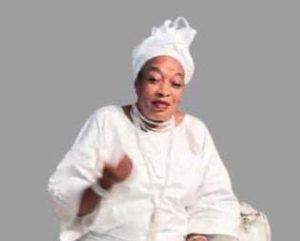
Erelu Túnwàṣẹ
Hon. Alderman of the Sovereign Anglo-Saxon Borough of Wandsworth, England, United Kingdom.
A biological descendant of Aláàfin Ṣàngó, son of Ọ̀rànmíyàn.
16 October 2026
About the Author