
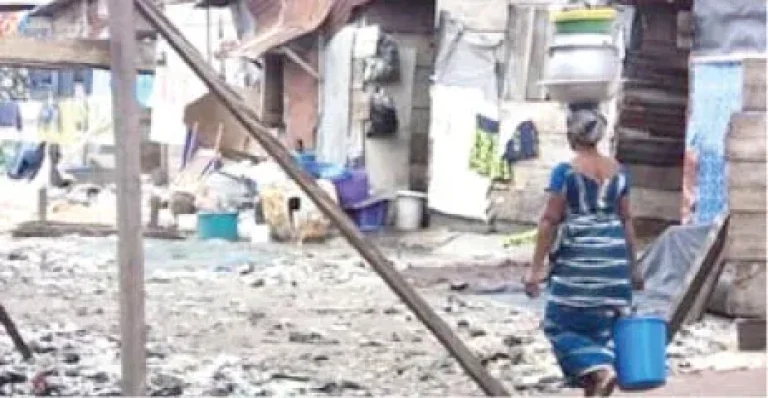
For residents of Tunkarimu, a congested informal hamlet in Ajegunle, the day has already begun at 5:30am. The first sounds are not those of traffic or business activity but the footsteps and voices of people hurrying to use one of the few restrooms available to the tenants of 16 rooms in the densely crowded community. Weekend Trust notes that for those heading to work, the morning schedule is a race against the clock.
Adeolu, a resident, said: “Having a bath in the morning here is a nightmare. The toilet is tiny yet so many people rely on it, so you get up early and there are still people waiting in queue for their turn.”
The delay, Adeolu added, may be long enough to upset the day’s plans.
“You have to wait a long time sometimes before you can get in. “It gets frustrating, especially when you are already thinking of going to work or starting your day’s business,” said Adeolu, 65, who said he was born and raised in Lagos.
He said the situation could get worse when the only supply of water to wash – a well – dries up because of the amount of people it serves everyday.
A middle-aged guy at Okorogbo Street who gave his name as Samuel said: “Some of us sleep late to fetch water into any available bucket or container, which we keep inside our rooms as a reserve for the next day.
Our correspondent said that such problems are a common fact of life inside the settlement. Affordable lodging for the residents who pay N10,000 a month for a room comes with a panoply of compromise, from overcrowding, shared facilities, limited privacy, inadequate sanitation and the continual concern that comes with living in an informal settlement. But they stay since the option is sometimes beyond their financial reach
For Lagos’ poorest citizens, the main hurdle to adequate accommodation is not the monthly rent, but the upfront payment.
A normal flat may attract annual rent reaching into thousands of naira, other than agency, legal and other charges.
For the casual worker, petty dealer, cleaner, porter or low-income artist who makes his money daily or monthly, such a big sum is almost impossible to come by.
One such community is Wowo Street in the nearby area of Tolu. Basil Owunka, 61, and his family of eight prepared for yet another nite of living with little space and less privacy in the crowded quarters that run along the colony. Their room would scarce pass for a proper habitation anywhere else.
These one-room apartments, colloquially called “Face Me, I Face You” are home to many and foster frequent quarrels among the housewives and children.
But to some inhabitants, it is the N5, 000 or N10, 000 per month that lures them to get roofs over their heads.
For workers whose income is doled out in small, uncertain sums, the figure is a lifeline in a city where formal lodging typically comes at rentals reaching into hundreds of thousands of naira.
But another resident, who gave his name as Basil, said the inexpensive rent comes with a hard bargain. He said tenants will often trade comfort for price, privacy for crowded, and security of tenure for the guarantee that they can sleep somewhere at the end of the day.
Basil, a labourer at a nearby sand dredging site at Tin-Can Island said a room at the Tolu neighbourhood is affordable for the poor. And in his view, the challenge for a casual worker, roadside merchant, cleaner, porter or minor businessman is rarely lack of willingness to pay rent but the upfront fee collected by property owners at the posh districts of Ajegunle.
He added the problem was compounded by greedy agents whose brains, he said, are the high costs of accommodation in the neighbourhood.
“You can demand a year’s rent before you even get the keys,” he continued. Add agency, legal and caution fees and a relatively cheap flat can suddenly cost hundreds of thousands of naira.
I have stayed here for over 20 years, Wowo Street, Olodi Apapa district of Tolu. Basil who spoke to our reporter added that for low wage earners, the goal of living in a near-comfortable flat is an unreachable financial wall.
“I lived in a descent accommodation on the Old Ojo road once. That was before I lost my job on a fishing trawler fishing. My landlord threw me out of my flat, since I owing house rent of nearly 2 years and could not pay. I started going to haul sand from the local boats at Tin-Can First Gate to survive,” he said, adding that he moved to his present accommodation after attempts to secure another job failed.
He also claimed Tunkarimu was created for individuals who cannot afford to pay a huge annual rent at once. He added the rooms are only big enough for the inhabitants as a mattress might take up a lot of the available space. Clothes, cooking utensils and other possessions vie for the remaining corners.
Interestingly, the region has attractions and entertaining side even with over-crowded compounds with rusting corrugated roofs.
Kehinde, a bricklayer, who disclosed that they live a communal existence in the region said: “At times when I don’t have enough money to feed myself, it is not a problem as I can ask my neighbour’s wife to help me with a small soup while I buy fufu with the small money in my pocket.
He said residents request from each other whatever they do not have at home such matches, salt or garri.
He added some homes utilise the same area for bedroom, living room, kitchen and store. At nite, the family members ‘push together’ to sleep. By daybreak, the space becomes a staging ground for another day of work.
The communal bathroom is one of the most obvious reminders of the cost of cheap lodging. Some locals, who asked not to be identified, said the morning queue was a daily source of frustration.
“You can’t just hang around because there’s a lot of other people behind you waiting. You’ll have to get a move on with your bath so that other people may use the restroom.’
Someone who has to leave early for work may find that a delay in the toilet means arriving late and losing cash.
“Sometimes I wonder how we got used to living like this. “You pay your rent but you still have to struggle for basic things like taking a bath in the morning,” remarked one resident.
This daily dissatisfaction is symptomatic of a larger paradox at the heart of Lagos’ informal housing dilemma. Thus, the N5,000 or N10,000 rent tells only part of the story. Some of the old houses are currently being sold out and replaced with modern buildings in some portions of the area.
Most of the freshly acquired properties have been developed into hotels and entertainment centers.
There are also homes in wooden buildings along the stinking canal that runs from the back of Boundary Market to Liverpool.
Here, the people pay in terms of the quality of their living environment. Shared bathrooms and toilets can get busy during peak times. The water supply may be unreliable. Poor garbage disposal can compound sanitation concerns. Poor drainage might lead to flooded walkways during heavy rains.
Another problem is fire in densely populated neighbourhoods where buildings are often close to each other with little access for emergency services.
Residents recognise the risks, but they stay because they have few inexpensive options.
Another tenant said: “The room is not what I would want for myself and my family but if I leave where would I go.” “The rent outside is too much.”
The people living in these settlements are not divorced from the economy of Lagos as they sell food on the streets, work as cleaners, carry items in marketplaces, repair vehicles, run small stores, fish, wash clothes, drive commercial vehicles and do countless other low-paid activities. They work long hours, going out early and coming home late, yet their salaries frequently do not stretch to a comfortable place to live.
Amukoko, another densely populated neighbourhood of Ajegunle, is facing a housing crisis, especially in seaside settlements where generations have established houses and livelihoods around fishing, trading and other informal enterprises.
To residents, the community is not just a place to sleep, it is where they work, raise children, operate enterprises and maintain social networks. Business Operations
Losing their space could also mean a family losing contact with customers, schools, workplaces and relatives who give help.
About the Author