
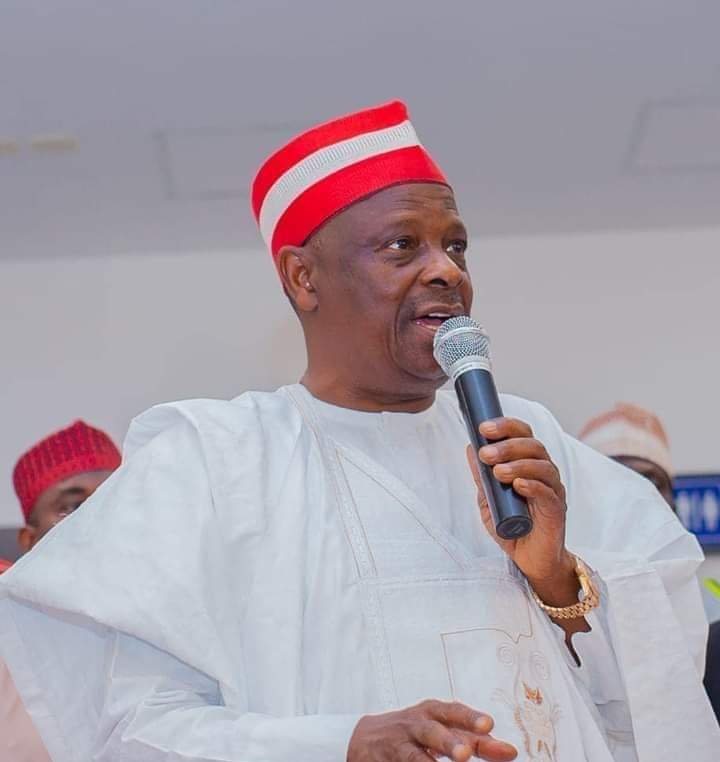
Only a few Nigerian political movements have recently had the same level of widespread support as Kwankwasiyya in Kano State.
The group, which eventually became known by its signature red cap, was born out of the fiery popularity of Rabiu Musa Kwankwaso, a former governor of Kano State. According to Weekend Trust, the group formerly represented loyalty, discipline, and grassroots mobilisation.
From the streets of Kano to the hallways of Abuja, Kwankwasiyya evolved from a political brand into a movement that pledged to overthrow an outdated system that the populace did not agree with.
However, according to our correspondents, the movement has not encountered the same difficulties since its inception. A number of its most famous chieftains, including a sitting governor, serving senators, and members of the House of Representatives, have defected.
The leader’s long-time supporters have questioned the movement’s ability to maintain the level of power that garnered about a million votes in Kano during the 2023 elections.
Political observers in Kano claim that the tale of Kwankwasiyya may not be a casting of its past victories but rather how it adapts to new realities as defections increase and alliances change.
An astute observer of the movement stated, “It is about survival, reinvention, and whether Kwankwaso himself can once again marshal the loyalty of Kano political base in the face of growing fragmentation.” Go through the Political News
The All Progressives Congress (APC) in Kano publicly proclaimed that the end of an era for the state’s popular political movement was imminent, using the difficulties as justification. However, its defenders maintain that their popularity is linked to voters and has never been impacted by political stances.
According to Sani Adakawa, a Kano local who is aware of the situation, the defections are an indication of the movement’s weariness and could have an impact on its performance in 2027.
Kwankwaso has been involved in politics for many years. A few of his people wish to try their luck somewhere else. It’s typical. But by 2027, it will undoubtedly lessen his authority in Kano. He won’t be able to claim that losing so many well-known people won’t have an impact on him, no matter how minor, he noted.
However, another local, Yusuf Usman, dismissed the defections as opportunistic, saying, “These politicians are only thinking of themselves.” They were given places by Kwankwaso, but they have deserted him. That is not how we, the common people, will betray him. “We’ll express our rage at the polls,” he declared.
Commercial driver Bashir Aliyu, on the other hand, expressed caution when he stated, “Kwankwaso is still strong in Kano, no doubt, but politics is about numbers and alliances.” It might be difficult to replicate the events of 2023 if he is unable to keep his big men together.
In an interview, Kabiru Adamu Kofar Ruwa, a founding member of Kwankwasiyya and the former governor’s close companion for almost 29 years, told our correspondent that the movement had lost its direction and that “even the Nigeria Democratic Congress (NDC) they now rely on is not a true opposition party.” They are not even guarantyd to run for office. HireGrant Writers
Why so many coworkers departed Kwankwaso
Many were not surprised by the defections in the Kwankwasiyya group in recent months. Analysts interpret them as a combination of political scheming, personal aspirations, and dissatisfaction with Kwankwaso’s unyielding leadership style.
The Kano governorship, two senatorial seats, 16 of the 24 House of Representatives seats, and more than two-thirds of the state House of Assembly seats were all won in 2023 by the New Nigeria Peoples Party (NNPP), which was then led by Kwankwasiyya.
However, the governor, two senators, and almost half of state and federal parliamentarians have defected to the All Progressives Congress (APC).
Former Kwankwaso’s protégé, Governor Abba Kabir Yusuf, has been attempting more and more to establish his autonomy in Kano politics. EmployGrant Authors
His supporters contend that the governor can no longer be viewed as just another member of Kwankwaso’s political family, particularly in light of the fact that he must form his own coalition and deal with the realities of government.
Federal parliamentarians such Abdulmumin Jibrin and Kabiru Alhassan Rurum, as well as senators like Rufai Hanga, Kawu Sumaila, and Kabir Gaya, among many others, also quit the movement, citing differences with Kwankwaso’s approach and his purported unwillingness to cooperate with more powerful national parties.
Moving to platforms like the African Democratic Congress (ADC) and then the NDC is perceived by some as limiting their political opportunities.
Once a crucial Kwankwasiyya mobiliser, Abdulmumin Jibrin also broke ranks, claiming that the movement had grown too inflexible to allow for a variety of goals.
He even claimed at a recent event in his area that Kwankwasiyya would not have any influence in 2027 after losing the majority of its foot soldiers, claiming that the APC would not give any party in the state even a seat.
The deeper tension that underlies these departures is Kwankwaso’s intent on keeping Kwankwasiyya a disciplined, even cult-like movement, which ran against to his lieutenants’ personal aspirations.
Many of them think they have little prospect of becoming relevant in Nigeria if they don’t integrate into the country’s major parties. Participate in Diaspora Networks
Others claim that Kwankwaso’s leadership style makes it difficult for friends to choose their own paths since it gives little opportunity for compromise or discussion.
The question of whether Kwankwasiyya can continue to exist as a unified entity has been highlighted by the defections.
Although Kwankwaso’s grassroots appeal is still strong, the movement’s influence in Abuja and elsewhere has been diminished by the departure of prominent members.
Defections are nothing new in Nigerian politics, according to Balarabe Mairiga, a Kano local who claimed to have been keeping up with the state’s political development.
Politicians always relocate to areas where their interests are safeguarded. He emphasised, “But Kwankwaso is unique; people like us will follow him anywhere because he has helped the poor more than any other leader.”
Habiba Abdullahi, another local, contended that although Kwankwasiyya’s structure would be weakened by the defections, its spirit would not.
The majority of young people enthusiastically don the red cap. Kwankwaso has the support of the masses even if prominent figures depart since he has never utilised them to win elections, she said.
The ticket for the NDC VP
After rejecting the APC’s advances during the 2023 elections, Kwankwaso did not withdraw from the national scene but instead looked for other forums that would enable him to maintain Kwankwasiyya’s identity while still expanding its influence outside of Kano.
He made a quick trial run at the African Democratic Congress as his first destination. One of his allies informed our correspondent that he relocated to the Nigeria Democratic Congress once more after realising the impending leadership turmoil inside the party. Participate in Diaspora Networks
Kwankwaso’s ambition to be relevant in national politics was demonstrated when he obtained a vice presidential ticket with Peter Obi inside the NDC.
It proves to his fans that Kwankwaso could bargain for power outside of Nigeria’s main political parties. However, his detractors see it as an indication of the political restlessness of a leader who is both unable to build a permanent national platform and unwilling to make concessions to the ruling establishment.
Although Kwankwaso’s choice to join the NDC given him a new platform, it has also widened rifts within his supporters, raising concerns about whether the Kwankwasiyya movement’s future is in smaller parties or if it should rejoin the mainstream.
Kwankwaso’s attendance at national congresses of three parties in just three months is a common taunt among Governor Yusuf’s supporters, who claim that Yusuf’s switch to the APC has prevented this. They contend that they cannot imagine a Kano governor running for office without a clear platform. EmployGrant Authors
Can Kwankwasiyya pull off the same feat from 2023?
Kwankwaso’s capacity to repeat his 2023 achievement in Kano is now seriously questioned due to all the problems the 2027 elections have brought up.
His over one million votes under the NNPP were the result of a close-knit Kwankwasiyya machine that mobilised across wards, cooperatives, and youth networks in addition to his own popularity. Now, that unity is eroding.
Replicating the level of mobilisation that shocked the APC and the Peoples Democratic Party (PDP) in 2023 would be more challenging without the structures and influence of Kwankwaso’s former lieutenants, such as Governor Yusuf, Abdulmumin Jibrin, Rufai Hanga, Kawu Sumaila, Kabiru Rurum, and others, as their movement has reportedly weakened the movement’s organisational foundation and Kwankwaso’s appeal. EmployGrant Authors
Analysts think Kwankwaso’s grassroots aura is still intact, though. Ordinary Kano voters are still drawn to his red cap symbolism, Talakawa speech, and track record of overcoming setbacks.
The question now is not whether he can inspire loyalty, but rather whether he can convert that loyalty into votes without the complete support of his erstwhile supporters.
Analysts contend that Kwankwaso’s ability to forge new connections outside of Kano in order to give Kwankwasiyya national significance and maintain the movement’s discipline in the face of disintegration will determine the movement’s future strength.
The defections indicate fragility, but the figures from previous elections demonstrate resilience. The 2023 landslip might end up being Kwankwasiyya’s high point rather than a springboard for further successes if these disputes cannot be resolved.
The NDC alliance’s expectations
When Kwankwaso joined the NDC and later agreed to run alongside Peter Obi, the party’s presidential candidate, it was anticipated that he would bring his whole political apparatus, the majority of which belonged to the Kwakwasiyya Movement.
It was calculated that uniting the two under a single platform would capitalise on their strong performances in the 2023 general elections, which were their first attempts at running for president.
In the 2023 elections, Atiku Abubakar of the PDP received 6,984,285 votes, Kwankwaso of the New Nigeria Peoples Party received 1,487,187 against Bola Tinubu of the APC, and Obi, standing on the Labour party platform, received 6,100,833 votes.
Together, Obi and Kwankwaso would have received 7,588,020 votes in 2023.
Furthermore, Kwankwaso only won in Kano State, whereas Mr. Obi won in Edo, Cross River, Delta, Lagos, FCT, Plateau, Imo, Ebonyi, Nasarawa, Anambra, Abia, and Enugu states.
However, commentators point out that the anticipated enthusiasm might not materialise because Kwankwaso in particular is losing his goons to other parties, and a number of other factors could jeopardise that forecast.
Kwankwaso continues to command support in Kano despite defections, according to Prof. Fage
Despite the flood of defections from his Kwankwasiyya organization, Professor Kamilu Sani Fage, a political analyst in Kano, has advised against discounting Kwankwaso’s power in Kano.
He maintained that rather than being motivated by ideological disagreements, people who leave Kwankwaso to join the ruling party are mostly motivated by self-serving political goals.
According to Fagge, who also teaches political science at Bayero University Kano (BUK), Kwankwasiyya followers are not an exception to the rule that Nigerian politicians switch parties in order to further their own goals.
He recalled that Kwankwaso had changed parties multiple times, from the PDP to the APC, ADC, and now the NDC. He added that the former governor was responsible for the APC’s defeat in Kano during the 2023 elections, which resulted in the state governor, two senators, and the majority of state and federal lawmakers joining the NNPP platform, which he had only joined in 2022. EmployGrant Authors
But he pointed out that, save from a few politicians, Kwankwaso had subsequently lost those allies.
Fage emphasised that betrayals and defections are common in Nigerian politics, saying that “elected political officeholders and other politicians are almost always motivated by personal interests rather than principles or ideologies.”
However, he maintained that Kwankwaso still has a cult-like following despite defections, especially among young people who “would blindly follow him to his political destination without questions.” He stressed that Kwankwaso’s political power should not be undervalued.
However, he admitted that Kwankwaso’s influence had been diminished by the governor’s defection and the departure of other lawmakers, and that his current position as the NDC’s vice presidential candidate might prove to be a liability given the challenge of persuading the state’s broader electorate to support the party’s presidential flag-bearer.
The origins of Kwankwasiyya
Kwankwaso’s struggle for political survival gave rise to Kwankwasiyya, which subsequently developed into one of the most powerful movements in Kano politics. According to the data that are now available, its origins can be found in 2007, when the Peoples Democratic Party lost control of the state and many were afraid of widespread desertion.
Kwankwaso’s close colleagues, including as Prof. Hafiz Abubakar, who went on to become Ganduje’s deputy in 2011, and Dr. Rabiu Sulaiman Bichi, who went on to become his Secretary to the State Government in 2011, started formulating a plan to keep his supporters united.
From modest gatherings in homes and workplaces, the movement quickly grew, enlisting Kano’s youth as its core and using them as a model to advance ideals of self-reliance, politics without resentment, and good government.
Over time, Kwankwasiyya’s populist message and grassroots appeal turned it from a survival strategy into a political brand that would control Kano’s electoral landscape for years to come. Eventually, the red cap came to represent discipline, loyalty, and solidarity, giving the movement a distinctive identity and uniting supporters behind Kwankwaso during his political exile. Go through the Political News
Kwankwasiyya positioned itself as a voice for the public, drawing influence from Malam Aminu Kano’s populist worldview. Kwankwaso pledged to “make the son of nobody become somebody” through social inclusion, empowerment, and education.
The movement’s performance in 2019 and 2023
At the polls, Kwankwasiyya’s transformation from a survival movement to a political force was most evident.
Following an eight-year dominance by the now-defunct All Nigeria People Party (ANPP), the movement, then led by the PDP, recovered Kano and witnessed Kwankwaso’s second term as governor following an eight-year hiatus.
The same happened in 2015 when Abdullahi Ganduje, who was then affiliated with Kwankwaso, won the APC’s Kano governorship with more than a million votes.
The red cap brigade demonstrated its might in 2019 when supporters of Kwankwaso united behind PDP candidate Abba Kabir Yusuf. The APC used all of its resources to keep Kano, and the fight was intense.
The movement proved its capacity to mobilise hundreds of thousands of votes and challenge the ruling party’s hegemony in the state, as it led the first poll before losing out in the contentious rerun, even though the election ended in controversy with Yusuf, the candidate supported by Kwankwasiyya, losing after a supplemental poll.
The movement has become into a powerful electoral force by 2023. Under the New Nigeria People’s Party, Kwankwaso ran for president and produced one of the most remarkable outcomes of the season in Kano. Participate in Diaspora Networks
With almost a million votes, the NNPP swept the state, surpassing the totals of the PDP and APC. The movement’s hold on Kano politics was solidified when Yusuf, Kwankwaso’s protégé at the time, rode the wave of Kwankwasiyya’s grassroots mobilisation to win the governorship.
Kwankwaso’s national significance was further demonstrated by the 2023 elections. He refused to join the APC despite being courted by them in the run-up to the election, opting instead to forge an independent path with the NNPP.
His choice demonstrated both his tendency toward stubbornness and his faith in Kwankwasiyya’s ability to secure votes.
The achievement of capturing Kano by such a large majority demonstrated that the movement was a political phenomenon capable of changing national calculations rather than only a local faction.
The election performance of Kwankwaso in Kano since 1999
Kwankwaso’s electoral path in Kano has been characterised by both successes and failures, each of which has shaped Kwankwasiyya’s legend.
In 1999, he made his debut as a grassroots politician after winning the governorship within the PDP. Ibrahim Shekarau of the ANPP overthrew him four years later in 2003, forcing him to reconsider his approach and reassemble his support.
As evidence that his movement had developed into a powerful force, Kwankwaso produced a spectacular comeback in 2011 and won the governorship again by a slim but significant margin.
Kwankwaso’s impact was evident even when he was not on the ballot. He switched to the APC in 2015 and was elected to the Senate, demonstrating that he could win over Kano’s supporters on other platforms.
But now that his numbers are dwindling due to defections, the question is whether he can still muster the same grassroots fervour that helped Kano win by such a large majority.
His electoral past demonstrates his tenacity and capacity for recovery, but it also highlights the possibility of disintegration at a moment when his movement is facing its most difficult test.
About the Author