

A pioneering private mission to rescue one of NASA’s oldest and most treasured space observatories has hit a serious snag when the robotic spacecraft launched to save the telescope ran into significant technical problems in orbit, casting doubt on the ambitious operation. The glitch has prompted questions about the future of the Neil Gehrels Swift Observatory, a spacecraft that has spent more than two decades investigating some of the universe’s most cataclysmic explosions.
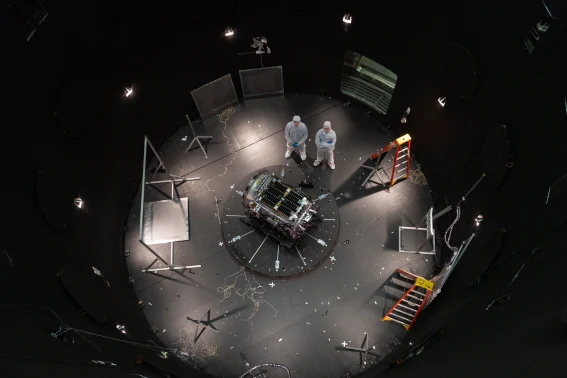
The rescue attempt is focused on LINK, a robotic maintenance spacecraft constructed by Arizona’s Katalyst Space Technologies under a $30 million contract with NASA. LINK, launched earlier this month, was supposed to rendezvous with the ageing Swift Observatory, grab it with robotic arms and push it into a higher orbit, extending the telescope’s life by several years. The mission is considered the first U.S. effort to rescue and reboost a working satellite in orbit with a commercial spacecraft.
But NASA said LINK has had major attitude-control problems, causing the spacecraft to spin wildly and disrupting communications with mission controllers. Initial inspections show two of the spacecraft’s three reaction wheels — key components used to control the orientation of a spacecraft — have failed. Engineers have also detected a performance drop in part of LINK’s cold-gas thruster system, making it more difficult to stabilise the vehicle.
NASA and Katalyst said there are reasons to be optimistic despite the setback. Most of its major onboard systems are still operating for LINK and engineers are still getting intermittent communications from the spacecraft. Ground teams are currently working around the clock to get full control before deciding if the rescue attempt goes ahead as planned.
The project was launched because the Swift Observatory, which went into service in 2004, is losing altitude more faster than predicted. The higher levels of solar activity have led it to deteriorate faster in its orbit and without intervention the spacecraft might re-enter Earth’s atmosphere later this year. Swift has been placed into a temporary safe mode and scientific observations halted to preserve its remaining orbital lifetime.
Swift has been an invaluable tool for astronomy for over 20 years. Its claim to fame is detecting gamma-ray bursts — the most intense explosions in the universe — and quickly notifying telescopes around the world so they can investigate these short-lived phenomena. It has also advanced the study of black holes, neutron stars, supernovas and other high-energy cosmic phenomena to make it one of NASA’s most scientifically productive space telescopes.
The mission has significant ramifications beyond Swift itself for the future of space operations. A successful test would show that commercial spacecraft could service ageing satellites by repairing, refuelling or repositioning them, decreasing the need to replace costly space assets and creating new opportunities for satellite servicing in the civilian and military sectors. The technology is also considered strategically essential as the United States and China race to build superior in-orbit servicing capabilities.
The mission is still in a crucial phase for now. Engineers are working to arrest LINK’s uncontrolled spin and re-establish solid communications before deciding whether LINK can continue its rendezvous with Swift. If the problems can’t be solved, NASA risks losing not just the spacecraft that would be sent to retrieve it, but also the chance to extend the life of one of its longest-serving astronomical observatories.
About the Author