
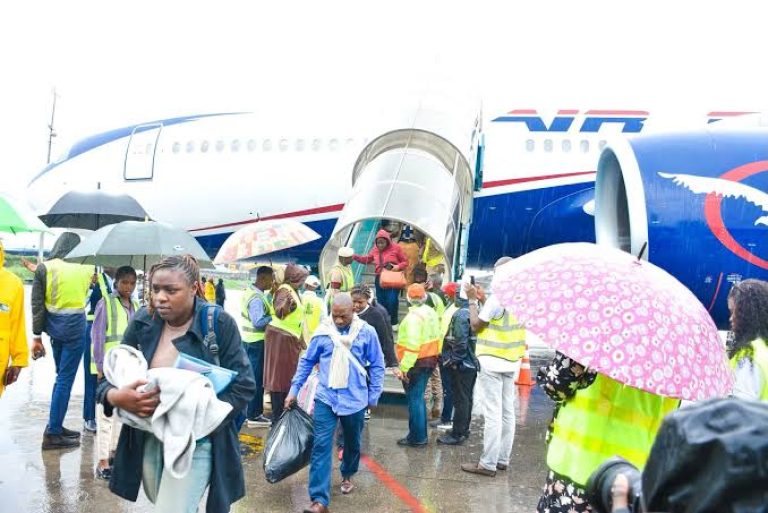
South Africa has said it will not compensate Nigerians who left properties behind after being expelled from the country.
The country reaffirmed that assets obtained unlawfully or in informal settlements would not be entitled for any type of restitution.
South Africa’s Minister in the Presidency, Khumbudzo Ntshavheni, reiterated the stance and brushed off reports that Pretoria may reimburse impacted Nigerians for properties left behind during past disturbances.
Sunday Trust says that she spoke in reaction to Nigeria’s Acting High Commissioner to South Africa, Temitope Ajayi, who said that the Nigerian government was examining alternative ways of compensating citizens whose assets were lost or abandoned during their evacuation.
Responding to the suggestion, Ntshavheni said during a media briefing there was no basis for such compensation in South Africa.
“All legitimate properties in the country are officially registered with the relevant authorities,” she said adding that constructions in informal settlements are illegal and therefore not recognised in the law.
She said impacted migrants who own houses bought legitimately should sell them in the property market in South Africa and not look for compensation from the government.
She said those who have genuine properties could sell them in the property market, adding that the government will not be responsible for abandoned assets.
Former Kaduna Central senator, Shehu Sani, condemned the minister’s statement, saying he was shocked at the strong stance.
“This is coming from a SENIOR Government official and NOT a thug from the streets,” Sani wrote in a comment on social media.
But Ntshavheni remained unperturbed.
I didn’t stammer. “You won’t be compensated for any property obtained through illegal means,” she replied.
The minister also reiterated South Africa’s appeal on the Nigerian government to share information on alleged sites being used for drug-related activities, adding that such data would aid law enforcement authorities in fighting organised crime.
The new exchange adds another chapter to the tense relations between Nigeria and South Africa over the treatment of Nigerian nationals.
Relations between the two countries had been under tremendous strain due to a recent spate of xenophobic incidents.
Several South African cities have witnessed the looting, vandalism and destruction of businesses and assets owned by foreign nationals including Nigerians.
The violence caused Nigeria to remove hundreds of its people via a government-assisted voluntary repatriation programme.
The attacks were widely condemned across Africa, with Nigeria demanding better protection for its citizens and their assets in South Africa.
Pretoria then vowed to increase security and prosecute those guilty, and the two nations set up diplomatic structures to improve bilateral relations and address reoccurring issues over migration, crime and the protection of foreign nationals.
About the Author