
The Joint National Association of Persons with Disabilities (JONAPWD) has warned that failure to accelerate the implementation of the country’s disability inclusion commitments urgently could leave over 32 million Nigerians with disabilities out of touch with critical government programmes and vital services.
The group raised worry over what it termed as the poor pace of execution of Nigeria’s obligations under the 2025 Global Disability Summit (GDS), claiming progress on disability inclusion remains inadequate despite legislative promises and institutional improvements.
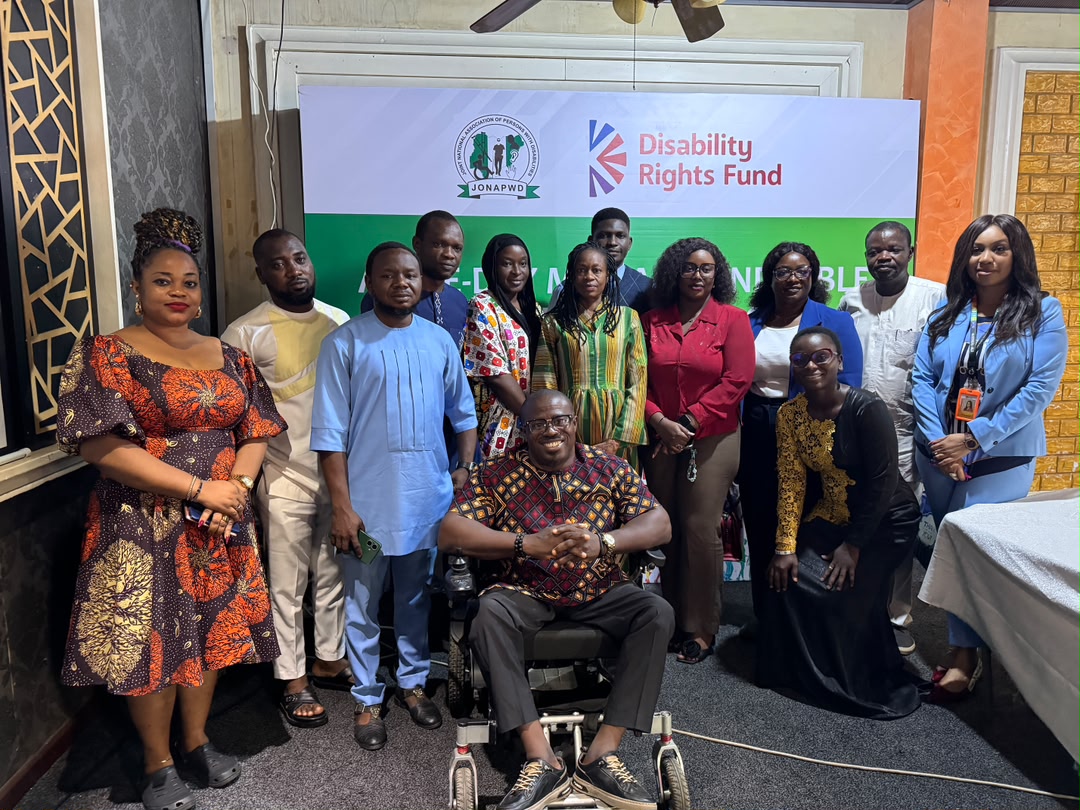
“The commitments Nigeria made at the summit should be a road map for the advancement of the rights and welfare of persons with disabilities,” said JONAPWD President, Abdullahi Aliyu Usman, at a discussion on Nigeria’s 2025 GDS promises in Abuja.
Bukunmi Adejumo, the association’s programme officer, said there was a need for strong accountability mechanisms and greater coordination among government entities to ensure that the commitments translate into concrete achievements.
He said handicap concerns are generally given little thought in national development discourse, despite affecting millions of Nigerians.
“Most of the time when government activities are going on, you hardly hear anything about disability inclusion. “That is why platforms such as the Global Disability Summit are important to drive commitments and accountability,” he said.
He said that Nigeria participated in the previous editions of the summit held in London in 2018 and 2022 before making fresh promises at the 2025 edition in Berlin, Germany.
Since 2017 the Global Disability Summit has brought together governments, development partners, civil society organisations and disability advocacy groups to support inclusive development and humanitarian action.
“After the Berlin summit, JONAPWD convened stakeholders from organisations of persons with disabilities to come up with an action plan for monitoring implementation and engaging relevant government agencies,” Usman said.
“The commitments of Nigeria were in 12 key areas, namely: inclusive education, healthcare, employment, social protection, digital accessibility, legal capacity, climate resilience, accessible infrastructure, humanitarian response and private sector participation,” he said.
JONAPWD president said accessibility is one of the biggest difficulties facing individuals with disabilities, regretting that many public buildings and amenities are still not accessible as provided in existing rules.
“We have accessibility standards built into our building codes but somehow those provisions often get ignored in implementation. “Getting accessibility right will significantly reduce many of the challenges in education, healthcare, employment and social protection,” he said.
He also voiced concerns about the status of inclusive education, noting that many children with disabilities continue to encounter challenges to accessing great learning opportunities.
He said some schools branded as inclusive institutions still do not have the infrastructure and support systems to care for learners with different forms of disability.
Usman also highlighted obstacles in the health sector such as restricted access to sign language interpretation for deaf patients, lack of disability-friendly services and difficulty getting assistive technology.
“We keep hearing that persons with disabilities are among the poorest in society, but many government livelihood and social protection programmes are not reaching them in huge numbers,” he remarked.
He said disability-disaggregated data currently shows that Nigeria has more than 32 million persons with disabilities, a figure he said calls for deliberate inclusion in governmental policies and development activities.
The group also urged for more involvement of persons with disabilities in humanitarian and emergency response operations, stating that aid programmes, disaster management plans and early warning systems should be developed to include persons with disabilities.
Usman said that progress in policy formation and institutional reforms is noted, but implementation is delayed.
“Yes we have seen progress on policy and institutional. We have measures and programmes that have been introduced. But the pace of implementation remains clearly slow. “We need stronger voices, stronger commitment, more coordination and more accountability,” he said.
JONAPWD called on government agencies, development partners and other stakeholders to step up efforts to implement Nigeria’s obligations under the Global Disability Summit and ensure that persons with disabilities are not left behind in the country’s development strategy.
About the Author