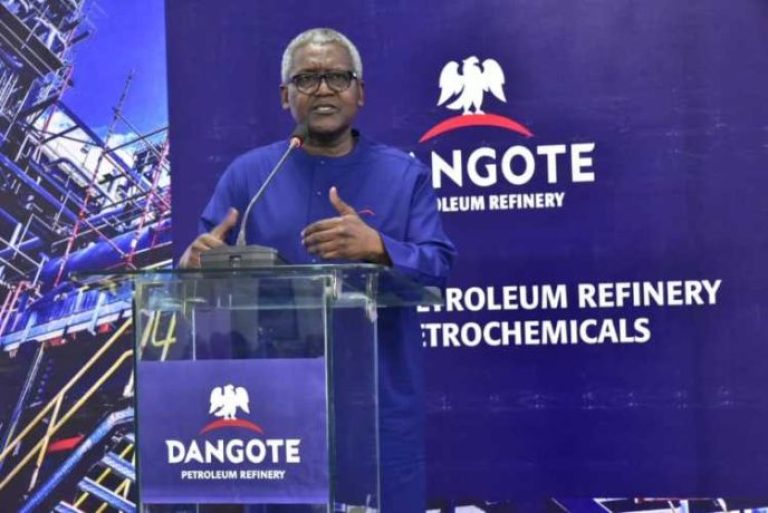

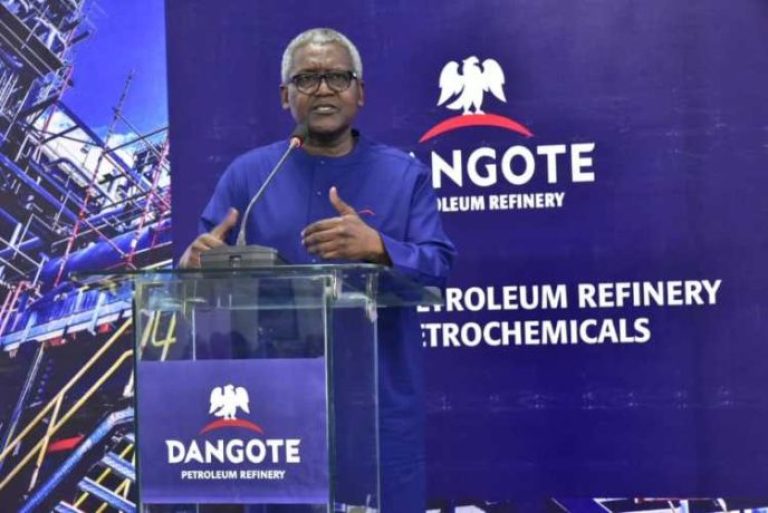
Alhaji Aliko Dangote, President of the Dangote Group, has revealed the group turned down the proposal by the Nigerian National Petroleum Company Limited to increase its 7.25 per cent interest in the Dangote Petroleum Refinery.
Dangote disclosed this in an interview with Chief Executive Officer of the Norwegian Sovereign Wealth Fund, Nicolai Tangen.
ONE of our journalists monitored the interview yesterday, the PUNCH says.
This is just as our correspondent’s findings indicate that fuel supplies from the $20bn Lekki-based refinery surged to 3.18 billion litres in the first quarter of 2026 while imports fell dramatically to 965.52 million litres.
Further research showed that the average domestic ex-depot petrol price from the Dangote refinery between January and March 2026 was roughly ₦1,000 per litre.
This suggests that the multi-billion-dollar refinery provided above N3.2tn worth of petrol locally throughout the assessment period.
Also, the war between the United States and Iran and the subsequent disruption of the oil sector and other sectors have led to a rise in revenue for the Dangote refinery as the plant has increased its refined petroleum products export.
Dangote told the interview that the Nigerian National Petroleum Corporation’s offer to increase its 7.25 per cent ownership in the refinery was turned down as the company plans to go public and allow other Nigerians to have shares in the plant.
NNPC reportedly acquired the 7.25 per cent ownership in the refinery for $1bn in 2021 with an option to buy the remaining 12.75 per cent stake by June 2024. But the state oil firm did a U-turn on its decision.
During the discussion with the Norwegian Sovereign Wealth Fund CEO, Dangote claimed that the national oil firm had tried to buy further holdings in the refinery but this was rejected.
He was asked about the biggest threats to his enterprises and Dangote said it was civil war and discrepancies in government policies. “Actually if there are civil wars which is not in the offing at all.
“The other biggest risk is government inconsistencies in policies and we are addressing that one because if you look at our refinery, the national oil company already owns 7.25 per cent and they are trying to buy more. We are the ones who said no. We want to now disseminate it and have everybody be part of it.”
Recall that the NNPC under the former Group Chief Executive Officer, Mele Kyari, lowered its interest in the refinery from 20 per cent to 7.25 per cent. Aliko Dangote disclosed this in 2024. He explained that the NNPC only possessed 7.2 per cent in the refinery and not 20 per cent as many Nigerians believed.
“In actual fact the agreement was 20 per cent, which we had with NNPC and they didn’t pay the balance of the money up till last year then we gave them another extension up till June (2024) and they said that they would remain where they had already paid which is 7.2 per cent. “So NNPC owns seven point two percent not 20 percent,” Dangote said in 2024, to the amazement of many Nigerians.
In the current interview the billionaire businessman also suggested that stockholders can collect their dividends in dollars.
“We are announcing that from now on, when you invest in any of our businesses, whether it is in cement, in the refinery, in petrochemicals, in fertiliser, we guarantee to pay you dividend in dollars because we are very well into exports. “80 per cent of our revenue will be in dollars,” he stated.
Dangote claimed he obtained an overwhelming amount of cooperation from several financial organizations including Nigerian banks to raise funding to construct the refinery.
The original plan was to fund most of the construction work “from our internally generated funds”, he said, but due to naira devaluation, the group “had to rely on Afreximbank, Africa Finance Corporation, Zenith Bank, Access Bank, UBA and a couple of the local banks, but of course we also have a very good relationship with the Standard Bank of South Africa and, at the beginning, Standard Chartered Bank of the UK”.
The corporation was lucky, he said, and what transpired when the factory was completed “turned out to be much more than our own expectations”.
Dangote said in an interview that he sold his properties in the United States and the United Kingdom to settle down in Nigeria.
You know what I did when I wanted to get into the industry? I have sold all my property in the US. I had two residences in America, magnificent mansions and I had a place in England. I wanted to truly sit down in Nigeria and be focused.
“You know sometimes when you own a holiday home anywhere you have to create the time to go and use that property. So my life is really simple now. I stay in motels whenever I travel. I pay. And when I go, no one’s going to ring me up and say I’ve got a burst pipe or whatever. I’m committed to what I do and I don’t just do things, I always build a vision.
Like right now, we had a vision for 2030. So I know I’ve got a quota to meet. I don’t do business. “All my businesses are targeted,” he claimed.
The business mogul responded on how he chooses the line of company to embark into, “I first of all look at what we need as a people? What are we meant to be making, and we are importing? So we perform what you call ‘backward integration’. “We make what people need and we’re making things now that when you wake up as a human being every morning, you have to use part of what we make,” he said.
Former spokesman for the NNPC, Olufemi Soneye, while defending the reason the NNPC lowered its intended investment in the Dangote refinery in 2024 said it was to invest in compressed natural gas stations.
N3.2 trillion fuel supply
Our correspondent’s analysis of statistics from official records of the Nigerian Midstream and Downstream Petroleum Regulatory Authority showed that petrol supply from local refineries grew to 3.18 billion litres in the first quarter of 2026, while imports plummeted to 965.52 million litres.
While the NMDPRA documents did not expressly refer to Dangote refinery in the first-quarter supply table, industry data reveal it is the only refinery in Nigeria currently known to be producing Premium Motor Spirit on a commercial basis.
The agency’s fact report also mentioned Dangote as one of Nigeria’s active refineries and monitored its PMS performance independently. The results showed that Nigeria’s overall petrol supply was 4.14 billion litres between January and March 2026, with local refinery production accounting for 76.7 per cent and imports accounted for 23.3 per cent.
This was a big change from the first quarter of 2025 when domestic refineries supplied 1.99 billion litres and oil merchants imported 2.43 billion litres. Total supply in Q1 2025 was 4.42 billion liters.
Our reporter transformed the 2025 statistics of average daily supply given by the NMDPRA into monthly quantities to enable a thorough year on year comparison by multiplying each month of million litres per day by the number of days in the month and then by one million. The latter was necessary, as the 2026 report revealed real monthly litre quantities, but the 2025 data was available only as daily averages.
The analysis revealed that local refinery supplies grew 59.2 per cent to 3.18 billion litres in Q1 2026 from 1.99 billion litres in Q1 2025. However importation declined by 60.2 per cent from 2.43 billion litres to 965.52 million liters.
Total petrol supply down 6.2% year-on-year despite local refining up 4.4% Total petrol supply down 6.2 per cent year-on-year from 4.42 billion litres in Q1 2025 to 4.14 billion litres in Q1 2026 despite the increase in local refining.
In January 2026, local refinery supply was 1.24 billion litres and imports was 698.19 million litres, while total supply was 1.94 billion litres. “This translated to a daily average of 40.07 million litres from local refining, 22.52 million litres from imports and total supply of 62.59 million litres.
Imports dropped by 8.8 per cent to 24.7 million litres per day, but local refinery supplies increased by 109.8 per cent to 19.1 million litres per day compared to January 2025. Total daily supply grew by 43.2 per cent to 43.7 million gallons per day.
Local refinery supplies fell to 824.45 million litres in February 2026, while imports declined to 85.10 million litres. Total supply dipped to 909.55 million liters. Average daily local refinery supply was 29.44 million litres, average daily imports were 3.04 million litres and average daily total supply was 32.48 million litres.
This revealed that the local refinery supply was 18.7 per cent greater than 24.8 million litres per day recorded in February 2025, imports dropped by 88.9 per cent from 27.5 million litres per day. Total supply also plummeted 37.9 per cent to 52.3 million gallons a day in the same month of 2025.
Refinery supply locally increased to 1.11 billion litres in March 2026 while importation increased to 182.24 million litres. The total supply was 1.29 billion liters. This meant daily averages of 35.87 million litres from local refining, 5.88 million litres from imports and 41.75 million litres in total supply.
Local supply from refineries also rose by 56.6 per cent to 22.9 million litres per day, while importation decreased by 79.5 per cent to 28.7 million litres per day compared to March 2025. Total supply was down 19.1 per cent to 51.6 million litres per day.
Total petrol supply declined 53.1 per cent month-on-month from 1.94 billion litres in January 2026 to 909.55 million litres in February, before rebounding 42.3 per cent to 1.29 billion litres in March.
Local refinery supplies dipped 33.6 per cent from January to February, before rising 34.9 per cent in March. Imports dropped 87.8 per cent in February, but surged 114.2 per cent in March.
The NMDPRA FAAC report for April 2026 stated that the supply of PMS climbed from 909.55 million litres in February to 1.29 billion litres in March, indicating an increase of 42.29 per cent. It also indicated that truck-out of PMS declined from 1.59 billion litres in February to 1.47 billion litres in March.
The data indicates that Nigeria’s petrol industry is less reliant on imports with domestic refining now accounting for the bulk of national supplies.
But the drop in total Q1 supply indicates that greater local refinery throughput has not entirely translated into increased overall petrol availability as compared to the same period in 2025.
Nigerians consumed about 4.93 billion litres of Premium Motor Spirit (petrol) to fuel various economic activities in the first quarter of 2026, it was earlier reported, based on an analysis of the Nigerian Midstream and Downstream Petroleum Regulatory Authority’s downstream fact sheet monthly data.
It showed that this amount was 7.4 per cent higher than the 4.59 billion litres recorded in the comparable time of 2025.
The report further stated that the Dangote Petroleum Refinery exported over 434 million litres of Premium Motor Spirit (petrol) in March 2026 even as the facility diversified its client base after dramatically outstripping domestic consumption.
The survey revealed that the refinery owned by Aliko Dangote was operating at an average capacity utilisation of 93.62 percent, bolstering its position as the largest supplier of refined petroleum products in Nigeria.
In prior comments quoted in 2025, Dangote group chairman Aliko Dangote said the refinery has enough refined goods in storage to meet local demand and added:
“We’ve got over half a billion litres in storage at the moment. The refinery is now generating enough refined goods, gasoline, diesel and kerosene to cover all of Nigeria’s needs.”
Commenting on the issue in an earlier article, renowned energy economist, Professor Wumi Iledare, said Nigeria has reduced its dependence on imported petrol but not abolished it. He also cautioned against assertions that petroleum importation had been stopped after increasing domestic supplies from the Dangote Petroleum Refinery.
“Understandable optimism,” Iledare noted in a personal letter captioned “Dangote Refinery, Petrol Imports and Market Reality,” but added that recent claims that Nigeria no longer imports fuel overestimate the economic reality of the downstream oil market.
There is justifiable hope in recent assertions that importation of petrol into Nigeria has halted as Dangote Refinery now fulfills domestic demand but these overestimate economic reality.
Dangote Refinery has substantially ameliorated the domestic supply situation and diminished the marginal dependence of Nigeria on imported petrol. “But neither Dangote refinery nor petroleum marketers determine national supply outcomes,’’ he said.
Jeremiah Olatide, Chief Executive Officer of petroleumprice.ng, claimed in a recent statement that Nigeria’s domestic refining capability has improved tremendously.
The breakthrough, Olatide said, was a key milestone in the country’s long-standing desire to lessen dependence on imported petroleum products.
Production 661,000bpd
In the new interview, Dangote also stated that his refinery is currently processing 661,000 barrels per day. This was even as he ticked off wins of the US-Iran war for its refinery and fertiliser company.
Dangote said the company has shown its capacity by developing a refinery of that size in Nigeria and by commissioning and operating it above its nameplate capacity of 650,000 bpd.
This would allow financial institutions to back the group when the time comes, he said.
The refinery has been tested. Now we’re processing even crude at 661,000 barrels a day. So we have proved that ability. “A lot of financial institutions are now saying, ‘Yes, if it is you doing this project, we are there to back you because we know that you can deliver; you have the capacity, you have the knowledge and you have the experience,’ he said.
Speaking on the impact of the Middle East situation on his enterprises, Dangote recounted the gains of the war, which has sent energy prices high across the globe.
And with the prices, there were windfalls for Dangote as worldwide demand for fuel surged. “Fertiliser has gone from $400 to $850 a tonne,” he said. Polypropylene jumped from $900 to around $3,000. He said without his polypropylene, most plastic companies in Nigeria would have shut down by now.
“The war has more positive than negative impact on our businesses as there is a high demand for fertilizers today. February prices for urea were around $400 a tonne before the Middle East crisis. We are selling a tonne of fertiliser today for $850 and we are actually oversold. Plastics Polypropylene has moved from $900. These days in the UK it’s roughly $3,000.
“And if not for the polypropylene that we are producing today, all the plastic industries in Nigeria would have shut down because there is nowhere you can even get it. “Our aviation fuel is oversold till mid July and we are producing 20 million litres of jet fuel a day,” Dangote said.
Dangote added, “We source about 56 per cent from Nigeria and some from Angola on crude supply. We buy a lot from Angola, we buy from Libya, we buy from the US. We were doing seven or eight cargoes of WTI from the US at one point. But we’re getting more crude from Nigeria now. We have to buy 21 cargoes currently, each month. That’s how large we are. We are more than doubling the refinery. “You know, we’re going to be at 1.4 million barrels a day in the next 30 months, which is huge.”
We had a category of what Aliko Dangote termed the ‘Mafia’ seeking to sabotage the refinery.
‘The Mafia are the ones who are really profiting because Nigeria was handing out approximately $10bn every year as subsidies. There are some shippers making stacks of money. There are traders making a lot of money buying crude and sending us refined products. Then there are the local people. Very few people are getting allocations because it was subsidised. So they are making billions of naira. “So these are the people that didn’t want us to settle down because they thought we were coming here to displace them and of course that’s what we’ve done now,” he continued.
He said plans were afoot to sell stakes and pump around $45bn into the enterprises to achieve a target of $100bn in revenue by 2030.
“We are looking at selling part of the business, bringing in more investors and also making sure that we continue to grow the business. Production of cement is up to 100 million tons. We don’t even need a lot of money in cement, we are getting financing and the cash generation is quite liquid.
“So we’ll be able to actually fund this $45bn, which will eventually take us to $100bn of revenue, because our target is to get to $100bn by 2030, with a market valuation of maybe more than $250bn, because as we speak today, last year, our EBITDA was $3bn, but the target by 2030 is to be 10 times that amount, to be at over $30bn of EBITDA,” he said.
About the Author